latest from the stream

essays, working notes, fragments, mixtapes, podcasts, and experiments

Soulcruzer

The Currency of Ordinary Lives

Field Notes from The Old Mint, Southam I went out for a short wisdom walk this afternoon. Nothing grand. No pilgrimage. No mountain path. Just enough movement to loosen the mind and let a little air into the machinery. Walking does that for me. It opens a space in which thoughts can arrive without being summoned. They come sideways, through the body, through rhythm, through the simple fact of moving forward while not necessarily trying to get anywhere. The day was so good that it felt almost rude not to stop for a pint. So I did. At The Old

Read More »
Soulcruzer

The Grid and the Ghost: A Soft-Cyborg’s Guide to Psyche and Soul

(1) The Linguistic Stutter The cursor on my screen is a rhythmic, glowing pulse. It is the heartbeat of a binary ghost, a small white rectangle of light that blinks with the mechanical patience of an entity that never sleeps. I sit here in the quiet hours, a “soft-cyborg” tethered to a vast network of information, and I type a sentence that feels like a confession: I am all about Psyche and Soul. To the grammarian, I have just committed a redundant sin. To the etymologist, I am stuttering in public. If we look at the Greek roots, psukhē translates

Read More »
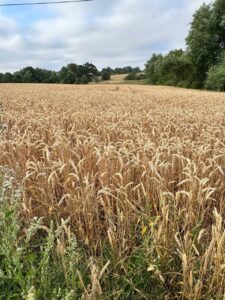
Golden wheat field stretching towards a tree-lined horizon under a pale cloudy sky
Soulcruzer

The Horizon

I’m standing in a field looking towards the horizon. It occurs to me that I’ve spent a lifetime doing this. Different fields. Different coastlines. Different countries. Different versions of myself, always finding a line where earth gives itself over to sky. The horizon is a peculiar thing. It promises distance while refusing arrival. However far you walk, it quietly withdraws, asking nothing except that you keep going. For reasons I can’t quite explain, the Oracle from The Matrix wanders into the field with me. Not the whole scene. Just one line. “I thought you’d have figured that out by now.“

Read More »

working notes

Fragments, field notes, and half-lit thoughts from the textual underground 

We’re headed up north for a few days of camping near the River Wyre. We chose the spot because it’s near Blackpool and the Lytham Festival is on, and we scored some free tickets to see the Petshop Boys and the Scissor Sisters on Saturday night. Blackpool is a good distance from us, so we decided to make it a four-day weekend. We’ve been to Blackpool once before. It’s a seaside town that has seen better days. This trip, we’ll spend more time in the smaller coastal towns and do more hiking.

Went to look at a caravan this evening. It was older than it looked in the photos.

The couple selling it lived on a farm. They said they had never actually camped in it. They had been using it as a spare room for their son while they renovated his bedroom.

If I were more of a handyman, I might have taken it on as a fixer-upper. But they had removed the whole front seating area, and they hadn’t tested the water or the gas, so it was a no from me.

We’re looking for something around 2004, four-berth, with a fixed bed.

This is what I imagined the old hypertext dream would be like before it got usurped by feeds, timelines, dashboards, and engagement funnels. What I find beautiful about the Universal Turing Machine memoir project is the form matches the nature of memory. The calendar suggests that we pass through time in a straight line. However, we don’t experience time in a straight line. At any given moment, your mind is in the past, the future, or, if you are disciplined enough, it resides in the present moment (in my experience, the mind only ever seems to be in the present for very short bursts of time).

We remember by association, by years that glow, by wounds, by recurring rooms, by people who become portals into the past, and by one summer that suddenly connects to something thirty years later. The Universal Turing Machine seems to understand that. It turns memoir into a navigable field rather than a corridor of time. Worth your time, especially if hypertext holds a special place in your heart.

i love a good collage, and a poem to boot. this piece from laura holly charman feels like a anti-self-hlep manifesto. instead of asking for the usual trope of certainty, happiness, or success, she’s asking to be disassembled and put back together in a way that only discomfort can do.

There’s a useful little door in Peter Carroll’s chaos magic that doesn’t require you to become a magician, buy the robes, or swallow the whole metaphysical pill.

The door is this question:

What happens if I believe this — for a while?

That shift changes the whole game. Belief stops being a fortress that you settle in and becomes a tool. Or maybe even a costume. Something you can put on, walk around in, test against the world, and then take it off again before you start mistaking it for your skin.

This is the part of chaos magic that still feels useful even if you keep both feet on the ground and a healthy amount of scepticism in your pocket. It treats belief less like a sacred possession and more like an interface. A way of selecting what becomes visible, what becomes possible, what your body reaches for next.

Most of us don’t experience belief that way. We inherit beliefs, absorb them, defend them, and confuse them with ourselves. A worldview becomes a room we forget we’re inside. We stop noticing the walls because they’ve been there so long.

Carroll’s move is mischievous: roll a die and inhabit a worldview for a while. Paganism. Monotheism. Atheism. Nihilism. Chaoism. Superstition. Not to find the winner. Not to discover the One True Lens. But to feel how each lens changes perception.

What do you notice as a pagan that you ignore as an atheist?

What becomes possible under superstition that vanishes under rationalism?

What does nihilism strip away?

What does monotheism gather into order?

What does chaoism loosen?

The point isn’t that all beliefs are equally true. The point is that beliefs do things. They organise attention. They open some doors and hide others. They alter the questions we ask, the risks we take, and the meanings we allow.

Robert Anton Wilson called these reality tunnels. A reality tunnel is not simply what you believe. It’s the whole perceptual apparatus that belief builds around you. The map doesn’t just describe the territory; it trains the traveller.

That’s where this starts to connect with writing, psychology, philosophy, and the everyday art of being human.

A writer can try on a belief to discover a voice.

A coach can help someone notice the story they’ve been living inside.

A blogger can use a post as a temporary model rather than a final verdict.

A person can ask, in the middle of an ordinary day, “What belief am I wearing right now, and is it still helping?”

This doesn’t mean treating life as make-believe. It means becoming more honest about the fact that we are already living through frames, assumptions, metaphors, inherited scripts, family myths, cultural software, old wounds, private hopes, and sentences we never consciously chose.

Chaos magic, at its most useful, says: if belief shapes experience, then learn to handle belief with care.

Don’t worship the model.

Don’t mistake the costume for the body.

Don’t let the map chain you to one road.

Try the lens. See what it reveals. See what it distorts. Then choose again.

For me, the enduring insight isn’t “nothing is true, everything is permitted” as some adolescent permission slip. It’s more sober than that, and stranger.

It’s the practice of epistemic agility.

The ability to move between frames without being captured by them. The ability to say, “This is useful, but not ultimate.” The ability to test a story without marrying it. The ability to remember that certainty can become a cage even when it began as liberation.

Maybe that’s the real magic here.

Not bending spoons.

Not commanding invisible forces.

But loosening the spell of the single story.

Learning to wear belief lightly enough that the soul can still breathe.
One of the traps in collaborative leadership is thinking that collaboration begins when we put people in the same room.

It doesn’t.

A room full of people can still be a room full of separate silos.

Everyone arrives carrying their own institutional habits, loyalties, scars, private pressures, and little rulebooks about how things are supposed to work. In health and care systems, this becomes even more tangled because the work is already complex, the stakes are high, and the organisations involved often have different histories, incentives, and ideas of what “good” looks like.

This King’s Fund report uses the language of collaborative leadership, but the bit that catches my attention is more basic and more human:

Before people can work together well, they need to agree how they’re going to behave with each other when the work gets difficult.

That sounds simple. But it might be one of the hidden foundations of collaboration.

Because the real test of collaboration is not how people behave when the workshop is warm, the coffee is decent, and everyone agrees with the slide deck.

The real test comes when money is tight, the data is contested, the history is messy, and someone around the table thinks another team is quietly protecting its own patch.

I write from the crossroads of philosophy, myth, music, AI, learning, and ordinary life. This is my living archive: part field notebook, part essay chamber, part signal fire from the textual underground, part hypertext adventure.

Working Notes from the Textual Underground

Hi, my name is Clay Lowe, aka Soulcruzer. This is the part where I have to reduce myself to a label so you can understand who I am and what I am about. But as Kierkegaard pointed out, labels have a way of negating the person. If I tell you I’m a blogger, I get reduced to whatever meaning you’ve assigned to the word ‘blogger’. It has been my habit to resist labels. And yet, here we are. So, in the context you find me in now, I am indeed a blogger, and I am much more than that!

I have worn many other labels. I’ve been an infantry officer, a learning and development consultant, a trainer, and a coach. I’ve also called myself a barefoot philosopher, a narrative alchemist, and a rogue learner, among others things. These were an attempt to orient me to myself and myself to you. More recently, I’ve been working out what it means to operate as a text-based ontologist in a world where text is becoming the universal substrate.

A text-based ontologist sounds like someone who should live in a footnote.

They don’t.

They live in the browser window, the notebook, the prompt box, the blog editor, the Obsidian graph, the half-finished post, and the walking thought captured before it evaporates. Their material is language. Their subject is being. Their method is to hold attention long enough for a sentence to disclose what it is carrying.

It’s not really a job title. It’s more of a way of relating to this blog and the wider web.

In the end, though, I’m just a dude doing his thing and sharing it on the internet. 

The best place to follow my work is here. Better yet, get the newsletter version and never miss a post, or alternatively, subscribe via my RSS feed.

latest from the podcast

status update

BlueSky Latest Posts
Last updated 10 minutes ago

last check-in

Worcester, Worcestershire, United Kingdom, UTC+1

I do like to chat. Say hi!

0
Would love your thoughts, please comment.x
()
x