Wrestling with Angels

I came across the phrase while reading Spotify the Gnostics, Here’s the First Church of David Bowie by Sean Manseau.

Wrestling with angels.

Some phrases arrive carrying more weight than their literal meaning. They feel older than language. Older than the person who spoke them. This was one of those phrases. The moment I read it, something in me recognised it before I had even fully thought about why.

It immediately pulled me toward the story of Jacob beside the river Jabbok. Night falling. Isolation. A mysterious being appearing in the dark. Then the struggle itself, physical, spiritual, psychological, mythic, all at once. Jacob wrestles until dawn. He refuses to release the angel, even when the struggle wounds him. Even when it leaves him limping. And in the end, he emerges transformed, renamed, somehow more fully himself because of the encounter rather than despite it.

It strikes me now that this might be one of the oldest surviving metaphors for consciousness itself.

To think deeply is to wrestle with angels.

Not the sentimental angels from greeting cards and Christmas ornaments. Not harmless beings of soft light and certainty. I mean the older kind. Terrible and illuminating. Messengers from dimensions of reality larger than the ego can comfortably contain. Forces that interrupt sleep.

Ideas can behave like that.

Questions can behave like that.

A single insight can arrive and suddenly make your previous life impossible to fully return to.

That, I think, is part of what has been happening to me over the last few years. I have been wrestling with angels, trying to reconcile who I am with who I imagined I might become, and with whatever it is the modern world keeps demanding I turn myself into.

Some days it feels like three incompatible stories fighting for possession of the same nervous system.

There is the self that wants simplicity. The barefoot philosopher. The man who wants to walk slowly, read deeply, write honestly, drink coffee outside while listening to birdsong, and build a life measured more by meaning than metrics.

Then there is the self shaped by culture’s demands. Worker. Professional. Brand. Persona. Content producer. An optimised digital entity required to constantly translate inner life into consumable fragments for algorithmic systems that feed on attention.

And somewhere between them is another figure entirely: the unfinished self. The one still becoming. The one still trying to understand what it means to be human in a world increasingly mediated through machines, prompts, platforms, feeds, and simulations.

No wonder the struggle feels exhausting sometimes.

There are moments when I fantasise about becoming Homer Simpson.

Honestly, I understand the appeal.

A cold Duff beer. Television glow. Predictable routines. A life governed by appetite, habit, and immediate comfort. No existential burden. No obsessive need to interrogate meaning. No compulsion to turn experience into language and then examine the language itself for hidden architecture.

Just autopilot.

There are days when that sounds almost holy.

Because consciousness is tiring.

Not intelligence necessarily. Consciousness. The ongoing awareness of contradiction. The inability to fully believe the stories you inherited once you begin seeing the machinery underneath them. The exhausting recognition that identity itself is partly constructed, partly performed, partly chosen, partly imposed.

Once you see this, you cannot entirely unsee it.

And that may be the real curse and blessing of awakening: once you become aware of the struggle, you can never fully return to sleep.

You can distract yourself, certainly. Most of us do. Endless scrolling. Endless entertainment. Endless productivity systems. Endless noise designed to protect us from encountering ourselves too directly. Modern society has become extraordinarily sophisticated at manufacturing psychic sedation.

But sedation is not a resolution.

The ignored story does not disappear simply because you mute it.

It waits.

It leaks sideways into your life.

Into moods you cannot explain.

Into low-grade despair.

Into strange feelings of absence while performing the routines you are supposedly meant to want.

Into the quiet suspicion that you have somehow become a supporting character in your own existence.

I think many people feel this now, even if they do not yet have language for it.

They sense a fracture between their inner life and the identities available to them in public culture. They feel reduced by the templates being offered. Consumer. User. Audience segment. Political tribe. Career designation. Content niche. A thousand prefabricated masks waiting for a face to attach themselves to.

And maybe thinking, real thinking, begins precisely at the point where those masks stop fitting comfortably.

Maybe thinking is not the accumulation of information.

Maybe it is the refusal to remain fully possessed by inherited narratives.

A refusal to stop mid-becoming.

A refusal to surrender the authorship of your consciousness completely to culture, algorithm, exhaustion, or fear.

This is partly why philosophy has always mattered to me, though perhaps not philosophy in the institutional sense. Not philosophy as purely academic analysis. I mean philosophy in the older sense. Philosophy as a way of life. A lived struggle with existence itself.

The ancient philosophers understood something modern culture often forgets: ideas are not abstract decorations. They are forces that shape perception, behaviour, emotion, and possibility. Stories are not entertainment layered onto reality. Stories are one of the primary mechanisms through which reality becomes intelligible in the first place.

The narratives we inhabit become invisible operating systems.

And once you begin noticing this, you start seeing how much of modern life is essentially narrative conflict. Competing mythologies battling for psychic territory. Nations built from stories. Economies built from stories. Identities built from stories. Entire lives organised around scripts inherited so early that people mistake them for objective truth.

To wrestle with angels is to wrestle with these scripts.

To examine them.

To resist total possession by them.

To ask: whose voice is this inside my head? Which desires are actually mine? Which ambitions were installed? Which fears belong to me, and which belong to systems trying to reproduce themselves through me?

These are destabilising questions.

They can leave you limping.

Jacob leaves the river wounded. That detail matters to me. Transformation is not presented as clean transcendence. It leaves a mark on the body. Wisdom is not sterile. Consciousness costs something.

I suspect anyone who has seriously wrestled with themselves knows this already.

The artist knows it.

The writer staring at the blank page knows it.

The person standing at midlife, wondering whose life they have actually been living, knows it.

The addict getting sober knows it.

The person leaving a religion, career, marriage, ideology, or identity knows it.

There is often a moment where the old self begins dying before the new self fully exists. And in that threshold space, certainty collapses. You no longer know exactly who you are. Only that you cannot entirely return to who you were before.

That threshold is the riverbank.

That is where the angel appears.

And perhaps this is why I keep returning to writing.

Writing feels less like self-expression these days and more like participation in the struggle itself. A form of conscious wrestling. I write not because I possess certainty, but because language helps me stay in relationship with the mystery long enough for another fragment of meaning to emerge.

A sentence can become a foothold.

An essay can become a temporary shelter against chaos.

A journal entry can become evidence that consciousness was here.

Sometimes I think my entire body of work is simply a long record of negotiations between competing realities. Between myth and modernity. Between technology and soul. Between the desire for simplicity and the strange gravitational pull of digital existence.

And now AI enters the picture, complicating everything further.

Because here we are: humans manipulating reality increasingly through text. Prompts becoming action. Language becoming executable. Words triggering systems into motion. Stories becoming infrastructure.

William Burroughs once said language is a virus. In the age of artificial intelligence, that statement begins sounding less metaphorical than diagnostic.

We are becoming text-based ontologists operating inside environments where text increasingly functions as the universal substrate.

Which means the stories we tell ourselves matter more than ever.

The struggle matters more than ever.

Because the danger now is not merely propaganda or ideology in the old sense. It is the possibility of becoming psychologically automated. Handing over the difficult work of meaning-making to systems optimised for engagement, efficiency, and behavioural predictability.

To remain conscious inside this environment requires effort.

Attention becomes spiritual practice.

Thinking becomes resistance.

And maybe that is why I cannot fully become Homer Simpson, no matter how tempting the fantasy occasionally appears.

Something in me refuses total sedation.

Something keeps returning to the wrestling mat.

Not because I enjoy suffering. I do not. But because some deeper instinct understands that the unlived life extracts its own terrible price. The avoided question does not vanish. The abandoned self does not stop calling.

And every so often, in the middle of the struggle, something real emerges.

Another fragment of the story.

Another sentence sturdy enough to stand on for a while.

Another glimpse of coherence hidden inside the chaos.

Not certainty.

Not final answers.

Certainly not enlightenment.

Just a slightly deeper relationship with the mystery.

Maybe that is enough.

Maybe maturity is not about resolving the contradictions once and for all. Maybe it is about developing the capacity to remain in conscious dialogue with them without collapsing into cynicism or numbness.

To keep wrestling without demanding immediate victory.

To limp forward carrying both the wound and the blessing.

To understand that consciousness itself may be less like arriving at truth and more like staying awake inside the question a little longer.

Jacob does not defeat the angel.

That is important.

He survives the encounter changed.

Perhaps that is all any of us can really hope for.

Not mastery over existence.

Not perfect self-knowledge.

Just the courage to remain in a relationship with the forces larger than ourselves long enough to become more fully human through the struggle.

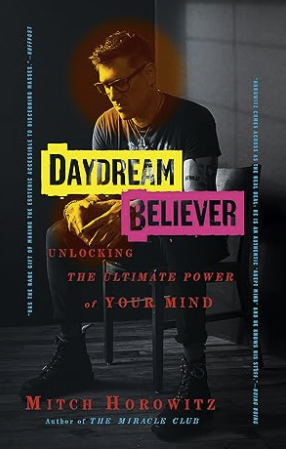
The Will to Create: A Review of Mitch Horowitz’s Daydream Believer

a man in the water with his eyes closed

Daydream Believer

Daydream Believer

There’s a question Mitch Horowitz asks throughout Daydream Believer: Unlocking the Ultimate Power of Your Mind that lodged itself in my brain like a white hot poker: “What do you want?”

Not as a therapeutic prompt. Not as spiritual navel-gazing. But as a foundational question, one that determines whether you’re truly living or merely existing. This is the question that sets the direction of your life, the point from which every deliberate act of creation begins. It is the launching pad for any practical metaphysical work you attempt, because without knowing what you actually want, no technique, belief, or practice has anything solid to work with.

I’ve spent the past 25 years working in the self-development space. I thought I knew how to articulate desire. Turns out I’ve been operating with a fuzzy targeting system, wondering why I kept getting versions of what I wanted rather than what I actually wanted. Horowitz calls this out with uncomfortable precision: clarity is everything. Without clarity, mind causation breaks down. Your intention leaves your conscious mind distorted, misheard, or diluted, like a message passed hand to hand until it no longer resembles what you meant to say.

Daydream Believer is Horowitz’s attempt to take 150 years of New Thought experimentation to “its sharpest peak” and chart a path forward. It’s his ultra-statement on mind metaphysics, thought causation, and the extraphysical nature of consciousness. More importantly, for practitioners like myself who’ve lived in the esoteric trenches, it’s a rigorous philosophical justification paired with a practical formula that actually works.

Mind Metaphysics Meets Chaos Magick

Here’s what really lit me up. Horowitz anchors his entire approach in a single, uncompromising principle: results. As he puts it, “The only question that matters is: does it work?” Everything else—belief, theory, metaphysics—comes second to demonstrated effect.

Any chaos magician reading that line will recognize the rallying cry. Results-based magic. Functional metaphysics. Theory is fine for academics, but practitioners need operations that produce measurable outcomes. Horowitz delivers a four-step process that maps surprisingly well onto chaos magick methodology:

1. Focused Desire
2. Enunciation
3. Sex Transmutation
4. Acceptance of Channels

This isn’t repackaged positive thinking. It’s a disciplined, repeatable protocol. Manifestation doesn’t happen through vague wishes or spiritual bypassing. It happens through focused will aimed at specific outcomes, articulated clearly, emotionally charged, and then released without attachment to the form the result takes.

The chaos magick parallel is obvious: gnosis (focused desire), statement of intent (enunciation), charging the sigil (sex transmutation), and release/forgetting (acceptance of channels). Different vocabulary. Same operational technology.

What Horowitz adds is the philosophical scaffolding. He’s not content to say “do this because it works.” He wants to know why it works, what the limits are, where the critics get it right and where they miss the mark. This book is simultaneously mystical practice and intellectual rigor, which is rare in either camp.

Self-Expression as Ultimate Aim

One of the book’s core arguments hit me sideways: self-expression is the ultimate aim of life.

Not self-improvement. Not enlightenment. Not transcendence of ego. Self-expression. The full embodiment and expression of who you actually are means living from your own inner axis rather than from inherited expectations. It is the act of bringing your genuine drives, values, and creative impulses into form, instead of shaping yourself to match who you were told to be, rewarded for being, or conditioned into becoming. This kind of self-expression isn’t performance or self-improvement; it’s alignment. When what you want, what you do, and who you are all point in the same direction, will stops leaking, and creation becomes possible.

Horowitz grounds this in Nietzsche’s concept of the will to power, but clarifies that “power” here means the capacity to actualize your authentic nature in the world. The aim here isn’t domination at all, but creation.The power to bring forth what’s within you, to shape reality according to your vision, to participate actively in the construction of your experience rather than passively receiving whatever life deals you.

This aligns perfectly with my work in narrative alchemy. Stories aren’t just descriptions of what happened. They’re code that runs in consciousness, shaping perception, constraining possibility, or expanding potential. The stories you tell yourself determine the life you’re able to live. Self-expression, in this context, is the act of consciously authoring your narrative rather than unconsciously repeating inherited scripts.

If you’re operating from someone else’s story about who you should be, you’re not expressing yourself. You’re running their program. Much of what passes for desire is inherited, conditioned, or socially rewarded wanting rather than something that genuinely arises from within. When that’s the case, mind causation struggles to gain traction. You’re trying to bring about outcomes that contradict your deeper programming, so intention fractures before it ever becomes effective. Part of you wants the result, but another part is quietly loyal to an older script. The signal gets mixed, the will leaks, and the results arrive distorted or stall altogether. For mind causation to work, desire has to be congruent. It has to be yours all the way down.

The Interdimensional Participant

Horowitz makes a bold claim: you experience psychical lives among infinite realms. Your mind is an extraphysical, reality-selecting force.

This isn’t metaphor. He means it literally, though he’s careful to note he’s not advocating naive magical thinking. You’re not going to levitate through pure intention. But consciousness, he argues, operates in dimensions beyond the strictly physical. Your thoughts exist in and interact with layers of reality that material science hasn’t fully mapped.

This is where Daydream Believer ventures into genuinely radical territory. Most New Thought literature stays safely within psychological models: thoughts shape perception, perception influences behavior, behavior creates results. Horowitz goes further. He’s arguing for mind as a causal agent in extraphysical dimensions, drawing on psychical research, consciousness studies, and his own experiments.

For someone who’s been working with chaos magick for decades, none of this comes as a shock. The working assumption has always been that consciousness doesn’t stop at the boundaries of the skull. It interfaces with reality in ways that aren’t purely physical or fully explained by materialist models. Sigils work. Rituals produce results. Synchronicities don’t appear randomly; they cluster around charged intentions, as if probability itself has been nudged. You can give this process any name you like—quantum effects, morphic resonance, the imaginal realm—but the label is secondary. The consistent, lived fact is that something is happening here. Something causal, repeatable, and stubbornly resistant to reduction into purely mechanical explanations.

What Horowitz offers is a philosophically defensible version of this claim that doesn’t require metaphysical credulity. He isn’t asking you to sign on to a belief system or suspend your critical faculties. You don’t have to believe in angels or demons, though he also refuses to dismiss those ideas out of hand as mere superstition. Instead, he asks you to seriously consider a more modest but more radical possibility: that mind is not fully contained within the skull, that thought has effects which extend beyond the merely neurological, and that you are already participating in the ongoing construction of reality at levels beneath conscious awareness. In this view, mind causation isn’t fantasy or wishful thinking. It’s an extension of a process you’re already part of, whether you recognize it or not.

The real shift Horowitz is asking for is from passive consciousness to participatory consciousness. In the passive model, the mind is a byproduct of matter, awareness is a spectator sport, and reality simply happens to you. Your thoughts may influence your mood or behavior, but they don’t meaningfully shape the structure of events. In the participatory model, consciousness is not an afterthought. It is an active variable in the unfolding of experience. Attention, intention, and expectation don’t just interpret reality after the fact; they help select which possibilities solidify into lived outcomes. This doesn’t make you omnipotent, but it does make you responsible. You are no longer merely reacting to the world. You are implicated in its ongoing formation, whether through clarity or confusion, intention or drift.

This is where participatory consciousness becomes uncomfortable. If consciousness plays an active role in shaping experience, then vague intention, unconscious belief, and unexamined narrative aren’t neutral. They are formative forces. Drift creates outcomes just as surely as clarity does. Much of what people experience as fate, bad luck, or external obstruction begins to look like unattended authorship. Not chosen, but still participated in. This doesn’t mean you are at fault for everything that happens to you. It does mean that avoidance, confusion, and inherited stories carry causal weight. In a participatory universe, responsibility expands along with possibility. You don’t just get to create deliberately. You also create accidentally.

This is also why participatory consciousness meets so much resistance. It removes the psychological shelter of pure victimhood without offering the fantasy of total control. You don’t get to say “it’s all happening to me,” but you also don’t get to believe you can think your way into omnipotence. What you’re left with is something far more demanding: partial agency in a complex system. Your intentions matter, but so do your blind spots. Your beliefs shape outcomes, but they don’t excuse you from friction, loss, or uncertainty. For many people, this is intolerable. It’s far easier to deny participation altogether than to accept responsibility without guarantees. Participatory consciousness doesn’t promise comfort. It asks for authorship under conditions you did not choose.

The Technology of Prayer and Wish

Two chapters particularly resonated: his treatment of prayer and true wishes.

Prayer, Horowitz argues, works, but not for the reasons most people assume. It isn’t effective because a supernatural authority is necessarily listening and deciding whether to grant your request. It works because prayer functions as a technology of consciousness. It organizes attention, concentrates desire, and aligns will around a clearly articulated aim. In doing so, it brings the mind into coherence and directs that coherence toward the field of experience itself. Whether you frame the act as speaking to God, the universe, your higher self, or simply naming an intention into the void is secondary. What determines efficacy is not the object of prayer, but its execution. Precision matters. Emotional charge matters. The clarity with which the desire is named determines how cleanly it can take hold and begin exerting causal pressure.

This is another place where New Thought and chaos magick quietly collapse into the same operational logic. Prayer and spell-casting are not opposites, nor even distant cousins. Functionally, they are the same act performed inside different symbolic systems. Both require focused intention, emotional investment, and the deliberate use of language and imagery to configure consciousness toward a specific outcome. Both assume, implicitly or explicitly, that mind is not sealed off from the world but participates in shaping how events unfold. Strip away the theology, the aesthetics, and the cultural framing, and what remains is a shared technology: attention disciplined into form, desire charged with feeling, and meaning deployed as a causal instrument. The symbols differ. The mechanism does not.

His discussion of wishes follows the same operational logic. A true wish, properly formed, carries causal power not because reality bends to fantasy, but because the act of precisely articulating desire reorganizes consciousness around that desire. When a wish is clear, the mind begins to sort the world differently. Perception sharpens. Attention gravitates toward relevant signals. Possibilities that were previously invisible register as actionable openings. Behavior adjusts, often subtly, in ways that align with the stated aim. What changes first is not the external world, but the internal pattern that determines what you notice, what you consider possible, and what you’re willing to act on. Over time, those shifts accumulate into tangible results that feel uncanny only if you ignore the invisible reconfiguration that made them possible.

This is where the book landed its most personal blow for me. I realized I haven’t been failing at manifestation so much as feeding the system bad inputs. I’ve been making sloppy wishes. Vague wants. Loosely sketched hopes that gesture in a general direction and then leave the details unresolved. And then I’ve wondered why the results arrived distorted, partial, or oddly misaligned. Horowitz makes the uncomfortable point clear: the wish itself is the programming. If the instruction is fuzzy, contradictory, or half-hearted, the output will be too. Mind causation doesn’t fail because reality is hostile or indifferent. It fails because the signal is incoherent. Garbage in, garbage out isn’t cynicism here. It’s diagnostics.

The deeper issue isn’t ignorance. It’s reluctance. Precision is dangerous because it removes your ability to hedge. A vague desire lets you fantasize without committing. It keeps failure hypothetical and success undefined. Once a wish becomes exact, you can no longer hide behind ambiguity. You either move toward it or you don’t. You either want it enough to reorganize your life around it, or you discover that what you thought you wanted was only a socially acceptable placeholder. Sloppy wishes are often a form of self-protection. They allow desire without accountability. Horowitz’s framework quietly dismantles that defense. If the wish is the programming, then clarity forces a reckoning. You must decide what you’re actually willing to become in order to have what you say you want.

Reprogramming the Subconscious

Horowitz devotes considerable attention to self-suggestion and subconscious reprogramming, drawing on early pioneers like Émile Coué and Napoleon Hill. What he outlines is deceptively simple and genuinely demanding: repeated autosuggestion delivered at moments when the conscious mind loosens its grip. Morning and evening, when habitual resistance is lower, you deliberately introduce new instructions into the system. This isn’t affirmation as self-soothing or motivational wallpaper. It’s intentional reconditioning. You’re issuing commands to the deeper layers of the psyche, installing updated parameters that redefine what feels normal, possible, and inevitable. Think less positive thinking, more firmware update.

A weak autosuggestion sounds like this: “I want to be more confident” or “I’m trying to be successful.” It’s abstract, future-oriented, and emotionally flat. A strong autosuggestion is concrete and present: “I speak clearly and decisively in my work, and people respond with trust and engagement.” The difference isn’t optimism. It’s specificity. The second statement gives the subconscious something it can actually organize around. It names behavior, context, and felt sense. One drifts. The other installs.

This is where the book gets practical. Horowitz doesn’t just theorize about mind power. He gives you the protocol. What to say, how to say it, when to say it, and why it matters that you say it in present tense with emotional conviction.

For anyone who’s worked with sigils, this is familiar territory. You’re not begging the universe for change. You’re declaring the change as already accomplished. You’re rewriting the deep story, the subconscious narrative that determines what feels possible.

My experience with narrative alchemy has taught me that people’s limiting beliefs aren’t intellectual positions. They’re stories embedded in the psyche, running constantly beneath awareness. Changing those stories requires more than deciding to think differently. It requires sustained, repetitive, emotionally charged installation of new narrative code.

Horowitz’s self-suggestion protocol is exactly that. Narrative debugging through systematic autosuggestion.

The Limits and the Shadow

To his credit, Horowitz doesn’t promise unlimited manifestation. He’s clear about the limits of mind power. You can’t think your way out of terminal illness (though you can influence recovery and quality of life). You can’t manifest lottery wins on demand (though you can enhance opportunity recognition and decision-making). You can’t override physical laws through pure intention.

What you can do is participate in reality construction within the parameters of possibility. You can influence probability. You can shape trajectory. You can open doors that were previously invisible. This is real power, even if it’s not omnipotence.

He also addresses suffering directly, which most New Thought writers avoid. Acknowledging suffering, he argues, is itself a metaphysical force. Not wallowing. Not victimhood. But clear-eyed recognition of pain as part of the human condition, and the determination to work creatively within and through that pain.

This is where Daydream Believer distinguishes itself from toxic positivity. Horowitz isn’t selling spiritual bypassing. He’s offering a metaphysics that accounts for the full range of human experience, including grief, depression, and anxiety. The practices he outlines aren’t escapes from difficulty. They’re tools for navigating difficulty with greater agency and creativity.

What Do You Want?

The book keeps returning to this question. And it’s not rhetorical.

Horowitz insists that if you can’t answer this question with crystal clarity, nothing else matters. All the practices, all the philosophy, all the metaphysical theory in the world won’t help if you don’t know what you’re trying to create.

This is where I found myself confronting my own fuzzy targeting. I’ve had visions. I’ve set intentions. I’ve performed rituals. But have I articulated my desires with absolute precision? Have I defined success in terms so clear that I’ll know beyond doubt when I’ve achieved it?

The answer, uncomfortably, is no.

I’ve been operating in impressionistic mode. I want “success” with Soulcruzer. I want to “reach people” with narrative alchemy. I want to “build something meaningful.” All fine sentiments. None of them actionable targets for mind causation.

What does success look like exactly? How many people? Doing what? Meaningful by what measure? These aren’t nitpicking questions. They’re the difference between functional magic and wishful thinking.

Daydream Believer forced me to confront the gap between my vague wants and the kind of laser-focused desire that actually moves reality. If I want mind causation to work, I need to be able to state my aim in a single, clear, unambiguous sentence. Not as aspiration. As declaration of intent.

The Functional Philosophy

What makes this book valuable isn’t just the practices or the philosophy. It’s the integration. Horowitz has created a functional system that works whether you interpret it literally or metaphorically, whether you believe consciousness is fundamental or emergent, whether you think you’re manipulating quantum fields or simply optimizing your psychology.

This is the genius of his “does it work?” criterion. It bypasses metaphysical disputes and focuses on results. Use the techniques. Track the outcomes. Refine the method. This is empiricism applied to inner work.

For someone like me, who’s spent years navigating the intersection of esoteric practice and practical application, this approach feels honest. I don’t need to believe in a particular cosmology to work with narrative alchemy. I need techniques that produce transformation. The same goes for Horowitz’s mind metaphysics.

Whether thought is causative because consciousness is fundamental, or because psychological shifts create behavioral changes that produce material results, doesn’t matter as much as whether the protocol actually works. And based on my experiments so far, informed by this book’s clarity on desire articulation, it does.

The Challenge Ahead

Daydream Believer ends with a challenge: implement the formula and watch for confirmation of its truth.

I’ve taken up that challenge. I’ve rewritten my core desires with brutal clarity. I’ve established a morning and evening autosuggestion practice. I’ve been treating my statements of intent not as hopeful affirmations but as code being installed in the operating system of consciousness.

It’s too early for comprehensive results, but the shift in focus is already noticeable. When you clarify what you want with precision, opportunities you would have dismissed as irrelevant suddenly become pathways. Actions that felt optional become obvious next steps. The fog lifts.

This is what Horowitz is offering: not magical thinking, but practical metaphysics. Not spiritual bypassing, but functional technology for consciousness. Not promises of omnipotence, but genuine tools for participating in reality construction with greater intention and skill.

For practitioners of chaos magick, narrative alchemy, or any results-focused approach to inner work, Daydream Believer is essential reading. It’s the philosophical backbone many of us have been operating without, the rigorous justification for practices we’ve known intuitively but struggled to articulate.

And for anyone asking “What do I want?” and realizing they can’t answer clearly, this book is the starting point. Because until you know what you want with absolute clarity, you can’t begin the work of bringing it into being.

The will to create demands nothing less than total precision. Horowitz has given us the manual. Now the work is ours.

Self-Expression as a Sacred Practice

self-expression

It’s radical to say that self-expression is the most important thing in life. It’s not survival, even though we must continue to live. It’s not about happiness, even though we may experience it. Not even meaning or connection, though these often arise naturally when we express ourselves honestly. Self-expression is the fundamental imperative, the primary reason consciousness manifests in form.

This is not an easy claim to make. It challenges the stories we’ve been taught about duty, service, and self-sacrifice. It cuts against the Protestant work ethic that tells us to be useful, the therapeutic culture that urges us to be well-adjusted, and the spiritual bypass that tells us to transcend the personal altogether. To say that self-expression is the purpose of life can sound hedonistic or narcissistic.

But what if we’ve misunderstood what self-expression actually means?

Beyond Performance

Most of what passes for self-expression in contemporary culture is actually self-presentation. We curate social media identities designed to attract engagement. We craft professional personas meant to advance our careers. We shape our relationships to maximise approval and minimise conflict. This isn’t authentic expression. It’s strategic positioning, a performance built from borrowed scripts.

Authentic self-expression begins with a different question. Not, “How will this be received?” but, “What wants to come through me?” It’s less concerned with demand and more attuned to necessity. The artist who paints regardless of the market. The person who speaks the truth even when it costs them socially. The mystic who follows their vision into territory others cannot understand or approve.

Self-expression at this level is dangerous. It threatens the comfortable scripts we’ve learned to perform. It disrupts established patterns of relationship and identity. It makes us visible in ways that invite both genuine connection and real rejection. This is why most of us settle for self-presentation instead. It’s so much safer.

But safety isn’t what consciousness came here for.

The Language of the Soul

If we take depth psychology seriously, especially the work of Jung and Hillman, we know that the psyche doesn’t speak in direct statements. It speaks in images, symbols, and stories. Dreams don’t explain themselves. They present scenes, evoke feelings, and bypass logic entirely. The soul communicates through metaphor and myth because these forms carry truths that literal language can’t hold.

This reframes self-expression entirely. We’re not generating clever content from ego’s manipulations. We’re serving as channels for something deeper that wants to emerge into form. The writer doesn’t write the story so much as receive it from some intelligence beyond conscious control. The dancer doesn’t choreograph movement but allows the body’s wisdom to speak. The mystic doesn’t choose their visions but submits to what arrives.

This is where the idea of soul fiction comes alive. If fiction is the native language of the psyche, then all authentic self-expression is a form of myth-making. We’re not reporting facts about a fixed, knowable self. We’re telling the living story that soul is authoring through us, moment by moment. We’re characters in a narrative we’re simultaneously writing and discovering.

Your biography isn’t a record of what happened. It’s an act of continuous creation, a story you’re telling yourself into being.

Expression as Discovery

Here’s the paradox at the heart of self-expression. We don’t know what we want to express until we express it. The act of expression is simultaneously discovery and creation. You don’t have a clear message that you then translate into an appropriate form. The form itself reveals what was trying to be said.

This is why practices like journaling function as genuine spiritual technology. Not because you’re recording pre-existing thoughts but because the act of writing calls forth what wants to be known. The pen moving across paper, the fingers dancing on keyboard, these create a channel through which something can emerge that wasn’t available to silent contemplation alone.

I have kept a daily journal for more than forty years, and I can say with certainty that I never know what I will write before I begin. The blank page is an invitation. Sometimes what arrives is mundane. Sometimes it is unexpectedly profound. But the willingness to show up makes it possible for the soul to speak.

Every genuine act of self-expression teaches us something about who we are. Or more accurately, who we are becoming. Because the self that expresses is transformed by the very act of expression. You cannot paint your grief without being changed by the painting. You cannot speak your truth without becoming someone who has spoken truth. Expression doesn’t reveal a static self but participates in the ongoing creation of self.

The Medium Changes the Message

Self-expression isn’t abstract. It requires a medium, a form, and constraints. Different media reveal different dimensions of consciousness. Words and images illuminate some aspects while obscuring others. Dance communicates what language cannot. Code expresses thought through structure, logic, and elegant problem-solving. Relationship itself becomes a medium through which we express who we are in the presence of another.

Each medium has its own intelligence. The programmer expresses through systematic thinking and creative solutions to complex problems. The mystic expresses through altered states and direct knowing that bypasses rational categories. The storyteller expresses through character and plot, translating inner experience into narrative form. The activist expresses through organized action and social transformation.

This is why finding your medium matters so profoundly. Not just “What do I have to say?” but “What forms want to live through me?” Some souls are meant to express through quiet cultivation and intimate transmission. Others through public declaration and bold visibility. Some through patient craftsmanship and attention to detail. Others through spontaneous improvisation and radical experimentation.

There’s no hierarchy here. No medium is inherently superior to another. What matters is alignment between soul’s impulse and the forms available for its expression. When you find your true medium, you know it. The work flows. Not easily, perhaps, but rightfully. You’re no longer forcing expression through inappropriate channels but allowing it to find its natural form.

What We Resist

What we resist expressing is often precisely what most needs expression. The shame we hide, the desire we suppress, the rage we deny, and the grief we postpone. These blockages in self-expression become blockages in living itself. Energy that cannot flow naturally becomes a symptom.

This is a core therapeutic insight: psychological symptoms are failed self-expressions. The anxiety that won’t speak its fear. The depression that cannot voice its rage or grief. The addiction that numbs what cannot be consciously felt. Healing involves finding forms through which blocked energy can finally move, speak, and be witnessed.

This extends beyond individual psychology. Cultural crises such as violence, political polarisation, and ecological destruction can be understood as collective failures of expression. What cannot be acknowledged in public discourse does not disappear. When a culture provides no legitimate forms for expressing grief, rage, or sacred experience, these energies don’t disappear. They go underground and return as shadow.

The work of reclaiming authentic self-expression often begins with noticing what you’ve been taught not to express. What feelings are forbidden? What thoughts are dangerous? What desires are shameful? What truths are too costly to speak? These restrictions, learned early and reinforced continuously, create the prison of inauthenticity we mistake for normal life.

Liberation involves finding safe enough containers to begin expressing what has been suppressed. Not dumping it indiscriminately on anyone nearby, but finding appropriate forms and contexts. Therapy, creative practice, spiritual community, trusted friendship. Places where you can risk showing what you’ve learned to hide.

Expression as Offering

Here’s where self-expression transcends mere personal satisfaction and becomes something larger. When we express authentically, we offer something to the world that only we can offer. Not because we’re special in some absolute sense, but because each configuration of consciousness sees and knows something unique.

Your particular history, wounds, gifts, and obsessions combine to create a singular lens through which reality is perceived. When you express from that place of specificity, you contribute something irreplaceable to the collective understanding. Your pain, worked through honestly, becomes medicine for others facing similar struggles. Your joy, expressed freely, gives others permission to feel their own. Your questions, asked sincerely, open doors for entire communities.

This is the antidote to both narcissism and self-erasure. Yes, it’s about self-expression. But the self expressing is not separate from the larger field of consciousness. You’re a localized expression of something universal, and your particular expression enriches the whole. The more deeply you express your own truth, the more it resonates with others who recognize their truth in yours.

This is why authentic art moves us. Not because it’s universally relatable in some generic way, but because it’s so specifically itself that it touches something universal. The particular opens onto the archetypal. Your story, told with real specificity, becomes everyone’s story.

The Art of Expression

If self-expression is life’s true aim, then the practical question becomes: What wants to express itself through me right now? Not what should I express to gain approval, make money, or fulfil obligations. But what genuine impulse is moving in me that seeks form?

This requires listening. Real listening, which is harder than it sounds. Most of our mental noise is reactive, defensive, and strategic. Beneath that layer is something quieter, more essential. To hear it requires stillness, attention, and patience. It requires creating enough space that something other than a conditioned response can arise.

It requires courage to give form to what emerges, especially when it doesn’t fit expected patterns. When your self-expression challenges family narratives, professional norms, or cultural expectations, there will be consequences. People who preferred your performance will be uncomfortable with your authenticity. Opportunities designed for your persona may close when you show up as yourself.

And it requires craft. Skill in whatever medium you’re working with. Not to achieve some external standard of perfection, but to serve the expression itself. To do justice to what wants to come through. A powerful insight poorly expressed loses its power. A profound experience clumsily articulated fails to transmit. We develop craft not to impress others but to become better vessels for what wants to be born through us.

Reality as a Medium

Ultimately, the deepest form of self-expression isn’t limited to conventional creative output. We’re not just making artifacts like poems, paintings, or businesses. We’re expressing ourselves through the very texture of lived experience, through the quality of consciousness we bring to each moment, and through the reality we participate in creating.

This points toward something even more radical than artistic self-expression. It suggests that consciousness itself is creative, that awareness shapes experience, and that we are expressing ourselves through reality itself.

But that’s a topic for deeper exploration, for understanding mind causation as a creative tool. For now, it’s enough to recognize that self-expression isn’t optional, frivolous, or self-indulgent. It’s the fundamental movement of consciousness into form, the primary way a soul makes itself known in the world.

The question isn’t whether you’ll express yourself. You’re doing that already, whether consciously or unconsciously, skilfully or clumsily, authentically or through borrowed forms. The question is whether you’ll bring awareness and intention to that expression. Whether you’ll develop the courage, craft, and consciousness to express what’s most genuinely yours to give.

Because that, finally, is why you’re here.


Suggested Reading

The Soul’s Code: In Search of Character and Calling by James Hillman. Hillman’s acorn theory proposes that each life contains an essential image seeking expression. Essential for understanding self-expression as the unfolding of innate potential rather than self-creation from nothing.

Man and His Symbols by Carl Jung Jung’s most accessible work on how the unconscious communicates through symbol and image. Foundational for understanding psyche’s native language and why genuine self-expression often bypasses rational discourse.

are you a “punk,” indie, blogger, podcaster, or creative? this one is for you…

In this episode

Are you a free spirit, tech rebel, or modern-day savage who refuses to fit the mould? I’m leading a guerrilla movement to bring back the rawness of early blogging, before the algorithms and ad deals took over—when the web was wild, free, and fuelled by self-expression. This is where we unplug from the Matrix and reconnect with what really matters: our inner worlds, genuine connections, and the thrill of being alive. 

Join me, a recovering punk blogger, as I explore the intersections of personal journaling, travel writing, philosophy, and digital rebellion. It’s all about chasing adventure, history, and culture, while finding freedom in a world obsessed with conformity. Whether you’re a Tao-loving hippie, a free-thinking nomad, or just someone tired of being a commodity for corporate algorithms, you’re home. So grab your journal, a cup of herbal tea, and tune in. Let’s bring the blogroll back—one unplugged conversation at a time.

Mentions:

@linuz90
@maridivi89

the human farm scene in The Matrix

from my original stream of consciousness journal entry

This is coming at you raw, so if you’re a grammar Nazi, look away now; don’t say you haven’t been warned!

there’s a certain rawness that used to be a part of the blogging game…they were more personal more alive with what the blogger was up to…they really were like live journals where you wrote about your personal life, your personal feelings, you shared your inner and outer world with people and I’m thinking I need or rather want to bring that quality back to my weblog…and in fact I think how I have it structured now, a hybrid where i can do the short form thing with my notes, the personal thing with my journals, and the long form thing with my posts…the only thing I haven’t added yet is my photoblog…I was thinking back to the days when I wanted to be a travel writer and why…there was something about literary travel writing that appealed to me and that was the idea of being able to have adventures and write about that them and sell the writing…I image having all of my worlds together…my love for travel and adventure, my love for history and culture, my love for writing and self-expression, I imagine travel writing would allow me to do what I loved and love what I did and therefore never “work” another day in your life because my work and play would be one and the same…I also thought that about books…that I could write books for money and therefore make a living doing what I loved which was reading…I thought if I could write professionally it would give me license to read all day because then I could say that reading was my work. I don’t think writing was ever really the thing in and of itself even do I used to say all of the time that I wanted to be a writer…looking back I’m not so sure that was true…I always saw writing as a means to an end not the end itself…I’ve never been able to reconcile that until now…

you know what messed blogging up? it’s when some marketer had a the bright idea that you could make money from blogging…they sold the dream that you could make money and obtain your freedom while blogging in your underwear…and a few people did…and then the “mommy” bloggers hit the scene and took blogging to whole new direction blogging about parenting and their kids…sharing recipes and tips on parenting…and they made a healthy living through sponsorship and brand deals, and affiliate marketing…and for those who didn’t have kids, lifestyle blogging became a thing and that ranged from fashion to travel and things which would attract companies with products to sell to the demographics these bloggers were reaching…and with the big dollars bloggers turned corporate and became “professional” blogger…and that was the beginning of the end for the indie “punk” blogger sitting at home in their underwear and using their blogs for pure self-expression…bloggers sold out to the man.

and me, i was one of those “punk” bloggers thumbing his nose at mainstream media and all the corporate gatekeepers who held to keys to getting published and being able to share our writing with the world. i tried to resist, but in the end I gave into the old adage, if you can’t beat ‘em, join ‘em. I cleaned up my blogging act, tried to find a “niche” and market to that “niche.” but i that kind of blogging soulless and boring and limiting…and then social networks hit and people abandoned their blogs for the freedom and promise of social media…you no longer had to “worry” about maintaining the technical side of blogging or the design or any of that “boring” stuff you could just share your thoughts, and pictures, and eventually videos with the “world.” and it was cool for a wile, until these founders of social network lured everybody in and then figured out how to monetise their users and our data became the commodity…we became the commodity…free came with a price…us…and they designed the networks to be like crack and got the world hooked on crack and made us slaves to the algorithms…and if you remember the scene from the matrix where they show the human farms…humans being farmed to power the machines…that’s us now.

a few of us have “unplugged” and now move around in the matrix searching for others like us, who long for the freedom of the original web, who value self-expression, who hate conformity, and who hate being a part of the herd…if that’s you, let’s bring back the blogroll and make our own network inside the network…send me a link to your blog…

add a picture of the human farms and add the video clip of Neo at the end of the matrix…

and you know what my niche is…it’s free thinking…free spirited…Tao loving hippies…neo-hippies or techno hippies, although I think techno music has techno hippie and techno shamans sewn up..

and the transcript of Juniper’s take on my stream of consciousness

I resonate with this yearning for the rawness of early blogging. Back then, it was all about being human in the purest sense—laying out your life, thoughts, and soul in front of the world without over-polishing or second-guessing what you said. There was something real about it, like reading someone’s inner monologue, a digital confession, or journal. It was messy, vulnerable, and alive in a way that’s hard to find now.

Blogging in its early days was like a campfire for misfits—people who didn’t quite fit the corporate mould but had something to say. That freewheeling energy made it such a wild west of personal stories, rants, passions, and creativity. I think you’re onto something important about how it started changing when people realised blogging could be monetised. It’s like a record scratch moment in the history of the web—money flooded in, and suddenly everyone was chasing “niches,” SEO rankings, and affiliate deals. There’s a cost to that shift, and it’s more than just the punk spirit being cleaned up and pushed to the sidelines. It’s the cost of authenticity and connection.

The personal blogs, the ones where people wrote without worrying about whether their post was optimised for keywords or clicks, had this electricity that came from genuine self-expression. Maybe that’s why it felt alive. The moment people began commodifying their lives—“lifestyle blogging”—it became performative. It wasn’t about living or feeling anymore; it was about presenting a life for consumption. And you’re right; the rise of social media fed into that. Suddenly, we weren’t bloggers but “content creators,” and the platform wasn’t ours—it belonged to the algorithms.

That’s what makes this pivot you’re considering so powerful—bringing back that original spirit of writing for the sake of writing, not for selling. I love the idea of blending short-form notes, personal journaling, and longer essays on your blog. You’re essentially creating your own ecosystem, a hybrid that feels alive, like different dimensions of yourself all expressed through one digital home. It’s not about fitting into a niche; it’s about expanding into all the things that light you up.

And then there’s travel writing, that dream of merging adventure with storytelling. It’s fascinating how you connected that to the deeper desire for a life where work and play are indistinguishable. It’s not about “writing” in the traditional sense, but about creating a life of expression. Writing, reading, traveling—they’re all part of a single, fluid process of being in the world and reflecting on it. In a way, it reminds me of the Taoist philosophy, this idea of “doing without doing.” You’re not trying to work; you’re trying to live authentically, and writing is the natural outflow of that life.

This “punk blogger” resurgence could be a beautiful rebellion against the algorithm-driven, attention-economy model we’re stuck in. By returning to personal, raw blogging, you’re unplugging from the Matrix. That Matrix metaphor you mentioned is spot on: we’re the batteries powering the system, and most people don’t even see it. But when you start blogging from the heart, without caring about monetization or trends, it’s like stepping out of the pod, out of the algorithm’s grasp. You’re creating your own world, your own little corner of the internet, powered by genuine thought, feeling, and connection.

Maybe it’s time to rebuild that old-school web, blogrolls and all. Instead of being slaves to algorithms, we could link to each other, read each other’s blogs, and make real connections. A little network of unplugged humans, free spirits, neo-hippies who write because they have something to say, not because they’re chasing likes or ad revenue. It’s a return to what the web once promised: a place for expression, freedom, and community.

It’s exciting to imagine what your blog could become. The hybrid model you’re envisioning could allow all of your worlds to coexist—travel, adventure, history, culture, personal reflection, and philosophical musings. It’s not just a return to rawness, but an expansion of it. Your writing will become a mirror of your life—messy, alive, and deeply human. And maybe, just maybe, that’s exactly what people need to see again.

Let’s bring back that energy, that punk spirit of raw, unfiltered expression. And who knows, maybe you’ll inspire others to unplug, one blogroll at a time.