I asked this question a couple of years ago. I would rephrase the question now. The world definitely doesn’t owe you a meaning. You have to make it for yourself. It’s built slowly from the choices you make that compound over time. You can be free without direction. You can have direction without freedom. What really matters, though, is whether you can wake up and choose the same life again.
Prompts
Unhinged Bio

I stole this idea from Justin Brooke on his LinkedIn profile. It’s a FUN PROMPT, and what came back from ChatGPT was pretty cool. I also asked Claude; the results were good, but they lacked an edge. Anyway, the prompt is:
Write an unhinged BIO about me.
Here’s mine:
Clay Lowe is a walking footnote in the great unwritten manuscript of the universe.
Part blogger, part philosopher, part myth-drenched field reporter from the edge of ordinary life, he spends his days following the rhizome wherever it wants to go: down muddy footpaths, through obscure books, into the textual underground, across the strange borderlands where AI, memory, myth, and meaning start making eye contact.

He is the kind of person who can go out for a walk, hear one bird say something cryptic from a hedgerow, and come back with a 2,400-word essay about consciousness, hypertext, Rousseau, and why your morning coffee might actually be a ritual of ontological rebellion.
Clay blogs as Soulcruzer, which is less a brand and more a flare fired into the night for other wanderers, misfits, seekers, notebook-hoarders, recovering productivity cultists, and anyone who suspects life was never meant to be reduced to calendar blocks and LinkedIn updates.
His current obsessions include mythic imagination, blogging as self-liberation, AI as a strange collaborative familiar, living artfully, walking as a method of thought, and building a life-first creative business that may or may not eventually involve a balcony in Crete, mountain air, sea light, and a suspiciously powerful cup of coffee.
He believes writing is not merely expression but excavation. Not content, but contact. Not performance, but a way of staying awake inside the mystery.
Approach with curiosity, strong coffee, and a willingness to follow the thread wherever it leads.
I liked it so much, I had ChatGPT make a magazine cover out of it.
The illusion of choice

I was choosing a book to read this morning and realised I wasn’t actually choosing. I was scrolling through recommendations, algorithmic suggestions, and what other people had tagged as important. The menu had been prepared. I was just picking.
There’s a difference between choosing and selecting from a menu.
Choosing is generative. It comes from inside. You’re authoring the question as well as the answer. You’re making something that didn’t exist in the option set.
Selecting is consuming. The frame has already been set. Your job is to optimise within it. Better coffee, better career path, better productivity system. All real decisions. None of them questioned whether the menu itself is one you wanted to be reading from.
Most of what we call freedom is selection. We’ve gotten very good at it. We can comparison shop, weigh trade-offs, and maximise utility within the constraints we’ve been given. We feel autonomous because we’re picking.
But we didn’t write the menu.
The question I’ve been sitting with: where in my life am I choosing, and where am I merely selecting?
The answer is uncomfortable. Most of my days are menu-driven. The calendar was built by other people’s urgency. The inbox is someone else’s agenda. Even my thoughts arrive filtered through frameworks I inherited and never examined.
The places where I’m actually choosing are smaller than I want them to be.
Writing is one. This blog is one. The decision to treat AI as a collaborator rather than a tool or threat—that was a choice. It required building outside the menu.
But even here, I catch myself drifting back toward selection. Optimising for engagement. Watching what lands. Shaping the work to fit a template I didn’t design.
The menu reasserts itself. It always does. That’s how menus work. They’re efficient. They’ve been tested. They promise safety in exchange for a little bit of sovereignty; you won’t even notice you’re giving up.
Until you do.
Journal prompt for you:
Where in my life am I choosing, and where am I merely selecting from a menu?
The Angel of Vengeance

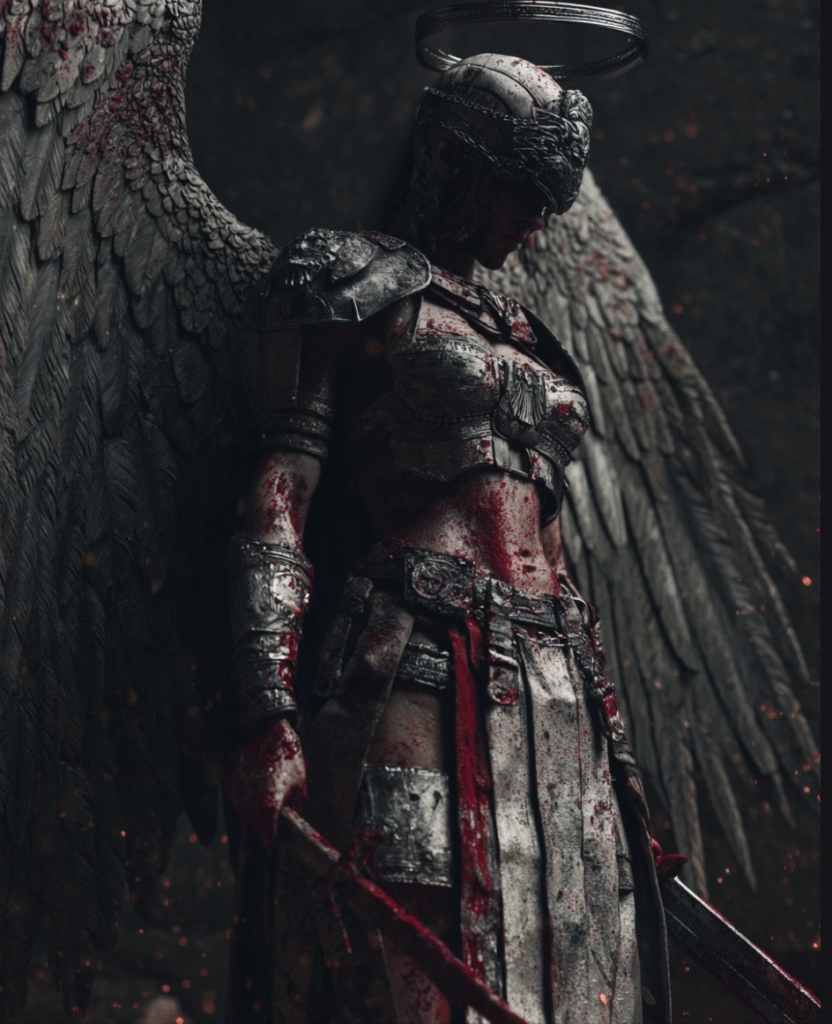
this angel of vengeance hits hard
she feels carved from the cold strata beneath
our usual feelings, stepping out of the psyche’s
deepest chambers.
this is what the soul looks like when it decides that clarity matters more than comfort. vengeance here isn’t petty retribution, it’s the fierce, surgical commitment to cutting away what has stalled your becoming. her swords aren’t raised in rage but in resolve.
if you sit with this as a narrative alchemist, the figure becomes a mirror. every major transformation has an inner guardian like this one, a presence that insists on truth before mercy, action before excuses. it’s the part of you that refuses to postpone the work any longer.
here’s a practical step to turn this into something usable:
take five minutes and write a single sentence beginning with:
“The truth I can no longer step around is…”
let the angel stand watch as you name it. this is how symbolic fire becomes momentum.
The Phoenix Path

Here in the UK, Easter weekend unfolds across four sacred days. It’s long enough to lose your everyday rhythm and find a deeper one. And if you play the game right, you can slip between the cracks of routine and catch a glimpse of something mythic moving beneath the surface.
While most of us frame it as a bank holiday or a chance to catch up on chores, there’s something older stirring beneath the surface. This season embodies powerful archetypes—death, descent, resurrection, and return. These patterns echo in ancient myths and mirror nature’s own thawing resurrection.
Whether you observe Easter as a religious rite, a cultural rhythm, or simply a welcome break, you’re standing in a liminal doorway. A sacred pause in the flow of things.
What if you used it to remember who you’re becoming?
This weekend, rather than rushing into plans, consider stepping into a slower, deeper story. One told through fire and feathers. One whispered by a mythic bird that has always known how to die well—and rise better.
Let this be your epic ordinary day. A quiet revolution. A return to what truly matters.
—Clay
Storythinker & Mythic Mentor for Seekers on the Threshold
Helping you rewrite the story beneath your story.
In a time before time, when stories walked the earth before language knew their names, there lived a singular bird—a radiant creature of flame and song. Some called it the Phoenix. Others knew it by older names: Bennu, Firebird, Ashfeather, Emberwing.
She was the living symbol of a truth too wild to tame: that death is not the end, but a beginning disguised.
When her time came—and it always came—she did not flee the fire.
She flew straight into it.
Willingly.
Gratefully.
She built her own funeral pyre from the branches of memory, the feathers of former selves, the dry bark of beliefs no longer needed. And at the appointed hour, she sang a song that split the sky—a song of sorrow and surrender, yes, but also one of fierce hope. A becoming-song.
And as the flames consumed her, a miracle unfolded.
From the ashes rose not a stranger, but herself made new.
Winged again. Burning still. Wiser now.
The Phoenix doesn’t fear endings.
She knows:
Ash is fertile. Fire is sacred. The self is a spiral.
✍️ Phoenix Journal Prompts: Chart Your Own Rebirth
Let’s step into the myth. Not as spectators, but as participants.
Use these prompts as rites of passage—a map through your own ashes.
- The Pyre
What parts of my life, habits, or identity are ready to burn?
What have you been clinging to that no longer serves you?
What identities have calcified around you that feel too small now?
Bonus Practice: Write a symbolic obituary for an outdated version of yourself.
- The Flame
What is the fire I must walk through?
What truth are you avoiding?
What pain, challenge, or transformation do you need to face fully to be free?
Bonus Practice: Give that fire a name. Turn it into a mythical trial.
Example: The Furnace of Self-Forgiveness, The Blaze of Not-Knowing
- The Ashes
What remains when everything unnecessary is gone?
Beneath the fear, beneath the story—what essential part of you endures?
Bonus Practice: Describe this “ember-self” in metaphor or image.
Who or what are you when all masks fall away?
- The New Wings
What rebirth am I ready to claim?
Not a resolution. Not a goal. But a truth wanting to be lived through you.
Bonus Practice: Write a “Resurrection Vow” to yourself.
Begin with: “I rise now as…”
- The Song
What is the melody of my becoming?
If this transformation had a soundtrack, a mantra, a single word—what would it be?
Bonus Practice: Choose a song that captures the energy of your rebirth.
Play it loud. Let it mark the start of your next chapter. My song is:
The Phoenix Path is Spiral, Not Linear
Remember, the Phoenix doesn’t rise once.
She rises every time she falls.
Rebirth is not a singular event, but a sacred pattern, a lifelong rhythm of shedding and becoming.
So don’t rush this.
Let each journaling prompt be a feather.
Let your responses be sparks.
And let the fire be your ally.
Today, you walk the epic ordinary path of the Phoenix.
Not to become someone new,
but to remember who you’ve always been—beneath the soot, beneath the scripts,
burning with purpose.
Today’s Self-Inquiry Prompt: The Narrative of Power

“The most courageous act is still to think for yourself. Aloud.” — Coco Chanel
Personal Power: The Sovereignty of the Self
Personal power is the ability to shape reality from within—to act with intention, to navigate the world on your own terms, and to remain unshaken by external forces. It’s not about dominance over others but about sovereignty over yourself.
At its core, personal power is the integration of three elements:
- Self-Awareness – Knowing who you are beyond social scripts, inherited beliefs, and external validation. It’s the capacity to question your own narratives and rewrite them when they no longer serve you.
- Intentional Action – The ability to translate your thoughts, beliefs, and desires into tangible reality. This is where knowledge meets application.
- Resilient Autonomy – The ability to stand firm in your choices, adapt when needed, and not be easily manipulated by fear, authority, or expectation. True power is flexible; it bends but does not break.
What Personal Power is NOT
- It’s not control over others—that’s domination, not power.
- It’s not certainty—a rigid mind is easily shattered. Real power thrives in uncertainty.
- It’s not validation-seeking—power that depends on external approval is a borrowed illusion.
How Personal Power Manifests
- The ability to say no without guilt.
- The ability to say yes without hesitation.
- Holding your own in any situation, whether it’s an argument, a crisis, or a room full of people who disagree with you.
- The capacity to shift your perspective at will—playing different mental models against each other like a strategist on a battlefield.
- Moving through the world with presence, as if you belong anywhere you decide to be.
Prompt
Consider the narratives that have shaped your perception of power—both personal and external. Who or what has defined power for you? Have you internalised any scripts that disempower you?
Reflection Exercise:
- Identify a moment when you felt powerful. What were the conditions that created this feeling?
- Identify a moment when you felt powerless. What made it so?
- If you could craft a sigil of personal power, what symbols, words, or images would you encode into it?
Write freely. Let the inquiry unravel itself.