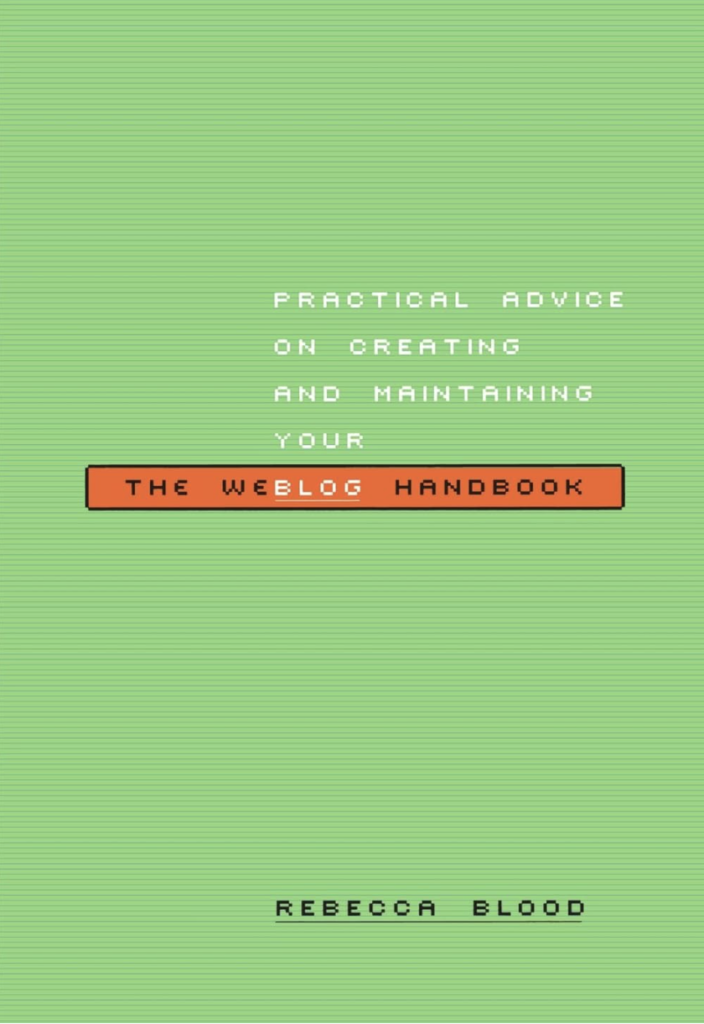
I finished reading Rebecca Blood‘s book, The Weblog Handbook: Practical Advice on Creating and Maintaining Your Blog. The book may be obsolete in its instructions, but not in its philosophy. That often happens with books written before a medium becomes an industry. They describe a culture before it becomes a market.
What I found myself responding to wasn’t the “how to blog” advice. It was, why did weblogging exist in the first place?
Back in the early 2000s, a weblog wasn’t primarily a content strategy or a personal brand. It was more like an intellectual commonplace book opened to the public. It was thinking in public. A running conversation with yourself and with a small circle of curious strangers.
Rebecca Blood understood this because she was writing while the form was still discovering itself. Nobody knew what a successful blog looked like because success wasn’t yet measured in followers, SEO, newsletters, funnels, or monetisation.
Chapter 2, Why Blog?, is probably the heart of the book because her answer isn’t really about publishing. It’s about attention.
A weblog asks:
- What did I notice today?
- What deserves pointing at?
- What idea refuses to leave me alone?
- What connection did I just make?
- What am I learning by writing this down?
That’s a radically different set of questions from today’s:
- Will this rank?
- Will people share it?
- What’s my niche?
- How often should I post?
- Can I turn this into a lead magnet?
The medium slowly became a performance.
Ironically, as the tools became better, much of the spirit became thinner.
I don’t think blogging died. I think weblogging disappeared.
A weblog implied movement. It was literally a log of a journey through the web and through one’s own thinking. You’d link to an article, quote a paragraph, add three observations, wander off on a tangent, and invite someone else into the conversation. The links mattered as much as the words. The blog wasn’t a destination; it was a node in a larger conversation.
Today’s blogs often feel self-contained. They rarely acknowledge they’re part of a wider ecology of ideas. Hyperlinks have become citations or SEO signals instead of acts of generosity.
Early bloggers wrote because they wanted to participate in the web. Today many people write for platforms. Those are almost opposite impulses.
The old web rewarded connection. You linked because you’d found something worth sharing. Someone linked back. Rings of conversation emerged almost accidentally.
The platform web rewards capture. Keep people here. Optimise engagement. Don’t let them click away.
One imagines the web as a network of paths through a forest.
The other imagines it as a shopping centre.
That difference changes not only how we publish but how we think.