We talk about consuming books, as though reading were a kind of nutritional exercise: pages in, knowledge out. But the best reading has never felt like consumption to me. It feels more like entering into correspondence with another consciousness across space and time. A conversation where one voice has the strange advantage of having thought about what it wants to say for years, sometimes centuries.
The art of reading begins when we stop treating books as containers of information and start treating them as occasions for thought.
A book is not finished when the author writes “The End.” It is finished when the reader has wrestled with it long enough for something inside themselves to rearrange. Every worthwhile book is completed twice: once by the writer, once by the reader.
There is also the question of pace.
The modern world encourages us to read the way we scroll—fast enough to harvest the headline before moving on. But some books refuse this economy of attention. They ask to be lingered over. A single sentence from Montaigne, Woolf, Nietzsche, or Solnit can occupy an afternoon. Not because it is difficult, necessarily, but because it unfolds. Like a landscape seen from different angles, it reveals more each time you return.
Perhaps reading is less like travelling down a road than wandering through a forest. You can rush from one edge to the other and claim you’ve “done” the forest. Or you can stop beside an old oak, notice the fungi on its bark, listen to birds you’ve never heard before, and discover that the forest was never simply a route—it was a relationship.
There is an ethics to reading, too.
A generous reader doesn’t merely ask, Do I agree? They first ask, What is this person trying to show me? Agreement can come later. Understanding comes first. Reading well requires a temporary hospitality of mind, an ability to let another worldview take up residence without immediately redecorating it according to our own tastes.
Of course, books are not always right. Some deserve argument. Some deserve abandonment. Some become more valuable because we resist them. But even disagreement can be a form of intimate reading if it arises from genuine encounter rather than reflex.
The finest readers become collectors of questions rather than answers.
They close a book carrying not a list of quotations but a slightly altered way of seeing. They begin noticing things in the street, in conversations, in their own thoughts that previously passed unnoticed. The book has become less an object than a new lens.
This is why marginalia matters. Underlining. Scribbled notes. Dog-eared pages. Conversations with friends. Journal entries after finishing a chapter. Reading is not passive reception but active participation. Every mark we make in a book is also a mark the book has made in us.
And perhaps this is the deepest art of reading: learning to read not only books, but the world itself.
Eventually the boundary dissolves. A walk becomes a chapter. A stranger becomes a footnote. A dream becomes an appendix. The city becomes a text full of symbols, omissions, revisions, and hidden authors. You realise that books were never teaching you merely how to read pages. They were teaching you how to become more readable to yourself.
The mature reader is therefore not someone who has read thousands of books. It is someone whose reading has become a way of being in the world—curious, attentive, slow enough to notice, humble enough to be changed, and alive to the possibility that every genuine encounter, whether with a paragraph or a person, is another chance to revise the story they are living.
I almost don’t want to say it out loud, as if naming it might hurry things along, but there was a trace of winter under the morning. It wasn’t cold. The air had acquired an edge, just enough to remind me that the year is already leaning towards another season. Where did the summer go?
Thinking often changes like this. I keep circling a question, carrying it from the desk to the path and back again, until one morning I realise I am no longer asking it from the same place.
For the past week the question has been: What is my practice?
The useful version of that question reaches beneath my work, my products and whatever skills I can put on a page. It asks what I am cultivating day after day, whether anybody notices or not.
The internet muddies the answer. I understand the marketplace and its machinery. If I want people to find my work, I have to make it visible. The platforms reward recognisable openings, familiar pacing and proven formats. Success leaves footprints, and the rest of us follow them until even originality begins to look as though it came from a template.
Every time I start thinking too strategically about “content”, I feel my attention detach from the thing that made me want to write. I start positioning rather than wondering. I ask, Will this perform? before I ask, Is this true?
These morning walks have been teaching me another rhythm. Walking, talking aloud, letting a thought find its pace somewhere between footstep and breath. I rarely leave the house with a destination for the thinking. The walk is the thinking. By the time I return, I know something I couldn’t reach by sitting still and pressing harder on the question.
July’s thirty-one days of blogging did something similar. It began as a challenge, became a habit, then asked to be treated as a practice. A challenge has a finish line. A habit can run without much presence. A practice asks me to turn up and meet the day that is here, with whatever quality of attention I can bring to it.
The Textual Underground has been holding versions of this thought for a while. On one walk, i uncovered a useful sequence: walk, notice, record, return, write, publish a trace. Another note asked what particular world becomes available through a person’s attention. Beneath both sits the same suspicion: the work begins before the writing does.
The blog has become the public edge of that practice. It can hold a finished essay, but it can also hold a photograph, a rough connection, a sentence that hasn’t decided what it believes yet. I don’t want it to document a row of conclusions. I want it to show a consciousness moving through time, books, streets, conversations and its own recurring questions, sometimes changing its mind in public.
Attention may be the thing I am cultivating. Attention to the year turning in the air. To old stone under a heavy sky. To the conversations overheard in cafés and the books that keep talking after I have closed them. To the odd thought that arrives halfway up a hill and refuses to leave me alone.
Writing is what attention leaves behind.
The business may grow from those traces. Readers may gather around them. Some notes may become essays, workshops, books or objects I can’t see yet. But those are later forms. If I make them the source, I lose contact with the walk, the question and the part of me that still writes to discover what he thinks.
I picked up an old book this morning: Perceiving Ordinary Magic: Science and Intuitive Wisdomby Jeremy Hayward. The cover is a blue corridor of repeating geometry, the kind of image that used to promise either a difficult physics lecture or a trip through somebody else’s consciousness.
Somewhere in its opening territory, Hayward pointed me back towards Chögyam Trungpa and the Shambhala teachings. I had known the word warrior mostly through its degraded modern forms: the hard man, the self-improver, the person who mistakes tension for strength. Trungpa’s use of it runs in another direction. The warrior is the one who stops arranging life around not feeling what is true.
How often do I reach for the phone because the room has gone quiet? How quickly do I begin rehearsing the future when a task becomes awkward? How much of what passes for planning is just an elaborate way of avoiding the next plain thing?
The Shambhala language calls these little defensive constructions the cocoon. I know the feeling. A bright, upholstered chamber made of scrolling, second-guessing, imagined conversations, old arguments, and the promise that relief is one more click away.
Hayward’s phrase, “ordinary magic”, offers another way into the same space. Not magic as an escape from the real, but the possibility that the real becomes more available when we stop trying to categorise, use, control, or explain it into submission.
I have set up a small fourteen-day experiment for myself: sit for fifteen minutes with my eyes open; walk without headphones; notice one cocoon move; make one small honest return; write a few lines before bed.
No warrior costume. No spiritual badge. Just an attempt to find out what becomes perceptible when I stop defending myself from the ordinary.
There was no great expedition in it. I was walking back through Southam by a route I know too well, heading toward the familiar turn that gets me home with the least fuss. Then I thought: I could go that way instead. I had no errand on that street. No appointment. No shop to visit. It was a residential stretch of town, the kind of road I had probably passed a hundred times without giving it a glance because it had never offered anything I needed.
That was the point.
I walked it anyway. The houses had a different feel. The street had its own arrangement of front gardens, parked cars, brickwork, hedges, caravans, and small human decisions. Nothing spectacular happened. I did not discover a portal in the pavement or receive a message from a crow. I just entered a portion of my own town that had remained invisible because convenience had made it irrelevant.
That small diversion has been sitting beside my reading of Rebecca Solnit’s A Field Guide to Getting Lost. Solnit’s book is full of bigger territory: deserts, artists, explorers, blue distance, memory, loss, death, wilderness, the strange gap between where we are and where we thought we were going. But it has made me think again about the domestic scale of getting lost. How much of our world disappears because we know the quickest route? How much of ourselves disappears because we have accepted a plan before we have tested whether it belongs to us?
This is not a standard book review. I am not going to march through the contents, hand out marks, and tell you who should purchase it. I want to stay closer to the experience of reading it. Solnit has written a book that gives wandering a form. It keeps setting off from one subject, finding an adjacent path, allowing history, landscape, art, grief, philosophy, and personal memory to change the pressure of the original question. Then, when you have forgotten where the question began, she brings you back to it from another direction.
That is one reason I loved it. It is also why the book has left me thinking about walking, blogging, inherited life plans, GPS, the old pleasure of getting a map wrong, and the part of us that wants somebody else to tell us what to do next.
The human appetite for a map
Most of us want a map. We want the plan, the route, the reassuring sense that the person at the wheel knows where the road is going. We want to know that the job will lead somewhere, that the relationship is on schedule, that the decision is sensible, that our identity holds together when somebody asks what we do.
There is nothing foolish about wanting security. A map can keep you from walking over a cliff. A plan can help you feed a family, meet a deadline, recover from a crisis, or find your way home before dark. I used to love rock climbing and mountain walking, and I have never confused adventure with a refusal to prepare. A compass, a map, some knowledge of the weather, enough food, an honest sense of your own ability: these things matter.
But a map can also become a substitute for contact with the territory.
Before the phone put an OS map and a blue dot in every pocket, you could get properly twisted around. A riverbed might not be where you expected it to be. A path might be overgrown. A ridge might look different from the angle you approached it. You worked with map and compass, corrected your bearings, checked the ground against the paper, and slowly found your way through. The point was not to be incompetent. The point was to be in a live relationship with the world.
Now I can walk almost anywhere with the comforting knowledge that a glowing rectangle knows exactly where I stand. That is an extraordinary convenience, and I am glad to have it when I need it. Yet something has changed. GPS can tell me my location without asking anything of my attention. It can preserve me from the experience of not knowing where I am.
The same thing happens in the wider life. We inherit maps before we can inspect them. Get married. Get a job. Buy a house. Have children. Build a respectable career. Keep moving. Do not make a mess. Do not disappoint anyone. I grew up in New Jersey. I had no idea that I would spend much of my adult life in England, that I would be living here twenty-six years later, married, writing this from a town I could not have placed on a map when I was young.
Life had other plans, or perhaps life had no plan at all and kept offering turns I could not see from the starting point. Either way, I have had to lose the plan more than once.
That is why Solnit’s central question catches me so hard:
“How will you go about finding that thing the nature of which is totally unknown to you?”
It is an old philosophical puzzle, but it also describes the ordinary predicament of being alive. The thing you need may not be something you can identify in advance. It may arrive as a place, a person, a vocation, a grief, a book, a thought you only meet once you have moved beyond the territory you know how to name.
The dark is not empty
Solnit writes: “Leave the door open for the unknown, the door into the dark.” It is a sentence with the force of a threshold. The dark here does not mean evil. Nor does it require us to treat mystery as supernatural proof of anything. The dark is the unknown: the unplanned part of a life, the territory that has not yet yielded its terms.
That dark can frighten us because the known gives us a temporary sense of control. We know our role. We know the route home. We know what gets rewarded. We know which version of ourselves other people recognise. Step past that edge and the old signals weaken. You have to listen harder.
There is a line in Solnit’s book, drawing on Walter Benjamin, that has stayed with me:
“To be lost is to be fully present, and to be fully present is to be capable of being in uncertainty and mystery.” I recognise that from the mountains.
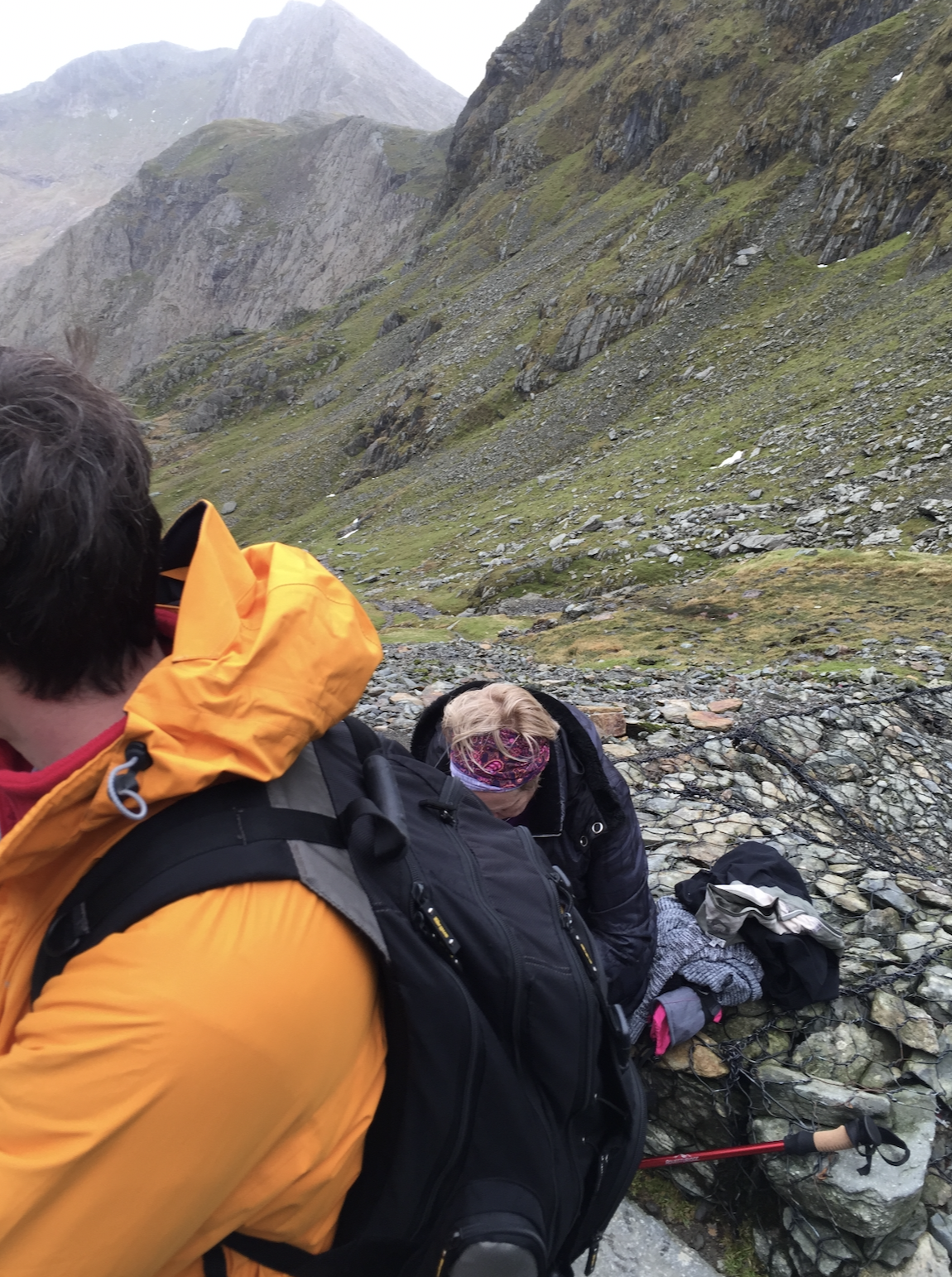
Snowdonia has long felt like a spiritual home to me. I can remember stopping on a hill walk and looking out at the vastness around me: old mountains, distance, weather moving through the valleys, and little old me in the middle of it. The endless internal chatter begins to fall away. I am no longer sorting email, rehearsing conversations, checking the clock, or trying to solve the whole rest of my life. My body is on the path. My attention belongs to the ground, the climb, the weather, the next step.
It happens on a long trek with particular force. On the Camino de Santiago, the life I had brought with me seemed to melt off over days of walking. The journey has its own rhythm. You wake, walk, eat, rest, walk again. But the same thing can happen on a local Wisdom Walk. One steep climb is not required. A person can leave the phone in the pocket, skip the route tracking, turn onto an unfamiliar street, and become more available to what is already there.
This is where getting lost becomes something other than escape. It is not disappearing from your life. It is arriving in it.
Adventure with a margin
I do not think getting lost means throwing caution into the hedge and calling the result freedom. The wilderness has no obligation to reward our fantasies. The road does not care whether we have read enough philosophy. A person can get in over their head, physically or psychologically. The old stories understood this. When the hero crosses the threshold, there is no guarantee of return. Some people do not come back because they die. Others do not come back because the strange territory seduces them into losing contact with the world they left.
A writer I once read classified adventure on a scale that ran from harmless outings through to encounters where death became a serious possibility. His point, as I remember it, was that the best adventures sit somewhere near the middle: difficult enough to demand all your attention and skill, dangerous enough to heighten the senses, yet still within your capacity to navigate if you stay awake.
That feels right to me. I have always liked adventure with some control parameters. The best edge is often where you do not know the outcome but you have enough resourcefulness to meet it. You know what to do when you do not know what to do.
That phrase names a kind of personal power. Not power over other people. Not the inflated confidence of somebody selling a system online. Personal power means sovereignty over your own attention and behaviour when the familiar plan stops working. You cannot master the unknown. The unknown keeps moving. The minute you enter a new territory and learn its shape, another edge appears beyond it.
The skill lies elsewhere. You build enough inner authority to cross the next boundary without handing your life over to panic, imitation, or the first confident person who claims to have the answer.
Our culture has made that last temptation very easy. Open YouTube, Instagram, X, or any platform where advice wears a clean shirt and a polished thumbnail, and someone will explain the route. Start this business. Follow this system. Escape the nine-to-five. Become the person you were meant to be. The internet can teach us almost anything. It can also make it look as if everybody else has solved the riddle of being alive.
I know people whose online presence makes their life look assembled, evolved, and complete. Behind the scenes, they are as confused as the rest of us. That is not a moral failure. It is simply a reminder that presentation is not knowledge. A neat map can be an advertisement for certainty rather than evidence of it.
I wrote recently about the story that wants you at your desk, the inherited script that tells us obedience, legibility, and future reward are the only adult forms of life. Solnit’s book belongs beside that question. Getting lost can be a refusal of the approved diagram. It can also be a gentler act: putting the diagram down long enough to see whether another life is trying to make itself known.
A book that wanders on purpose
Solnit does not merely argue for this kind of openness. She writes it.
That is what makes A Field Guide to Getting Lost more than an elegant collection of observations about uncertainty. The chapters are mini explorations. They set out with one pressure and return by a route you could not have predicted. She moves through art, landscape, personal memory, historical material, colour, desire, loss, and the particular lives of people who have lived close to absence. The diversions do not feel like ornaments. They change what the central idea can mean.
I love writing that works this way. I love the moment when a book gives you a point of departure, then lets the mind travel. A remembered scene opens into history. A journey through a place opens into literature. A philosophical question gets returned to the body, the room, the road, a human voice. You make detours, yet the detours are the actual route.
Robert Twigger’s How to Be a Man in the Lousy Modern Worlddoes something similar, running the account of a man living through pregnancy and impending fatherhood alongside an inquiry into masculinity. In Robert D. Kaplan’s Balkan Ghosts, travel through actual ground continually opens out into cultural memory, politics, history, and books, before bringing the reader back to a road, a border, a city, a body in motion. Christopher Ross’s Tunnel Vision: Journeys of an Underground Philosopher has that same ability to make place and thought speak to each other.
This is the kind of prose I want to keep learning from. It does not use the world as scenery for a thesis. It lets the world interrupt the thesis.
Solnit’s “blue” sections are part of that method. She has described needing more space as the book developed, and blue becomes more than a way of extending the work. It becomes distance, longing, sky, water, the colour that keeps receding as you approach it. The book gains room to breathe. It can follow a thought past the point where a more efficient writer would close the paragraph and move on.
That may sound indulgent to somebody trained to judge every page by speed and utility. I think it is a form of intellectual hospitality. Solnit gives the reader enough room to have associations of their own. She does not lock every door behind her.
For a writer, this is liberating. An essay does not have to behave like a corporate presentation with a conclusion waiting at the bottom. It can be an ecology. It can wander without becoming vague. It can keep faith with a question long enough for unexpected companions to arrive.
The hearth after the wandering
This is also why the book has refreshed something in my sense of blogging.
I have often thought of myself as an explorer of minds and territories, a pathfinder who goes out to see what is there and comes back to tell the story. The exploration can happen in mountains, in a local town, on the web, through hypertext, in a book, on a long walk, in the odd archive trail that begins with one note and ends somewhere nobody could have planned.
The blog is where I come back.
When I was podcasting more heavily, I used to think of the podcast as a twenty-first-century campfire. The blog has that function too. It is the hearth. You return from the walk or the rabbit hole, sit down among other people, and say: I found this. I do not know whether it is useful to you, but it altered something in me.
That is a different relationship to writing from the one offered by the modern advice economy. The blogger does not have to be the person who possesses the final map. The blogger can be the person who leaves a trace. A map made after wandering is not the same as an instruction manual. It can say where somebody has been without pretending that another person should retrace every footstep.
The hope is not that readers will adopt my worldview. I would rather the piece loosened something. I would rather a reader stopped and wondered: Where did this belief come from? Whose plan am I carrying? What might happen if I took a different turn? Then the comments become part of the work. I share an experience; another person shares theirs; both of us see a little farther. The blog becomes closer to Socrates in the marketplace than a stage where the expert delivers answers.
This is why Narrative Alchemy begins with attention to the stories already running inside us. Stories are code. They organise what we notice, what we fear, what feels possible, and the kinds of future we can imagine. A belief can act like a route we have walked so often that it becomes invisible.
The breadcrumb exercise is one way of stepping off it. Choose a belief and ask where it came from. Who gave it to you? What experience fixed it in place? What purpose did it once serve? Then ask the more awkward question: does it still belong to you? The work is not to fling away every old belief in a fit of rebellion. Some maps contain hard-won wisdom. The work is to notice that a map is a map, not reality itself.
A small field guide of your own
Solnit’s book has not persuaded me to seek danger for its own sake. It has reminded me that I do not need a grand expedition in order to practise an openness to the unknown.
Walk a street in your own town that has no obvious use. Leave the direct route to the high street and take the lane you have never taken because nobody you know lives there and nothing waits for you at the end. Drive by a road you normally ignore and take it, if it is safe to do so. Let the usual calculation of time and efficiency relax for an hour.
Or stay at home. Sit in the garden, make coffee, and follow one belief back through its breadcrumbs. “I have to be sensible.” “I cannot make a living from that.” “People like me do not do that.” “I should know what I am doing by now.” Do not attack the belief. Ask it where it came from. It may have arrived through school, family worry, a humiliation, a reward, an old act of love, a world that has changed around you. Knowing its source does not settle the matter, but it can give you back a little choice.
That is enough for a beginning. You do not have to get lost in a desert. You do not need to throw away the map, the job, the marriage, or the responsibilities that make a life possible. You only need to find one place where the map has become too sure of itself and loosen your grip.
A Field Guide to Getting Lost is an excellent treatise on getting lost because it never turns lostness into a cheap slogan about reinvention. It knows the dark is real. It knows that loss can hurt, that uncertainty has consequences, that the world remains larger than our desire to explain it. Yet it keeps the door open.
Read it if you want a book that will not rush to rescue you from the questions it raises. Read it if you like prose that thinks by wandering, circling, and returning. Read it if you have spent too long following a route because it is the route you know.
Then go out. Take the wrong turn on purpose. Or sit quietly with the belief you have never questioned. You may not find the thing you are looking for. That is the old problem. You may find the thing whose nature you did not yet know.
I keep seeing headlines about the new rules of attention, usually written by somebody who wants to sell a better way of getting hold of it.
The old rules were blunt enough. Interrupt people. Startle them. Keep them scrolling. Learn which colours, fears, desires and half-conscious wounds make a thumb hesitate for a second longer. Call it engagement. Invoice the result.
Nobody needed to explain this to us. We felt it in the back of the skull after twenty minutes on the phone: the strange mix of stimulation and depletion, like eating a whole packet of crisps for supper. Full of something. Nourished by nothing.
But attention has changed because the internet has changed. The web is filling with language that resembles language without having passed through a life. Clean little answers. Cheerful summaries. Posts that arrive with all the texture of a hotel corridor. They may be useful. They may even be correct. But they have not stood at a bus stop in the rain, forgotten why they walked into the kitchen, or had to sit with a sentence for three days because it would not behave.
So perhaps the first new rule is this: give people evidence that you were here.
Not performative authenticity. I do not need another stranger telling me they are “showing up as their whole self” beside a beige carousel. I mean the signs of actual contact: the grit on the walking boots, the awkward conversation at the café, the book with its spine cracked open on the table, the particular thought that arrived while you were taking the bins out.
A person’s attention still goes where they sense a living presence.
The second rule: do not make your reader pay for your neediness.
A lot of the attention economy runs on an unspoken demand: stay with me, validate me, complete the circuit. But writing can offer a different arrangement. You can give someone a room to think in. You can leave a door open. You can hand them a question worth taking on a walk.
The reader may not remember every word. They may remember that your piece slowed something down inside them. That it returned them to their own life with a little more curiosity.
That seems a fairer trade.
And the third rule may be the most difficult: make things that release attention back into the world.
The feed wants us facing inward, locked in the bright little casino of the screen. The barefoot philosopher wants to close the laptop and notice the birds having some kind of meeting in the hedge. He wants to read a paragraph, then look out of the window for ten minutes. He wants the internet to lead back to the street, the body, the unfinished conversation, the book waiting by the bed.
Maybe that is where blogging comes back into its own.
A blog does not have to chase you through every room of your life. It can sit there like a small public bench. You visit when you feel like it. Someone has left a note. Perhaps it is useful. Perhaps it sends you elsewhere. Perhaps it reminds you that another human being is trying to make sense of being alive under the same strange sky.
The new rules of attention may have less to do with capturing it than deserving it.
And the people worth reading may be the ones who know when to give it back.
Attention shapes experience by determining what elements of reality become vivid and meaningful while others fade into background noise. Where you direct your focus literally constructs your lived reality, not just your memory of it but the actual texture and quality of the moment as you experience it.
When you attend to something, you’re not passively observing it. You’re actively participating in bringing it into being as an experience. The same room becomes completely different depending on whether you’re noticing the quality of light, listening for sounds, feeling emotional tones, or analyzing spatial relationships. Each attentional filter creates a distinct experiential world.
This means your habitual patterns of attention are sculpting your life. If you constantly attend to threats, you live in a threatening world. If you habitually notice beauty, you inhabit a beautiful world. Not because the external circumstances have changed, but because attention is the mechanism through which reality becomes experience.
If attention determines what becomes real for you, then directing attention becomes the primary magical act. Before you can change anything, you must first bring it into the field of awareness. This is why practices like journaling, meditation, and ritual work so well for transformation. They’re technologies for deliberate attention direction.
Attention is indeed a superpower, but it’s one you have to work hard at keeping under control, especially since there are so many ridiculous distractions around fighting to steal it from us.
This piece from Anne Alexander really resonated with me. I’m guilty of burning the candled at both ends as well as multitasking like a fiend, two things that are not so good for our attention, which turns out, is a superpower if you cultivate it.
I’m looking forward to reading Peak Mind, by DR Amishi Jha a neuroscientist who has done extensive research on how our attention works. She shares a great beginner’s technique for starting a mindfulness practice. It’s called STOP. I’ll walk you through it on the podcast.
Thanks for listening and sharing the podcast with your network, much appreciated.