The Hill of the Goblins and other matters

Sunday. Mid-morning.

We’re just south of Mold, tucked into a fold in the Flintshire landscape that the main roads have mostly forgotten about. I’m on a family retreat with my wife, our son and his partner, our daughter, and Rosie. Rosie is eleven months old now and is the reason we are all here. She’s the reason for most things now. The Welsh countryside handled the phones for us: my signal was nearly nonexistent, and the Airbnb WiFi was hit and miss, but nobody really minded. I did most of my reading in the mornings before the house woke up, which is my habit. And, during nap times, I would steal a few more pages.

My wife and I are settling into our new titles as Nanna and Pops. We are new to these titles and still finding out what they mean. What I know so far is that watching Rosie move through the world is one of the stranger and more absorbing things I have done. She is on the verge of walking. She can pull herself upright using furniture and edge along it, hand over hand, completely focused, working out in real time how a body operates in space. She crawls to whatever calls her attention and arrives at it with an expression of total seriousness. Watching a mind at that stage — before language, before category, just pure investigation — does something to you. I kept catching myself thinking, ‘That’s what learning actually looks like before we teach ourselves to be afraid of getting it wrong.’

I’m in a chair with a cup of coffee that’s gone lukewarm and a comic book guide to chaos magic open across my knees.

This is, I think, exactly where I’m supposed to be.
The Hill ofthe Goblins

Mold is an interesting place to read this particular book.

The town sits in the Vale of Clwyd, and its name is Norman French — mont-hault, high hill — named after the man who built the castle here around 1140. Robert de Montalt raised his motte and bailey, and the Welsh promptly spent the next century taking turns tearing it down. Owain Gwynedd took it in 1146. Llywelyn the Great took it again in 1201. The English got it back. The Welsh took it back. This is how things worked on the Welsh March. The high hill changed hands, and the name stuck.

But the Norman castle is the newcomer. A mile west of Mold sits Maes Garmon — the Field of Germanus — the traditional site of what medieval chroniclers called the Alleluia Victory. In AD 430, the Bishop of Auxerre led a force of Romano-Britons against an invading force of Picts and Saxons. His weapon was a battle cry. He taught his troops a call, and at the critical moment, three times he cried Alleluia. The army took it up. The sound rolled back off the surrounding hills. The invaders, apparently, fled in terror.

A bishop who won a battle by understanding acoustics, psychology, and the power of collective belief. I’m going to come back to that.

And then there’s Bryn yr Ellyllon. The Hill of the Goblins.

In 1833, some workers quarrying stone just outside town broke into an ancient burial mound and found something that stopped everything. A cape made of solid gold, shaped to fit a single human body, hammered from one ingot into a piece of ceremonial dress that would have made the arms almost useless — the upper body pinned and immobilised, the person inside it turned into a figure of pure ritual power. It dates to somewhere between 1900 and 1600 BC. Whoever wore it was not going to fight or dig or carry. They were going to be seen. They were going to stand at the centre of something and radiate authority while the people around them supplied the meaning.

The Mold Gold Cape is in the British Museum now. The hill it came from is called the Hill of the Goblins because the local folk memory knew, without knowing how it knew, that something supernatural had happened there. That’s what happens when people bury power in the earth. The land remembers, even when the story is lost.

This particular corner of Wales is saturated. Layers on layers. You don’t read a book about magic here and feel like you’re doing something eccentric.

I came to The Psychonaut Field Manual sideways, the way I come to most good things.

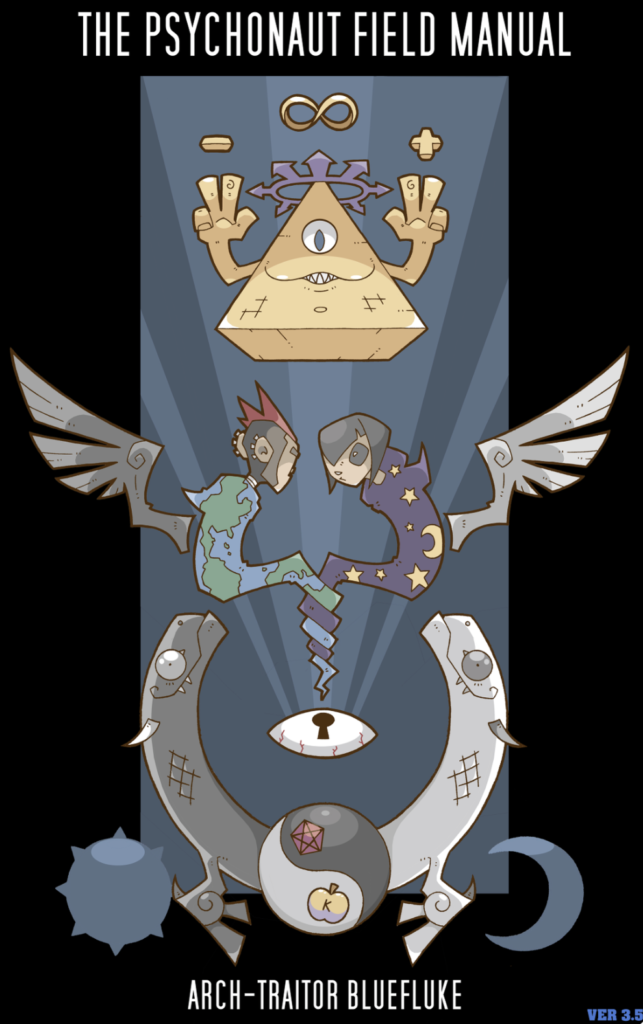
I’ve been reading Sarah Lyons’ How to Study Magic, a book that does what it says and gives you the lay of the land across different magical traditions without trying to sell you any of them. She covers chaos magic, though lightly, and I suspect deliberately so. It’s clearly a territory she respects but doesn’t want to reduce. What she does instead is point toward the deeper water, like Phil Hine’s Condensed Chaos, Aidan Wacher’s Six Ways, and Bluefluke‘s manual for people who want to actually work the practice. She directs readers to the Ultraculture website for the download. I looked there and didn’t find it. Eventually I tracked it down on the Internet Archive. It’s a PDF. A comic book PDF. Forty-four pages of hand-illustrated guidance, drawn in a style that sits somewhere between a D&D sourcebook and an underground zine, and the best part is it’s free (as long as you don’t try to sell it).

The trouble with most introductory chaos magic books — and I’ve read enough of them — is that they fall into one of two failure modes. Either they go so deep into the historical and theoretical apparatus that the beginner drowns in citation before they’ve done a single practical exercise, or they’re so vague and evocative that you finish the book feeling spiritually stirred and practically no further forward. Bluefluke’s introduction names this problem directly: “Few legitimate books exist for the lone beginner, and even fewer aren’t just regurgitating century-old tech written in plain language under a cohesive narrative.”

The Psychonaut Field Manual is the book Bluefluke wanted to find and couldn’t. So he drew it himself.

It is “a theology-free manual containing all the best tech written in plain language under a cohesive narrative.” His words. And they’re accurate. He means it literally. There is no required belief system here, no tradition you have to buy into, no authority you have to defer to. You bring your own cosmology, add it to the exercises, and see what happens. The manual is the engine. You supply the fuel.


What hooked me, on page four, was this.

Level One is called BELIEF IS A TOOL. It opens with the following:

Any damned fool can operate any of the following tech provided they believe that they can. Belief is not only the first tool you’ll master on your journey but also the most powerful. Faith moves mountains and shit. Call it imposition of the will. Call it the placebo effect. Call it the descent into madness. Regardless, magic works.

This is precisely the point at which most esoteric writing flinches. The author will acknowledge that belief is important, then spend the next three paragraphs hedging the claim, gesturing at neuroscience or synchronicity theory or the morphic field, trying to make the supernatural respectable. Bluefluke does none of this. He states the operating principle, acknowledges that you can call it whatever you want, and moves on. The name is irrelevant. The mechanism is not.

What he’s describing is something that runs through everything I work with. In NLP it is the presupposition that the internal map determines the external territory. In Vaihinger’s Philosophy of As If it is the concept of the useful fiction — the idea that you can hold a belief provisionally, as a tool, without requiring it to be objectively true, and still gain the full functional benefit of holding it. In chaos magic it is the principle that Peter Carroll articulated in Liber Null: that the specific content of a magical paradigm matters far less than the intensity and clarity of the belief itself. And in Bluefluke’s visual shorthand it is two characters standing next to each other — one saying, ‘See! Nothing is happening!’ I knew magic was bullshit,” while the other says, “Holy shit. This is awesome! I knew it would work!” — demonstrating, in one panel, the entire phenomenology.

He goes further than the cartoon, though. Ceremonial magicians in robes doing the Enochian hokey pokey — his words — look ridiculous from the outside. But the theatre of the thing is load-bearing. “Shit happens not because they think it will but because they know it will. Whether they attribute the outcome to inner mastery or sketchy metaphysical hippie shit is irrelevant. It doesn’t matter what you believe. Just believe.”

The bishop at Maes Garmon understood this. He wasn’t doing theology. He was doing belief engineering. Get the collective into a single focused state, and the outcome follows. The alleluia rolled off the hills, and the army that heard it ran.

This is what has always drawn me to chaos magic over any system that requires doctrinal commitment. The other frameworks I work with — Jungian depth psychology, narrative therapy, and the archetypal tradition — they all make truth claims or at least make it tempting to treat their maps as the territory. Chaos magic refuses. It hands you the map, reminds you it’s a map, and suggests you throw it away once you’ve reached the destination. Belief is a technology, not a confession of faith.


From there the manual builds in clean, numbered levels.

Level Two is Gnosis, which Bluefluke defines with unusual precision: “Your goal here is not to find inner peace or become ‘one with everything’. Rather, it’s to shut down all auxiliary thought in order to focus most of your brain’s processing power on a singular point of action.” This is not the yoga retreat definition of meditation. It’s an operational state. You are developing the ability to hold complete attention on a single point, which will be the substrate for everything that follows — sigil work, visualisation, projection. Without this capacity the rest of the manual doesn’t function. He knows this and says so. Practise for at least ten minutes a day. He doesn’t ask whether you feel like it.

Level Three opens the third eye. Not as a mystical organ but as a visualisation training system. Step by step, increasingly demanding exercises to develop the ability to project stable imagery with what he calls vivid closed-eye clarity. The point he makes here stays with me: “The third eye + pineal gland theory is 100% required tech for future exercises, and the more you practise it, the more vivid your visualisations will become.” He’s not interested in whether the third eye is literally a gland. He’s interested in whether the training produces the result. It does. That’s the argument.

Level Four — Right Hand of Eris — introduces sigil construction using a tarot deck as a decryption key. It’s one of the most grounded and practical treatments of sigil magic I’ve read. The tarot isn’t invoked here for its traditional meanings or its esoteric associations. It’s used as an image generator: you pull cards, write down the figures, scratch out the vowels and repeating letters, and simplify the result into a geometric shape, and the sigil emerges from the process. Practical, demystified, immediately repeatable.

Then comes what Bluefluke calls the First Big Secret. This is where the manual earns its depth.

The mind, he writes, is not a single entity. It is a multi-organism. He maps it as three interlocking operating systems: the subconscious, which he calls the reptile brain — “the realist, the survivalist, the hungry man”; the superconscious, the higher self — “the artist, the moralist, the idea man”; and the self-conscious, the soul — the software layer created by the interaction of the other two in early childhood, built from perceived needs and the given environment. “Consciousness is less like a dictatorship in which you are supreme leader and more like a yin/yang democracy wherein you are the only voter.”

The goal of the magical practice, as Bluefluke frames it, is to get all three to operate in alignment toward a chosen outcome. When they disagree — when the reptile brain wants safety and the higher self wants transformation and the software layer is running old code about whether you deserve either — the working fails. Getting them on the same page is the actual work. The sigils and the gnosis and the third eye training are all infrastructure for that one conversation.

This is where chaos magic converges, fully, with narrative therapy, NLP, and depth psychology. Different maps, same territory. The three operating systems are the id and ego and superego in new clothes, or the subpersonalities of Internal Family Systems, or the representational systems of NLP, or the complexes of Jungian analysis. The content differs. The structure of the problem — a divided mind working at cross-purposes to itself — is universal.


If you’re a visual learner, you’ll love this format as an introductory text to chaos magic and beyond.

There is a lot of chaos magic material in the text. Dense, reference-heavy, arcane in the original sense — hidden, deliberately obscured, written for an in-group. The Psychonaut Field Manual is drawn. The ideas wear costumes. The characters argue in speech bubbles. The instruction steps are numbered in chunky headers. The warnings come in CAPITALS with illustrated faces making alarmed expressions. There is a character called a servitor — an artificial spirit created to carry out specific tasks — depicted as a small floating creature with its own personality, and the instruction on how to delete it when its job is done (“It is vital that once your servitor has completed its task that you delete it. If you fail to do so it will grow, become resentful and possibly turn on you”) is illustrated with an increasingly agitated small demon. This is not an accident of format. The visual language is the clarity. The ideas are strange enough without being packaged in language that performs its own strangeness.

Bluefluke uses rough language. He uses profanity as punctuation, which either puts you off immediately or signals immediately that there is no mystification going on here. The book is not trying to sound important. It’s trying to be understood.

That matters for a field where obscurity has often functioned as a barrier to entry — and a power mechanism for those on the inside of it.

Bluefluke has been sharing this manual since 2014. It’s now in its fourth edition. He has continued to update it, improve it, extend it — while keeping it free. The Internet Archive currently hosts at least three separate versions. His DeviantArt page has over a million views. None of this happened through marketing. It happened because the thing is good and he let it go.

That’s the sigil firing. The thing released is the thing that works.


I read the whole manual over the weekend, put it down, picked it up again on Sunday morning, and sat with it for a while. The hills rolled south toward the Clwyd Valley. Somewhere under the fields a few miles away, a Bronze Age figure waited three and a half thousand years to be found wearing a gold cape in the Hill of the Goblins.

The Alleluia rolled off the hills and the army fled.

Someone, three hundred years after that, built a castle and named it for his own high place.

Every layer of this landscape is somebody’s working. Somebody’s charged intention, buried or built or shouted into the acoustics of a particular valley at a particular moment. Not all of it survives. But the land does, and the names do, and the gold does, and something about the atmosphere of the place stays alive long past anyone who could explain it.

The Psychonaut Field Manual is free. If you’ve ever been curious about chaos magic and bounced off the available material because it assumed too much, was mystified too much, or positioned itself too far inside a tradition you didn’t share, start here.

Make Yourself

Saturday. Early. The Malvern Hills are doing something extraordinary with the light.

I’m writing from a little self-contained place just outside Mathon — a village on the western lee of the hills, technically Herefordshire now, though its soul has always been tangled up with Worcestershire. We picked it as a halfway point for the group. The geography just worked. But you don’t always know what a place is going to do to you until you’re sitting in it at 5am watching the sun come up from behind ancient hills, listening to sheep in the field beyond the garden.

sheep

The village is older than almost anything I can hold in my head. The name comes from the Old English maððum — “gift.” In 1014, Ethelred II gave this district to an ealdorman named Leofwine. By the Domesday Book it was already a significant parish, belonging to the Abbey of Pershore. The Church of St John the Baptist has stood here, in essentially the same form, for nine hundred years. The east gable uses cruck construction — two massive log beams forming an apex — a survival of medieval structural honesty that the Victorians somehow missed when they were enlarging everything else.

What gets me about Mathon is this. Half a million years ago, a great river ran through here, draining the West Midlands southward. Then the glaciers came. The ice blocked the path and created a massive lake where the village now sits. When the ice retreated, the river was gone. What had flowed south now flows north — a tiny brook called the Cradley, a whisper of what was. The landscape is a palimpsest. The reversal is written in the silt.

Mathon also gave its name to two hop varieties — the Mathon White and the Mathon Greening — and the industry was significant enough that Royal Worcester Porcelain created a pattern to celebrate it. The commercial hopyards are mostly gone now. But the hops still grow wild in the hedgerows. A feral memory of a vanished economy.

A landscape is never finished. It is just resting between movements of ice and water.


My week has been like the English weather. Overcast, then suddenly clear, then overcast again.

make yourself

Something happened last week that I can only describe as an unlocking. The philosopher in me — not the coach, not the narrative alchemist, not the Barefoot Philosopher brand — the actual philosopher, the one who’s been in there since before any of the professional identities existed — stood up. Just stood up and looked around at what I’d built and said: where am I in this?

I didn’t have a good answer.

I’ve been putting so much into Narrative Alchemy as the primary identity. And it’s real work, it matters, I believe in it. But I had the order wrong. The philosopher isn’t a subset of the narrative alchemist. The narrative alchemist is a subset of the philosopher. I had the whole thing backwards. And that kind of structural error has a way of making everything feel slightly off, like wearing shoes on the wrong feet. You can walk. But something nags.

The other thing surfacing is Soulcruzer. Again.

I keep doing this with the blog. I breathe it open, let it roam, and then I look at it through some marketing lens and start tidying. Start positioning. Add a niche, clarify the offer, give it a reason to exist that the market can understand. And for a while it looks presentable.

Then it sheds all of that and runs.

Every time. And I keep diagnosing this as a discipline problem, a strategic problem, a commitment problem. But sitting with it this week, I think it’s none of those. The blog knows what it is. I’m the one who keeps forgetting.

Soulcruzer wants to be digital Clay. Not Clay-the-brand. Clay, the actual person, thinking and wandering and working things out in public. The mirror, not the marketing brochure. I’ve been trying to turn a living thing into a shopfront.

I’ve been blogging since 2004. The blog has outlasted everything. Not because I found the right niche or the right strategy. Because at my best on it, I’m just actually present. Showing up as myself, following the thought wherever it goes, trusting that the mind in motion is the thing worth reading.


Then Incubus landed in my ear. I couldn’t escape the Make Yourself refrain. Had to stop and actually listen — this is what happens when the Philosopher is awake and the associations are running.

The song is a meditation on the fragility of a life unexamined. Brandon Boyd uses paper-mâché to describe the person constructed by external forces — social expectation, inherited scripts, the ambient pressure of the culture. At a distance, paper-mâché looks solid. It mimics the form of something substantial. But it is hollow. It won’t survive a change in the weather.

If I hadn’t assembled myself, I’d have fallen apart by now.

There’s a nod in there to something I’ve been thinking about for years. The psyche isn’t a finished product delivered at birth. It is a collection of fragments — biological drives, social conditioning, personal history — that will drift toward entropy unless there is a conscious assembler at the centre. To make yourself is to take responsibility for the glue.

And then the line that hits differently now: And if I fuck me, I’ll fuck me my own way.

The ultimate claim to autonomy. Better to fail by your own hand than to succeed as someone else’s project. There is a specific dignity in making your own mistakes. If you are going to be screwed — and the world will try — it is a radical act of sovereignty to ensure that even your self-destruction is one you authored.

The bridge moves somewhere more tender. You should make amends with you / if only for better health. Living a life that isn’t yours is exhausting. The amends required are between the person you are performing for the world and the self waiting to be assembled.

The song doesn’t offer a map. Only the consequence of failing to start.


The Malvern Hills are fully lit now. The sun is up. The sheep are doing whatever sheep do on a Saturday morning.

The philosopher is back. I’m not sure he ever fully left. I think he was just waiting for me to stop pretending he needed better positioning.

The Art of Rhetoric: Cicero’s Superpower

Cicero—Rome’s master of words, the man who turned rhetoric into a weapon sharper than any gladius. If history had a hall of fame for persuasive speech, Marcus Tullius Cicero would have a prime seat, right next to Socrates and Churchill. His story is a masterclass in how language, when wielded with precision and strategic intent, can shape the fate of nations.


The Art of Rhetoric: Cicero’s Superpower

Born in 106 BCE, Cicero wasn’t a general, nor was he born into Rome’s ruling class. In a world dominated by patrician bloodlines and military prowess, he was an outsider—an ambitious equestrian with only his mind and his words as weapons. But oh, what weapons they were.

By the late Republic, Rome had become a dangerous chessboard of power struggles. Political survival required not just alliances and military might but the ability to shape public perception. Cicero recognised this and made rhetoric—ars dicendi (the art of speaking)—his pathway to dominance. He studied under the best teachers in Greece, including the Stoic philosopher Diodotus and the famed orator Apollonius Molon of Rhodes, who also trained Julius Caesar. Cicero mastered every trick in the book: irony, invective, logical precision, emotional appeal. His speeches were not just arguments; they were symphonies of persuasion.

His big break came in 70 BCE with the Trial of Verres. Gaius Verres, a corrupt governor of Sicily, had looted his province and thought he could escape justice by bribing his way out. Cicero took the case against him, demolishing Verres with such relentless eloquence that the man fled into exile before the trial even finished. The Romans loved a good courtroom drama, and Cicero had just become its biggest star.

From Advocate to Consul: The Rise of a Statesman

Cicero wasn’t just a courtroom sensation—he leveraged his rhetorical prowess to climb the political ladder. By 63 BCE, he reached the pinnacle: Consul of Rome, the highest elected office. It was here that he delivered the speeches that solidified his legacy.

The Republic was on shaky ground. Lucius Sergius Catilina (Catiline) was plotting a violent coup. Cicero, through intelligence networks and sheer political instinct, discovered the conspiracy and took it down with a series of legendary speeches—the Catilinarian Orations. Standing in the Senate, he thundered against Catiline with lines that still resonate:

“How long, O Catiline, will you abuse our patience?”
(Quo usque tandem abutere, Catilina, patientia nostra?)

With this speech, he didn’t just expose Catiline; he made himself the saviour of the Republic. The Senate gave him near-dictatorial powers to suppress the coup, and he executed Catiline’s co-conspirators without trial. It was a masterstroke of political theatre.

Cicero vs. Caesar: A Rhetorical Gladiator in a World of Generals

For all his eloquence, Cicero was walking a tightrope. The late Republic was a playground of warlords—Pompey, Crassus, and the rising force of Julius Caesar. Cicero, ever the defender of res publica (the Republic), opposed the idea of a strongman ruling Rome. But unlike Caesar, who commanded armies, Cicero had only his voice.

When Caesar crossed the Rubicon in 49 BCE, plunging Rome into civil war, Cicero hesitated. He neither fully supported nor opposed Caesar, a strategic ambiguity that left him politically sidelined. After Caesar’s victory, Cicero was pardoned but diminished. He had spent a career using words to control men, but now men of action ruled Rome.

The Philippics: Cicero’s Final War of Words

When Caesar was assassinated in 44 BCE, Cicero saw a chance to restore the Republic. But there was a new threat: Mark Antony. Believing Antony to be another tyrant in the making, Cicero launched a rhetorical assault known as the Philippics—a series of speeches that savaged Antony’s character, painting him as a drunken, power-hungry thug.

But words, no matter how sharp, can’t stop the sword. Antony, furious, declared Cicero an enemy of the state. In 43 BCE, Cicero was hunted down and executed. His hands and head were displayed in the Roman Forum, a grim warning that rhetoric alone could not save the Republic.

Cicero’s Legacy: The Eternal Orator

Cicero’s death marked the twilight of the Republic, but his influence endured. His works became the foundation of rhetorical education for centuries. Augustine, Thomas Jefferson, John Adams—great thinkers across time—studied Cicero to learn the power of persuasion.

Perhaps the greatest irony of Cicero’s life is that while he failed to save the Republic in his time, his writings became a cornerstone of political philosophy. His On Duties (De Officiis) remains one of the most influential works on ethics and leadership. His letters reveal a mind both brilliant and deeply human—ambitious, vain, witty, and ultimately tragic.

The Takeaway: Cicero’s Power Playbook

  1. Master the Art of Speech – Cicero proved that words can be a weapon, a shield, and a path to power. He understood how to command attention, frame debates, and control narratives.
  2. Know When to Act – While his rhetoric was unmatched, Cicero’s hesitation in the face of realpolitik (especially with Caesar) left him vulnerable.
  3. Build Alliances – Even the greatest orator needs allies. Cicero’s downfall came when he lost political protection.
  4. Never Underestimate the Power of Ideas – Though his body was destroyed, his words lived on. He became immortal not by ruling Rome but by shaping the minds of those who did.

Final Thought

If Cicero had lived in the modern world, he wouldn’t just be a politician—he’d be a media mogul, a bestselling author, a podcasting giant. He understood, better than almost anyone in history, that in the battle for power, rhetoric is the force that moves men.

And in a way, he still speaks to us. Every time we persuade, argue, or inspire, we’re playing Cicero’s game.


Interview with Cicero

Allied Counteroffensive, 18 July 1918 and the West Yorkshire Regiment

Source: https://www.iwm.org.uk/collections/item/object/205246715

This post is inspired by my friend Dave’s post about his Uncle Harry who died fighting in the Allied counteroffensive during the summer of 1918. His Uncle Harry served with the West Yorkshire Regiment (62nd Division). I recommend you read Dave’s anecdote for a personal insight. It was a nice segue for me to continue with my renewed passion for history, which you’re now starting to see feed into the blog.


By the summer of 1918, the tide of World War I teetered precariously on the edge of uncertainty. For months, the German Spring Offensive had battered Allied lines, threatening to break through and seize Paris. The situation had grown dire as German forces clawed their way deep into French territory, forming a dangerous salient around the Marne River. But on July 18, 1918, the Allies struck back with a counteroffensive that would shift the course of the war—an audacious gamble that began west of Bligny Ridge and reverberated across the Western Front.

At the heart of this counteroffensive was the British 62nd (2nd West Riding) Division, which included the storied West Yorkshire Regiment. This regiment, made up of battalions forged in the industrial heartland of Yorkshire, was no stranger to the horrors of war. By July 1918, they had already endured years of brutal fighting, but their resolve remained unbroken. The regiment was instrumental in the Allied effort to reclaim Bligny Ridge and surrounding areas, playing a vital role in containing German forces and enabling the broader advance.

The action was part of the larger Second Battle of the Marne, an epic struggle that marked the last major German offensive and the beginning of a relentless Allied push. This counteroffensive, planned meticulously by French General Ferdinand Foch, aimed to exploit the overstretched German forces who had advanced too far, too fast. The Allies had spent weeks reinforcing their positions with fresh troops, including American divisions eager to prove themselves on the battlefield.

On the morning of July 18, the assault began. French, British, and American forces surged forward in a coordinated attack west of Bligny Ridge, near Soissons. The element of surprise was their greatest weapon. Instead of a preparatory artillery barrage—a hallmark of earlier battles—the Allies advanced under the cover of a creeping barrage, moving swiftly to catch the Germans off guard. French tanks rumbled across the fields, their clanking steel hulls cutting through barbed wire, while infantry units pressed forward behind them.

The West Yorkshire Regiment, particularly the 8th Battalion, distinguished itself during these operations. Later in the month, on July 29, the 8th Battalion spearheaded the capture of Montaigne de Bligny, a strategic hill near the ridge. The hill, long held by German forces, provided a commanding view of the Marne valley. Seizing it was no small feat. Under heavy fire, the battalion advanced with unwavering determination, overcoming machine-gun nests and entrenched positions. Their success secured this vital high ground, contributing significantly to the Allied counteroffensive’s momentum.

Bligny Ridge, though not the epicentre of the assault, remained a crucial strategic feature. The German positions near the ridge provided a vantage point over the Marne valley, and Allied forces in this sector, including the West Yorkshire Regiment, played a vital role in containing any German attempts to counter the counteroffensive. The ridge, scarred by earlier battles, bore witness to renewed fighting as the Allies pushed to keep the Germans pinned down.

By the end of the first day, the Allies had achieved a stunning breakthrough. The Germans, unprepared for the ferocity and speed of the attack, began to falter. Over the next few days, the momentum of the counteroffensive grew. French and American forces recaptured Soissons, cutting off key German supply lines and forcing a retreat. Bligny Ridge, though no longer a primary focus, stood as a symbol of the Allied resurgence, its hard-fought ground secured by the sacrifices of earlier battles.

For the West Yorkshire Regiment, the events of July 1918 were a testament to their bravery and discipline. Their actions, particularly in securing Montaigne de Bligny, exemplified the determination of the Allied forces during this critical phase of the war. The regiment’s contributions were pivotal in the eventual success of the counteroffensive and the subsequent turning of the tide in World War I.

The success of the July 18 counteroffensive marked a turning point in the war. It shattered the myth of German invincibility and proved that the Allies could coordinate large-scale attacks across multiple fronts. The Second Battle of the Marne, of which this action was a part, signalled the beginning of the Hundred Days Offensive, a relentless Allied advance that would drive the Germans back and ultimately lead to the Armistice in November 1918.