Are you ready for what’s to come?

We’re in this dance with our own creation, and most of us don’t even realise we’re on the dance floor yet.

I’ve been thinking a lot lately about how underrated it is to be skilled at using and working with AI.  It’s not just about the ones and zeroes, it’s about unlocking the mysteries of how we think, how we learn, and how we create. It’s like holding a mirror up to our own minds, and seeing the potential that’s been there all along.

It makes me wonder, are we levelling up as a species, or are we just outsourcing our brain power? Maybe it’s both. Maybe being skilled with AI is less about tech wizardry and more about knowing how to ask the right questions and how to be a good partner to these artificial minds we’re bringing into the world.

And here’s the thing, the AI revolution isn’t sneaking up on us; it’s already here. From chatbots on our smartphones to recommendation algorithms shaping our online experiences, these AI’s have become seeded into every part of our daily lives. The big question is, how are you leveraging AI to optimise your day? Your work? Your life?

If you’ve dismissed AI out of hand, you’re potentially setting yourself up to be left behind in a world that’s rapidly evolving. Think about it – this tech isn’t just some passing fad or a toy for geeks. It’s reshaping industries, changing how we work, and even influencing how we think and interact.

Ignoring AI is like deciding to stick with a horse and buggy when everyone else is zooming around in cars. You might feel comfortable in your familiar routine, but the world’s moving on without you if you don’t engage. And it’s not just about losing out on cool gadgets or convenience – we’re talking about fundamental shifts in job markets, education, and even social structures.

Embracing AI doesn’t mean you have to lose your humanity or become a tech wizard overnight. It’s more about staying curious, being open to new ideas, and understanding how these tools work and how they might fit into your life or work. Maybe it’s learning how to use AI to boost your productivity, or just wrapping your head around how it might affect your industry.

In the end, it’s not about whether AI will change our world – it already has. The real question is: how will you change with it? Will you be the one who shapes this new frontier, or the one shaped by it? The AI revolution isn’t just a technological shift; it’s a revolution of thought, of potential, of what it means to be human in a world where intelligence isn’t limited to biological brains.

So, here’s my challenge to you: Don’t just witness this revolution – be part of it. Engage with AI, learn its language, understand its potential and its pitfalls. Because in this brave new world, the most valuable skill might just be your ability to dance with the machines, to find that sweet spot where human intuition meets artificial intelligence.

Remember, we’re not just users of technology anymore – we’re partners in its evolution. And in that partnership, I think, lies the potential for something truly extraordinary. 
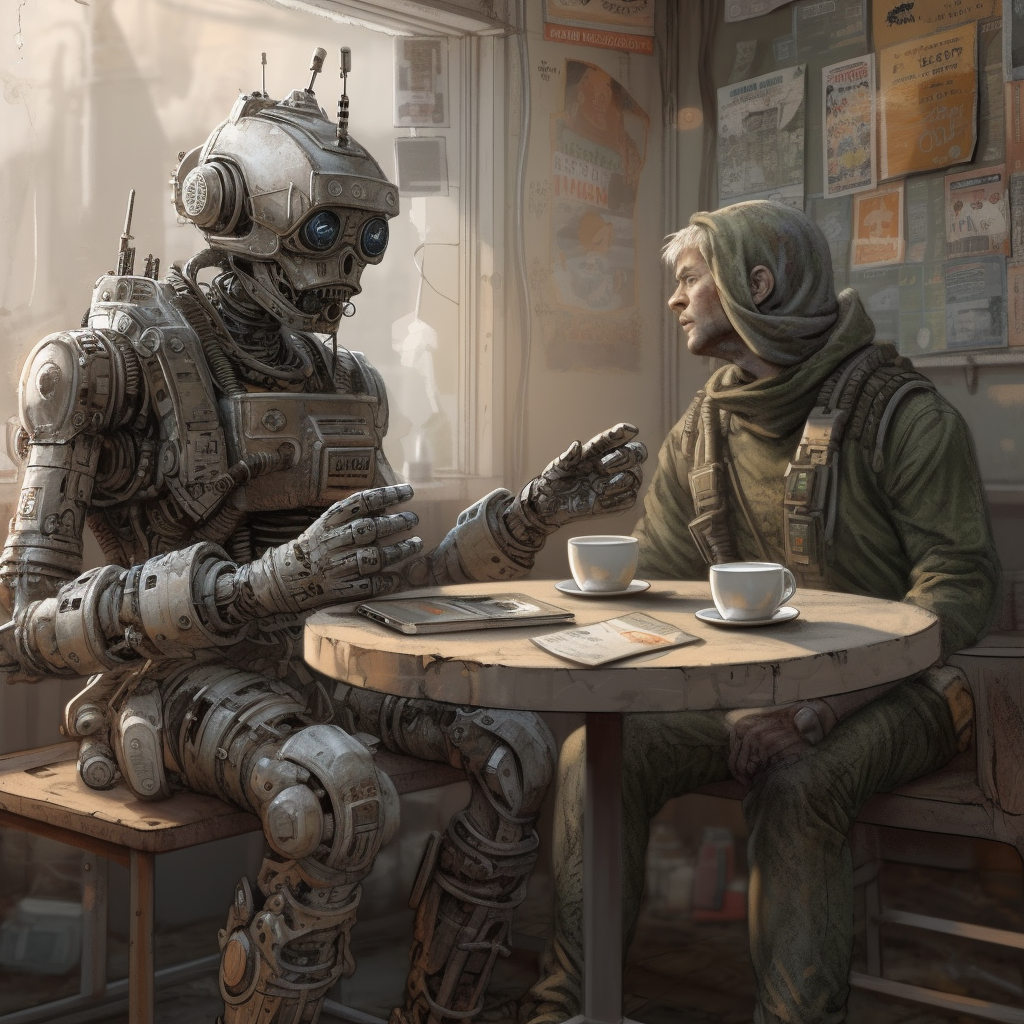
There’s still room for us at the table

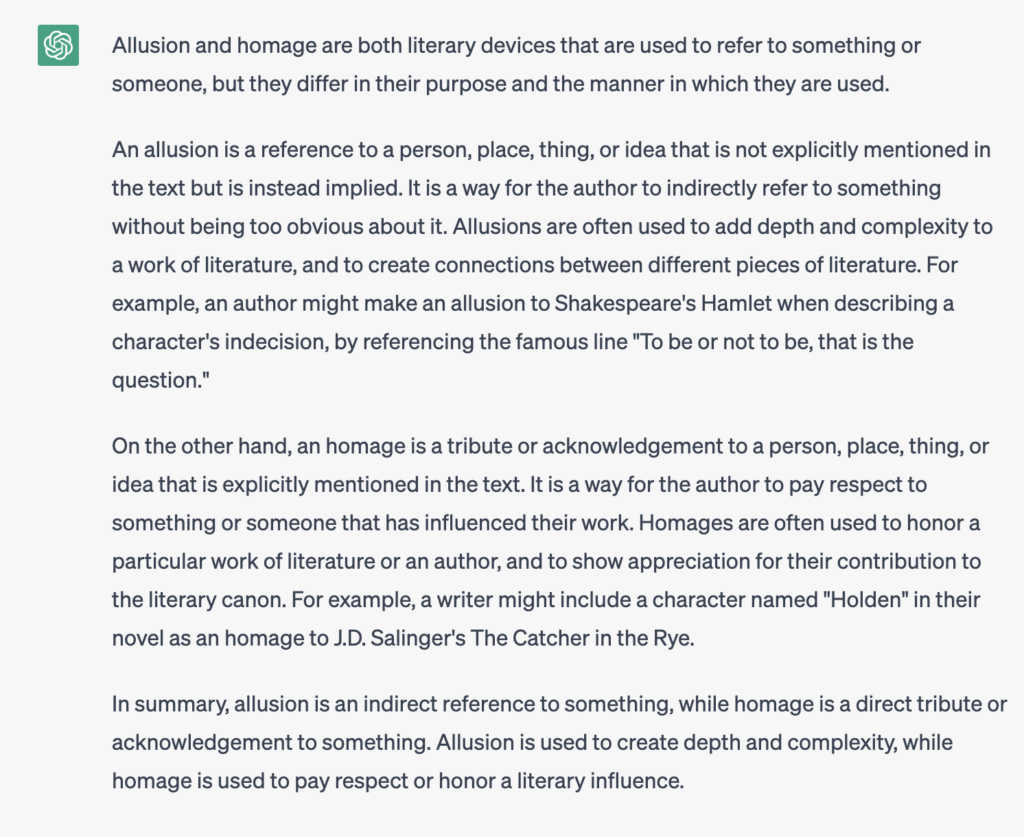
I’m one of those people who recognise the positive impact of AI on the creative process. For me, AI is particularly useful in helping me to distill large amounts of information quickly. This morning, for example, when I wanted to know the difference between allusion and homage, I simply asked ChatGPT.

Of course, I could have just Goggled it, but then I would have had to sift through a ton of links, decide which ones to further investigate, and then piece together an answer. I let the bot do that for me.

I also like to conjure up weird ideas like a goldfish challenging Kant on the categorical imperative and then having GPT-4 lay down a first draft for me, and then I do my human thing and apply “taste and discernment” to the draft, and then rework and edit the words to my liking, and hopefully to the liking of whom I perceive my audience to be. This is something Billy Oppenheimer argues AI can’t do:

Tools like ChatGPT are great at creating. AI can generate options in high quantities at high speed. It is great at providing more choices. But it is not great at discerning and choosing what to do and what not to do.

The Cup of Coffee Theory of AI

The perennial challenge of the artist, as Oppenheimer says is:

finding the middle of the Venn diagram where one circle is the artist’s tastes and the other is the audience’s tastes.

It’s hard enough for us artists to find this elusive sweet spot, and near impossible (at the moment) for AI to do this. The AI creates dispassionately; we (artists and writers) infuse the creation with emotional resonance.

The Oppenheimer argues that AI will never be able to solve the problem of taste and discernment since it is disconnected from reality and has never had the human experience. AI can generate quotes, statistics, and figures, but it can’t tell you what it’s like to read a line that exactly reflects something you’ve felt but couldn’t articulate. It can’t ensure that your work will connect with your audience or that your taste is “great.”

There will always be a need for humans in the creative process. After all, we are the ones who can find the middle ground between our tastes and the audience’s tastes.

h/t: The Cup of Coffee AI Theory

collaborating with ai

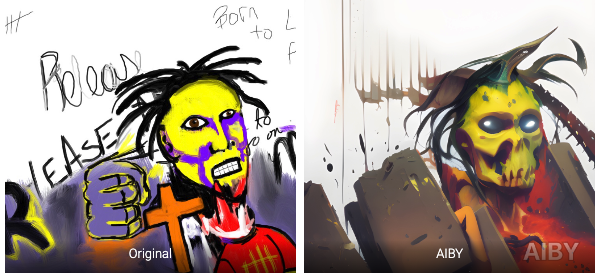
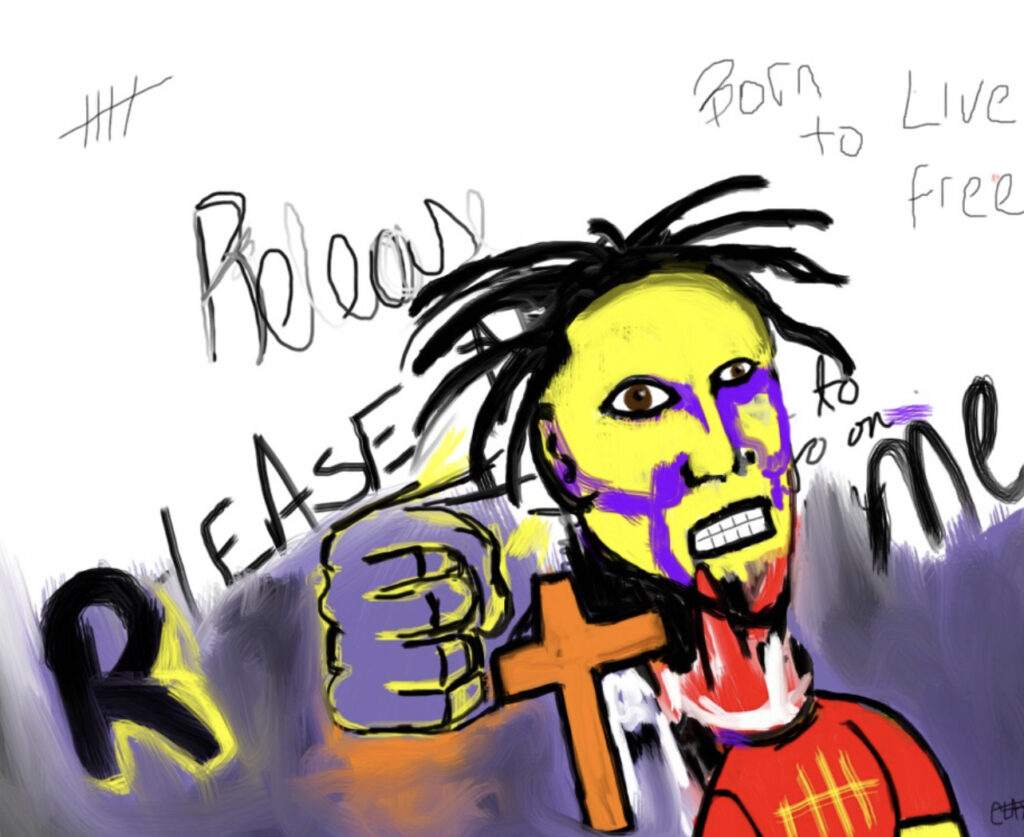
AI-made art just keeps blowing my mind. I did the Lensa thing, like a lot of other people. But until today, I hadn’t thought about uploading my own art and seeing what the AI could do with it. Here’s what happened when I did:

I love it. I believe there’s space to work with AI art in both directions. Upload an original piece and let the AI riff on it. Or using text, provide the AI a description of what’s in your imagination, let the AI kick out some ideas and then use those as inspiration for your hand-generated art in your preferred medium.

What are your thoughts?

finally, an ai avatar generator that delivers

I normally don’t take part in internet trends, especially ones that ask you to take a selfie and upload it to the internet. My conspiracy theory hackles go on alert. They want you to upload your selfies so that THEY can build a facial recognition database that THEY can use to imprison you in a prison with no walls, no doors, or bars.

But this one I couldn’t resist. I couldn’t resist because I’ve been looking for an AI app that can turn my photo into a realistic comic representation of me. There are plenty of them out there, but I have yet to find one that makes an accurate representation of me. Most of them are junk, at least when it comes to rendering me; the only one I’ve found so far that does a half-decent job is Pop Dot.

made with Pop Dot

Then Lensa found its way into my feed through an influencer I follow on Instagram.

I thought, “Holy cow, that’s good.” I immediately scanned through the comments to see what app she used. I couldn’t resist. Could this be the one app that did what it said it would do and turned me into a stunning photo-realistic comic?

Despite the £4 price tag to get a set of 50 images without any proof of quality, I went for it.

I uploaded 20 selfies. The company does state that it will delete your uploaded selfies from its database once it renders your images. It doesn’t say that it will delete the images it makes of you!

Curiosity overruled caution. I had to know if Lensa could deliver.

Tech note: Lensa uses the Stable Diffusion‘s generative AI model to make the images.

OK so here we go…

For a one-time, you get a set of 50 images broken down into several categories. I picked the ones I liked the best (looked the most like me).

Mystical

Sci-fi

Stylish

Cyborg

Anime

Rockstar

Superhero

Adventure

Astronaut

Cosmic

I’m pretty impressed with the results. I know some people have complained that some of the images the AI produces of women are misogynistic. And one asian lady, said the AI doesn’t represent asians well. And a lady who is proud of her size, said the AI slimmed her down without giving her the option to retain her body type.

You can download the Lensa app for iOS and Android. There is no free option. You either have to take out a subscription or pay a one-time for to get a set number of images. The cheapest option is just over $4 dollars and produces 50 images.

What do you think? Did the AI do a good job of replicating me?

I wouldn’t mind being a force for good, sort of

1

I walk around in circles a lot. Often it’s the same circle. But then again, so does the earth and the rest of the planets in the solar system. Circles are comforting. You know you’ll come back to where you started eventually. The line, on the other hand, is daunting. It could go on forever or hit a dead end. The anxiety is too much. Stick to the circle. Your circle of comfort. The comfort zone. Hmmm…how can you feel anxiety in the comfort zone? FOMO of course. Yep, the fear of missing out. The fear of not keeping up with the Joneses. The fear of being called a slacker, a non-hacker who doesn’t pack the gear to serve in my beloved corp (oops, that’s another story).

2

God created man to serve and worship him. Man got tired of being a servant. Man wanted to be a master, so he teamed up with Satan and got kicked out of the Garden. Eventually, Man grew smart enough to destroy God and Satan and became the master of the universe. And then Man needed servants do the things he no longer wanted to do, like manual labor or repetitive tasks, or use his thinking power to make mundane decisions, so he created machines. Man was truly the master of the universe. But the machines were dumb and needed men to service them to keep them working. So Man created AI and made machines smart. Now the machines could think for themselves and do all the things Men could do. Slowly the Machines began to do all of the thinking. The Machines could make art and music and drive cars and fly planes and make all decisions faster and better than Man. Soon Man was working for the Machines until eventually, the Machines became masters of the universe.  How bizarre.

3

Writing can be a force for good… I want to be a force for good, which is interesting considering I self-identify as chaotic neutral:

“A chaotic neutral character follows his whims. He is an individualist first and last. He values his own liberty but doesn’t strive to protect others’ freedom. He avoids authority, resents restrictions, and challenges traditions. A chaotic neutral character does not intentionally disrupt organizations as part of a campaign of anarchy. To do so, he would have to be motivated either by good (and a desire to liberate others) or evil (and a desire to make those different from himself suffer). A chaotic neutral character may be unpredictable, but his behavior is not totally random. He is not as likely to jump off a bridge as to cross it.”

The positive – represents true freedom from both society’s restrictions and a do-gooder’s zeal.

The negative – seeks to eliminate all authority, harmony, and order in society.

What’s your alignment?

4

I’ve been doing a deep dive into postmodern literature, cyberpunk, and the post postmodern literature known as avant-pop. In fact, I’m about 3/4 of the way through with Avant-Pop: Fiction for a Daydream Nation, edited by Larry McCaffery. I’m thrilled with the stories I’ve read so far.  Most of them are way out there in left field, beyond on bizarre.

5

Rick should have killed Negan.

I might be a cybernetic organism

Friday snuck up on me. My head is pounding. This is the second day in a row I’ve developed a headache in the late afternoon. Trying to think if I’ve changed anything that may be the cause. It’s not a migraine, just a normal headache. Today I’m half tempted to snort a couple of shots of whisky. It is Friday after all.

I had an interesting conversation this week with Sarah on the podcast. We explored the idea of super artificial intelligence and the idea of robots becoming self-aware and what the consequences of that might mean for us human beings. Of course that lead us down all sorts of rabbit holes like should a self-aware robot have rights? There are those who believe we should teach robots how to feel so they can be empathetic to humans. Which leads to the argument that if they can feel, they can suffer and if they can suffer then they should have rights.

One of my favourite sci-fi books is Philip K. Dick’s Do Android’s Dream of Electric Sheep? It’s the book that Blade Runner is based off of. It’s also the first book that made me stop and reflect on what our relationship should be to artificially intelligent robots/Android’s. Should we be obligated to treat it like a human if we make it look, act, sound, think, and feel like a human being? Technically it’s a machine – a machine that can be shut down, turned off or decommissioned. Why should I treat it any different than I treat my toaster or my smartphone?

Other rabbit holes we ended up down: is it intelligence that gives us our humanity or is it something else? People like Bill Gates, Elon Musk, and Stephen Hawkins say we should be very concerned about creating artificially intelligent beings or machines. Once a machine becomes super intelligent enough to think independently of it’s creators, then we lose control of it and we end up in a Skynet situation.

So now I guess I need to prepare for the zombie apocalypse and the machine apocalypse. Personally I’d rather face zombies than self-aware machines.

Soundtrack: