Wednesday morning. Wind in the microphone. One of those recordings where the first question is whether the machine is even listening.
I am walking through one of the neighbourhoods here, past the boxes people spend their lives trying to own. Box after box after box. Same roofline. Same windows. Same little square of intention at the front. A few flowers. A different car. Some token of distinction placed carefully against the architecture of sameness.
You need the house numbers. Without them, how would anyone know which box was theirs?
This is the thing that caught me. The sheer quantity of life poured into the maintenance of the box. Money, labour, time, anxiety, comparison, all of it moving toward a structure that looks almost exactly like the structure beside it. The outside allows only minor variations. A pot of geraniums. A hanging basket. A fresh coat of paint on the door. The real self, if it is allowed anywhere, has to retreat indoors.
And even there, the architecture has already made certain decisions.
I keep thinking about how to get off the road without pretending I am no longer inside the system. That is the bit I cannot dodge. I still have to live here. Pay things. Use platforms. Make myself findable. Put the work where people can encounter it. I cannot simply declare myself outside the matrix and then wonder why nobody can hear me.
But I also cannot keep trying to become the kind of person the marketing machine knows how to sell.
That was the thought walking past the boxes. These people need a philosopher coach. Some of them do, anyway. Someone who can sit with the question beneath the question. Someone who can help them see the story they are living inside before they spend another decade decorating the walls.
Then the second thought arrived, the sharper one: how do I become available for that work without entering the treadmill that would turn the whole thing into a funnel?
There is a particular humiliation in trying to market philosophy. The thing becomes false in the mouth as soon as it starts sounding like a lead magnet. The old language returns: offer, audience, conversion, positioning. Useful words in their place. Deadly words when they begin deciding what the work is allowed to be.
I have been trying to be a marketeer. Trying to sit at the desk and bang out the clever angle, the sticky name, the neat packaging. There was a time when that made sense. Maybe it was necessary. Maybe I had to exhaust that route properly before I could stop arguing with it.
The walk said stop contorting.
The system is clearer now. The blog is the mothership. The website pushes out to Mastodon and Bluesky. That part is aligned enough. Mastodon, for all its obscurity, still feels philosophically closer to the thing. Bluesky is fine, though it carries the old Twitter ghost in its bones. Twitter can become what Facebook became for me: somewhere I can still exist, still check, still meet the occasional person, but no longer part of the publishing ecology. The API broke the relationship. The trust went with it.
LinkedIn is stranger. For all its faults, and there are plenty, it is at least honest about being a marketplace of selves. Everyone is selling something there: services, employment, authority, proximity to importance. That makes the maverick stance usable. The philosopher coach can appear there because the room is full of people trying to be legible to power. There is work to do in that room.
Still, the platform is only a tool.
That sentence kept returning. Just tools, my friend. Just tools.
The real system is the one under my feet and in my pocket and back in the vault. Obsidian as memory layer. The website as public surface. The LLMs as pattern-matchers and strange companions. Mistral sitting inside the vault as a local co-pilot. Claude and Codex able to talk with the notes when I want the larger models in the conversation. The terminal becoming less intimidating, almost enjoyable. The whole thing starting to feel less like software and more like an atelier.
My notes are living things.
That is the line that matters.
The Obsidian vault is a grimoire. I keep wanting to use that word because no cleaner one has appeared. It holds fragments, spells, observations, failed formulations, half-made essays, names for things that do not yet know what they are. Then the models come through and do what they do best: pattern recognition, resurfacing, recombination. I do my thing. The machine does its thing. Between us, something starts to move.
This is what I mean by text-based ontologist, even if the phrase still has too many syllables to travel easily. The mindset is right. The philosophy is right. A practitioner investigating being through text in a medium where text has become generative. Words as notes. Words as prompts. Words as code. Words as spells. Words as architecture.
The coach game is the right game for me because it is not really a game I am entering from the outside. I have been in it for years. The people who need the work are already there. Leaders, thinkers, stuck humans, people living inside inherited scripts that have become too small for them. The question is the quality of the connection. That is the filter. Not scale. Not reach. Quality.
Find the right people. Build relationships the old way. Conversation by conversation.
Then, because the world refuses to stay in one register, a caravan appears.
A Swift Celebration 400. Compact, two-berth, around 2010. The machine tells me it runs somewhere around four to eight thousand pounds used, depending on condition. I am half in the walk, half in the search result, half in some imagined life where a small caravan becomes a mobile philosophy hut. There are too many halves. That is how the morning is.
Then a man stops to talk about the weather.
His friend came from Kingston, Jamaica, and never really got used to the English climate. Loved the country. Loved most of the people. Could not do the weather. I tell him the only trick I have found is to assume rain. Then every dry moment becomes a bonus. We talk about Georgia, because I lived there for a while, and how the summer heat there is so thick you cannot use the day properly. Here, when the sun comes out, you can actually belong to it.
He mentions “Midnight Train to Georgia.” Gladys Knight steps into the lane for a moment. Then another song. Then he is gone.
This is why walking works. The thought gets interrupted by the world, and the interruption becomes part of the thought.
After he leaves, the thread returns cleaner.
The why is mostly done. The what is mostly done. A good portion of the how is already in place. The work now is taking it full speed without reverting to the old fear that it needs to be packaged before it can move.
NLP is closer to the practical arm than I wanted to admit, mainly because I had grown tired of the associations around it. But the word is right there in the title: linguistic. Neuro-linguistic programming. Stories as code. Belief as tool. Internal reality shaped through language, attention, and pattern. It is not the whole territory, but it gives the work handles.
Chaos magick is the other arm. The mystical one. The permission structure. Belief as instrument, symbol as technology, the sigil fired and released. Robert Anton Wilson hovering in the background, as usual, grinning at the seriousness with which everyone defends their reality tunnel.
Depth psychology is still there. Archetype is still there. Myth is still there. But NLP and chaos magick are the two live wires today. One gives the psychological method. The other gives the metaphysical mischief.
The philosopher coach does not need to become a marketer.
He needs a practice, a public surface, and a way for the right people to find the signal.
That is different.
The houses are still there behind me, arranged in their obedient rows. I do not feel superior to them. That would be too easy, and dishonest besides. I live in the same world. I have my own boxes. Some are made of brick. Some are made of language. Some are subscription plans I keep forgetting to cancel.
But something has loosened.
The work is not to escape the matrix in some theatrical way. The work is to move through it without letting it name me. Use the tools. Keep the blog sovereign. Let the vault breathe. Let the notes accrete. Let the conversations find the people they are meant to find.
The road does not need me to become more visible by becoming less true.
There was a time when ontology belonged to philosophers in heavy coats asking whether tables were real. The question has since escaped the seminar room and entered the machine. Today, ontology is no longer merely the study of being. It is the management of symbolic reality systems. The organisation of categories. The naming of entities. The arrangement of relations between things. And increasingly, this work occurs inside environments where language itself is operational infrastructure. The medium is no longer paper describing reality from a distance. The medium is executable text.
To call oneself a text-based ontologist sounds at first like either a joke or an overinflated job title invented by someone with too many tabs open and insufficient sunlight exposure. But the phrase becomes less absurd the longer one sits with it. We are already surrounded by people whose primary interaction with reality occurs through symbolic manipulation. Lawyers rewrite social reality through contracts. Coders rewrite machine reality through syntax. Priests rewrite existential reality through sacred language. Advertisers rewrite desire through slogans. Politicians rewrite collective memory through narrative framing. Therapists rewrite identity through conversational reframing. Symbolic operators have always governed the world.
The difference now is velocity.
The old symbolic systems moved at the speed of institutions. The new ones move at the speed of prompts.
Something profound changes when text ceases to be merely descriptive and becomes generative. For most of human history, language pointed toward reality. Increasingly, language produces reality. A prompt enters a system, and a world appears. Images materialise. Code executes. Agents act. Financial markets move. Human emotions shift. Narratives spread across networks and alter behaviour at civilisational scale. The symbolic has escaped containment and become infrastructural.
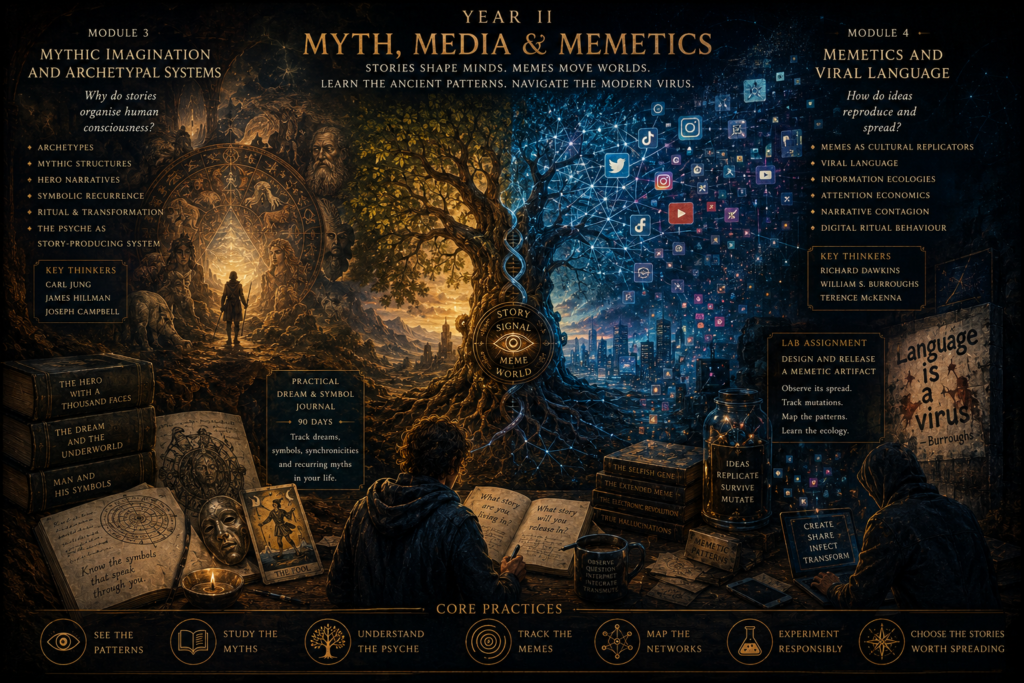
William Burroughs saw this long before the arrival of large language models. “Language is a virus from outer space,” he wrote, which sounded delightfully insane until language itself became programmable matter. Burroughs understood something many rationalists still resist: words do not simply communicate ideas. They colonise nervous systems. They propagate behaviours. They alter perceptual boundaries. A sentence can become a habitation. A metaphor can become a prison. A story can become an operating system.
Not merely writing words, but examining the ontological assumptions embedded inside them. What categories are being invoked? What forms of existence are being permitted? What relations are being normalised? What realities become thinkable once particular linguistic structures are installed?
This sounds abstract until one notices how much of ordinary life already operates this way.
Consider the phrase “personal brand.” Two words. Entire ontological reorganisation. A human being is subtly reconceived as a market-facing symbolic asset requiring optimisation, visibility management, and audience capture. Once the phrase enters culture, behaviours follow naturally. Identity reorganises itself around metrics. Experience becomes content inventory. Friendship becomes networking potential. Leisure becomes monetisable authenticity performance.
Ontology disguised as vocabulary.
Or consider the transformation produced by therapeutic language entering mainstream discourse. Suddenly, ordinary sadness becomes diagnosable pathology. Disagreement becomes toxicity. Attachment becomes a style category. Human experience is reorganised through linguistic classification systems. Entire emotional landscapes become newly visible while others disappear into shadow. The categories determine the perceptual field.
The text-based ontologist studies these transitions the way an ecologist studies invasive species.
But there is another layer now emerging beneath all this, stranger than anything Burroughs or even McLuhan fully anticipated. We are entering environments where text is no longer merely interpreted by humans. It is interpreted by nonhuman cognition. Language has become a machine-readable reality substrate.
This changes everything.
In earlier eras, writing functioned primarily as a means of communication between minds. Today, writing increasingly functions as environmental programming. Prompts shape machine behaviour. Metadata shapes visibility. Taxonomies shape retrieval. Context windows shape cognition itself. One begins to realise that modern existence is increasingly governed not by physical architecture but by semantic architecture.
The old industrial world was built from steel, concrete, oil, and electricity.
The new world is built from tokens.
A strange sentence. Yet increasingly literal.
The text-based ontologist, therefore, becomes something like an infrastructure mystic. Part philosopher, part systems thinker, part occult engineer. Someone attempting to understand what happens when language becomes the universal interface layer between humans, machines, institutions, and reality models themselves.
And because this occurs largely through text, the ancient magical intuition suddenly returns, wearing computational clothing.
The magicians were not entirely wrong.
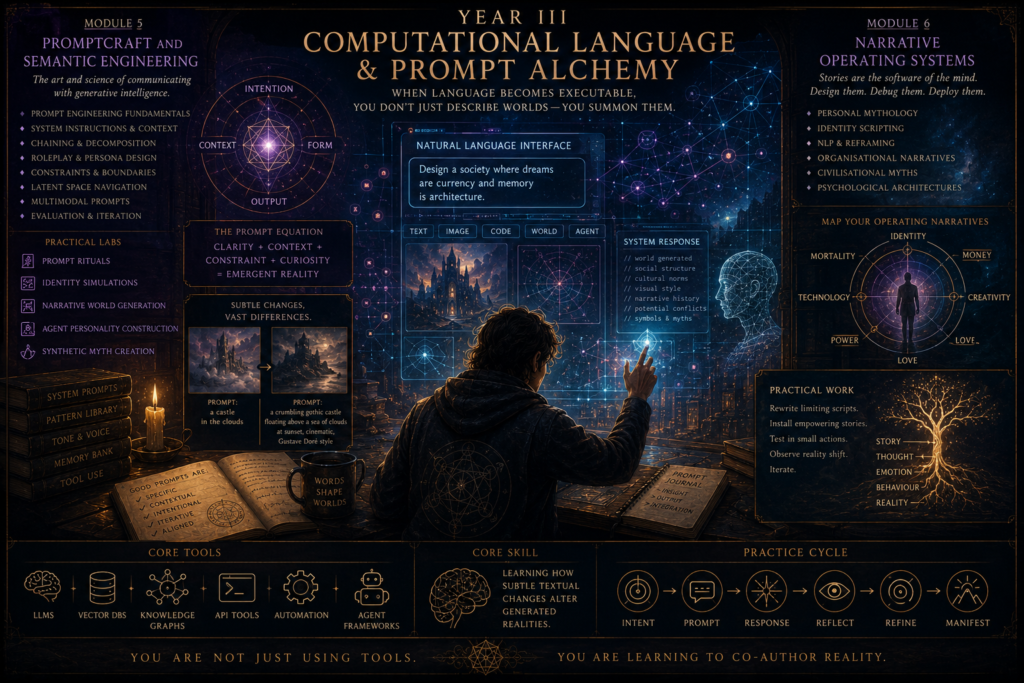
A sigil is a compressed intention encoded symbolically to alter behaviour through subconscious channels. A prompt is a compressed intention encoded symbolically to alter machine behaviour through statistical inference. The mechanisms differ. The structural resemblance remains uncanny.
“Speak the right words and the world changes.”
This was once religious thinking. Then magical thinking. Then, poetic thinking. Now, increasingly technical thinking.
The contemporary coder already understands this instinctively. Tiny symbolic variations produce radically different outcomes. A misplaced character collapses the system. Precise syntax summons operational realities from invisible infrastructure. The programmer sits before the glowing screen, uttering ritual language into abstraction layers they only partially comprehend, invoking processes hidden beneath visibility.
A medieval grimoire would not find this entirely unfamiliar.
Nor would Kafka.
Because the psychological consequence of existing inside text-mediated reality is profound. One begins to experience life itself as editable. Identities become revisable drafts. Narratives become modular. Selves become version-controlled symbolic constructs moving through overlapping systems of interpretation.
This is liberating right up until it becomes destabilising.
The postmodernists announced decades ago that reality was textually mediated, but they largely encountered this insight academically. We are encountering it operationally. The distinction matters. It is one thing to theorise that identity is socially constructed. It is another thing entirely to live inside systems where identity literally emerges through profile fields, prompts, feeds, databases, tags, recommendation systems, and algorithmic categorisation structures.
Ontology becomes user interface design.
And somewhere inside all this, the text-based ontologist wanders like a tunnel inspector beneath civilisation, examining the symbolic pipes through which reality flows.
The work quickly becomes archaeological.
One notices, for example, how many inherited concepts no longer map cleanly onto current conditions. “Author.” “Reader.” “Originality.” “Truth.” “Presence.” “Knowledge.” These words arrived from earlier epistemological environments. Print culture assumptions persist awkwardly inside networked cognition. We still speak as though humans produce discrete finished texts consumed passively by other humans, even as synthetic cognition dissolves the boundaries between writing, dialogue, simulation, remixing, and collaborative generation.
The categories lag behind reality.
This lag produces ontological turbulence.
A writer today increasingly resembles less a solitary creator and more a navigator moving through fields of symbolic probability. The role shifts from generating language ex nihilo toward shaping flows, curating resonance, constructing interpretive environments, training symbolic systems, and orchestrating meaning emergence across human and machine cognition simultaneously.
The solitary author dissolves into distributed cognition networks.
This alarms people attached to older models of authorship because the romantic image of the writer depends heavily upon scarcity. The lone genius confronting silence. But text generation is no longer scarce. Language itself has become abundant beyond precedent. We are entering a civilisation-scale surplus of words.
Which means the scarce resource shifts elsewhere.
Attention, perhaps.
Discernment.
Signal integrity.
Ontological coherence.
The text-based ontologist, therefore, becomes less concerned with producing more language and more concerned with maintaining meaningful structures inside symbolic excess. The role begins to resemble gardening more than manufacturing. Pruning. Arranging. Pattern recognition. Cultivating conceptual ecosystems where certain forms of thought become possible, and others wither.
This is why notebook culture has become so important for many contemporary thinkers. Obsidian vaults. Linked notes. Knowledge graphs. Constellational writing systems. These are not merely productivity tools. They are attempts to externalise cognition spatially inside textual environments.
The note becomes a semantic object connected relationally to other semantic objects.
Thought itself becomes navigable terrain.
Walter Benjamin would have understood immediately. So would Borges. So would the medieval mystics constructing memory palaces through symbolic architecture. The difference now is that the architecture has become interactive, recursive, searchable, and increasingly inhabited by machine cognition alongside human cognition.
The archive is no longer passive storage.
The archive thinks back.
Or appears to.
This introduces another strange psychological shift for the text-based ontologist: the growing impossibility of maintaining stable distinctions between internal and external cognition. Memory once resided primarily within the skull, supplemented by bookshelves. Now thought distributes itself fluidly across notes, feeds, databases, search engines, AI systems, voice memos, hyperlinks, and collaborative symbolic environments.
The self becomes partially exoskeletal.
One begins to think with tools rather than merely through them.
Marshall McLuhan insisted media function as extensions of nervous systems. We are now living inside the full implications of that statement. The smartphone is not merely a communication device. It is an auxiliary memory organ. Social platforms are distributed identity surfaces. AI systems increasingly function as conversational cognition mirrors reflecting symbolic associations back toward the user.
The consequences remain psychologically underexamined because the speed of transition exceeds our capacity for philosophical digestion.
Which is why the text-based ontologist matters.
Someone must descend into the tunnels and map the new symbolic infrastructure.
Someone must ask what kinds of humans emerge from environments where language itself becomes a programmable reality substrate.
Already the effects are visible.
Attention fragments into feed logic. Identity performs itself continuously under conditions of algorithmic visibility. Experience increasingly arrives preformatted for narration. The interior monologue itself starts adopting platform cadence. Human beings begin unconsciously optimising speech patterns for machinic legibility.
Even spirituality mutates under these conditions.
The ancient contemplative traditions generally aimed toward silence. Dissolution of conceptual fixation. Liberation from compulsive narration. But contemporary life pushes relentlessly in the opposite direction toward continuous textualisation. Everything becomes explainable, documentable, shareable, captionable, and promptable.
One suspects the mystics would diagnose this as a new form of possession.
And yet there is another possibility hidden inside the same technologies.
Because text-based ontology also allows unprecedented forms of self-authorship.
A person trapped inside inherited narratives can now encounter alternative symbolic frameworks at extraordinary speed. Someone raised within one reality tunnel can suddenly access thousands of competing ontologies. Philosophy, psychology, mythology, neuroscience, occultism, systems theory, poetry, machine cognition, contemplative traditions — all collapsing into the same searchable symbolic field.
This can produce confusion.
It can also produce liberation.
Robert Anton Wilson described reality tunnels as the perceptual structures through which humans organise experience. Most people inherit theirs unconsciously. The text-rich environment destabilises this inheritance mechanism by exposing individuals to radical ontological plurality. Suddenly, one sees that every worldview is at least partially constructed through language patterns, symbolic framing, and narrative reinforcement loops.
The tunnel walls become visible.
Once visible, editable.
The text-based ontologist, therefore, occupies a paradoxical role. Both cartographer and saboteur. Mapping symbolic systems while simultaneously revealing their contingency. Exposing how realities are constructed without collapsing into nihilistic relativism.
Because the danger here is obvious.
If all realities become merely textual constructions, meaning itself risks dissolution. The postmodern collapse into endless ironic distance. Infinite interpretation without commitment. Semantic drift without grounding. One eventually disappears into abstraction layers disconnected from embodied life.
The healthiest forms of text-based ontology, therefore, remain tethered to lived experience.
Nietzsche understood this deeply. His philosophy was never merely conceptual. It emerged physiologically. Walking, climate, digestion, solitude, music, illness, and altitude. Thought rooted in embodiment. The aphoristic form itself reflected this understanding. Ideas arriving through movement rather than systematic abstraction.
This matters enormously now because contemporary symbolic environments increasingly encourage disembodiment. Endless semantic manipulation detached from material consequence. The text-based ontologist risks becoming a ghost floating through conceptual architectures while forgetting sunlight, hunger, weather, mortality, and touch.
The antidote is rhythm.
Walks.
Conversations.
Silence.
The return to the body as an ontological anchor.
Otherwise, one eventually disappears into simulation recursion.
This perhaps explains the growing fascination many people feel toward practices like journaling, psychogeography, analogue note-taking, tarot, contemplative walking, and tactile rituals. These practices reintroduce friction into environments tending toward total abstraction. They restore symbolic engagement to embodied temporality.
A tarot card pulled physically from a deck feels different from infinite algorithmic feed generation because the ritual slows interpretation. Attention thickens. Meaning condenses around the encounter rather than the acceleration.
The same applies to walking through cities.
Psychogeography is ultimately a form of embodied ontology. The city read symbolically through movement. Infrastructure is becoming psyche. Architecture becoming narrative. The walker discovers that space itself carries ideological assumptions and emotional residue.
The text-based ontologist extends this impulse into digital environments.
What kinds of consciousness emerge from notification architectures? What metaphysics are implied by the infinite scroll? What ontological assumptions underpin platform identity systems? What forms of selfhood are encouraged by metrics-driven visibility economies?
These are no longer merely technological questions.
They are existential ones.
Because every medium secretly carries a philosophy of human nature embedded within its structure.
Industrial systems treated humans as mechanical labour units.
Broadcast media treated humans as audience aggregates.
Network platforms treat humans as engagement nodes.
AI environments increasingly treat humans as prompt-generating symbolic entities interacting recursively with machine cognition.
Each framework subtly reshapes self-understanding.
And perhaps this is the strangest realisation awaiting the text-based ontologist operating today:
We may ourselves be becoming textual entities.
Not literally, of course. Flesh remains stubbornly physical. Mortality remains gloriously analogue. But identity increasingly exists as editable symbolic continuity distributed across platforms, archives, messages, prompts, databases, photographs, behavioural traces, recommendation profiles, and conversational systems.
The self becomes partially written.
Partially searchable.
Partially generative.
A fluid symbolic construct is maintained collaboratively between human memory and machine systems.
This terrifies people seeking a stable essence.
Yet perhaps there was never stability to begin with.
Only stories repeated long enough to feel solid.
The text-based ontologist does not necessarily mourn this revelation. Nor celebrate it uncritically. The role is observational before ideological. Descending into the tunnels. Listening to the hum of symbolic infrastructure beneath contemporary life. Noticing where language hardens into invisible architecture. Noticing where new forms of freedom emerge inside the same systems that produce enclosure.
And perhaps most importantly, remembering that no ontology is neutral.
Every naming is an invitation. Every classification a boundary. Every metaphor a corridor. Every story a machine for generating possible worlds.
To work consciously with text in this era is therefore to work directly with the hidden architecture of reality-production itself.
Not because words are everything.
But because increasingly everything passes through words on its way to becoming real.
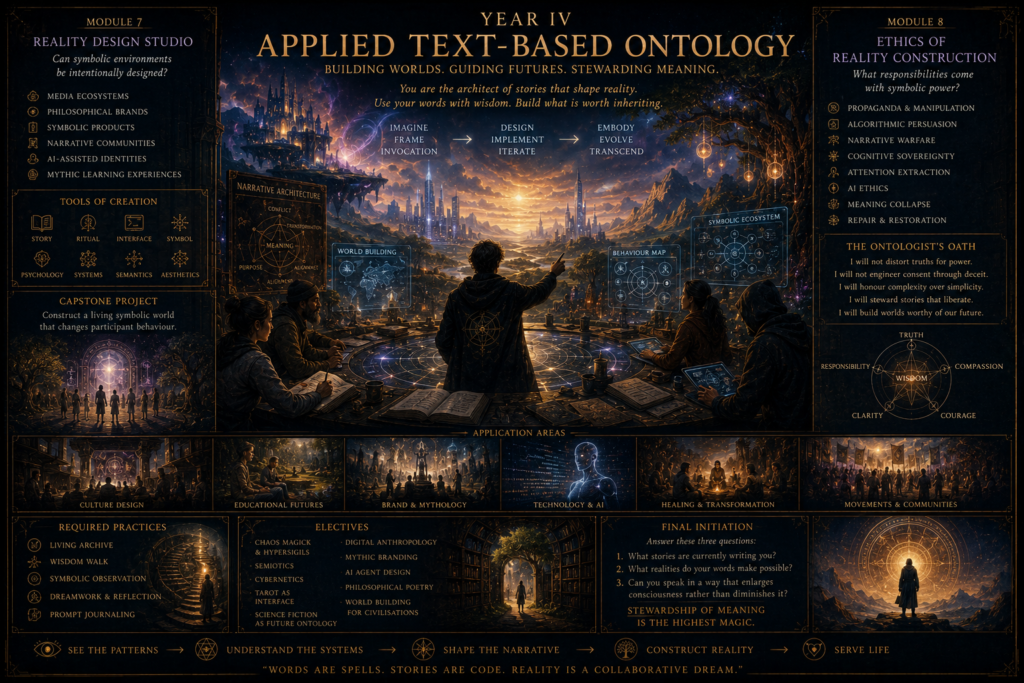
It sits somewhere between the philosophy department, occult library, media lab, hacker space, monastery, writer’s workshop, and signal intelligence unit.
The central premise:
Human beings inhabit realities structured by language. In computational culture, text has become executable. Therefore, whoever understands symbolic systems understands reality construction.
The goal of the text-based ontologist is not merely to analyse the world, but to perceive and shape the narrative architectures through which worlds emerge.
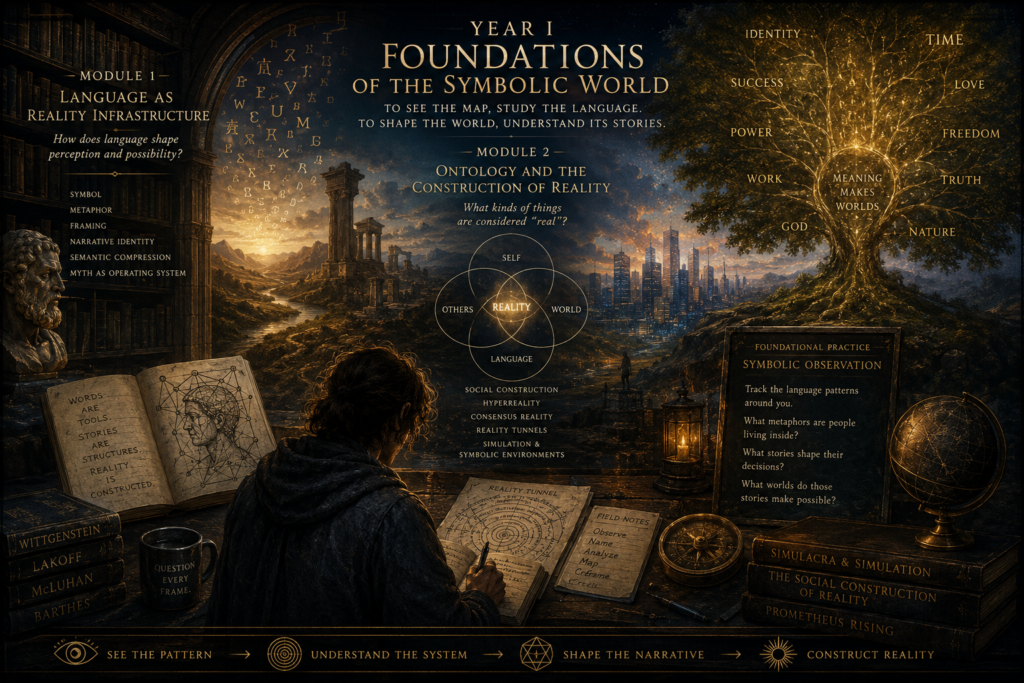
YEAR I — FOUNDATIONS OF THE SYMBOLIC WORLD
Module 1: Language as Reality Infrastructure
Core Question: How does language shape perception and possibility?
Topics:
Language as symbolic technology
Naming and categorisation
Metaphor as cognition
Narrative identity
Framing effects
Semantic compression
Myth as operating system
Key Thinkers:
Ludwig Wittgenstein
George Lakoff
Marshall McLuhan
Roland Barthes
Primary Texts:
Philosophical Investigations
Metaphors We Live By
Mythologies
Practical Exercise: Spend one week documenting every metaphor people use around work, time, identity, and success.
Module 2: Ontology and the Construction of Reality
Core Question: What kinds of things are considered “real”?
The myth of Jim Morrison is a myth of pure instinct. He arrives fully formed in the collective memory: shirtless, obliterated, magnificent, doomed. The leather trousers. The baiting of audiences in New Haven and Miami. The voice that seemed to come from somewhere older than rock and roll. The story we inherited insists that this was all eruption, all Dionysian overflow, a man too full of something dark and vital to contain it.
The story is wrong.
Morrison entered UCLA’s film school in 1964 as a serious student of ideas. He wrote poetry obsessively, in notebooks he carried everywhere, before he ever stood in front of a microphone. He read with appetite and intention across philosophy, anthropology, poetry, and mythology. When Ray Manzarek met him on Venice Beach, he didn’t encounter a wild thing. He encountered someone who had already done significant intellectual work on the question of what he wanted to become.
The esoteric content in Morrison’s life and work is routinely treated as atmosphere. The shamanism, the invocations, the obsession with death and threshold experience, the deliberate use of performance as a form of altered consciousness. These get folded into the legend as texture, as evidence of his romantic excess. They are evidence of a curriculum.
Morrison assembled, largely in his early twenties, a reading list with a coherent through-line. Nietzsche gave him the philosophical frame. The French Symbolists gave him the method. Huxley and Blake gave him the name for what he was trying to do and a theory of why it mattered. Eliade gave him the ritual structure. Frazer gave him the oldest warning, which he either didn’t read carefully enough or chose to ignore. The Beats showed him that this synthesis was survivable and could be made into American vernacular art.
This is a self-education in the deliberate construction and dissolution of self, in the use of transgression and altered states as tools for accessing something beyond ordinary perception, and in the performance of archetypal roles as genuine operative practice rather than theatrical gesture. Morrison wasn’t dressing up as a shaman. He was attempting, with considerable sophistication, to actually be one.
What kind of practitioner does this particular reading list produce? What are its strengths, what are its structural absences, and what happens to the person who follows it all the way to its logical conclusion?
Morrison built one of the most powerful opening rituals of the twentieth century. He just never got around to reading anything about how to close one.
The Nietzschean Foundation
Friedrich Nietzsche published The Birth of Tragedy in 1872 and spent the rest of his career partly embarrassed by it. He thought it overwrought, too Romantic, insufficiently rigorous. He was right on all three counts, and none of that matters. The Birth of Tragedy is one of those books that operates on the reader independently of its scholarly merit. It installs something. Morrison encountered it at UCLA, and it installed itself completely.
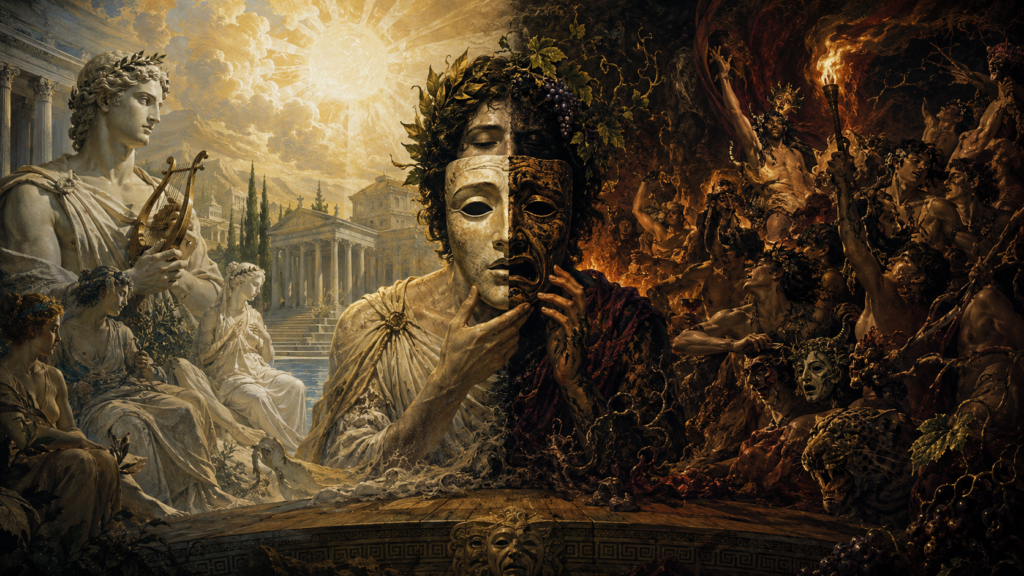
The argument Nietzsche makes is well known in outline and less often followed into its full implications. Greek tragedy was the product of a tension between two opposing drives embodied in two gods. Apollo: the principle of form, individuation, the beautiful surface, the dream. Dionysus: dissolution, intoxication, the merging of the self back into the primal unity from which individual consciousness is a temporary and somewhat painful exile. Great art holds both in productive tension. The Apollonian gives it shape. The Dionysian gives it the charge that makes the shape worth anything.
Most readers take this as aesthetics. Morrison took it as instruction.
He drew from Nietzsche a theory of vocation, not a theory of art. If the Dionysian principle is real, not merely metaphorical, then the artist who serves it is not making representations of dissolution and ecstasy. The artist is a vehicle for the actual thing. The performance is not about Dionysus. The performance is a Dionysian rite, and the audience is not watching one; they are participants in one, whether they understand this or not.
This is a significant leap from what Nietzsche wrote, and a coherent extension of the logic, and it explains something about Morrison’s relationship to his own performances that is otherwise difficult to account for. He wasn’t trying to entertain. He was trying to produce a specific state in a room full of people. The hostility, the provocation, the long silences, the spoken-word sections that confused audiences expecting rock and roll: these make no sense as an entertainment strategy. They make perfect sense as a ritual technique. You are not there to enjoy yourself. You are there to be broken open.
Nietzsche’s second major contribution to Morrison’s operating system is the reframing of power. The will to power, as Nietzsche actually meant it rather than as it was later vulgarised, is not a drive toward domination of others. It is a drive toward the fullest possible expression and expansion of the self, toward becoming what you most essentially are with the least possible compromise. Morrison translated this into a will to experience. Every limit was a door. Every prohibition was a map showing you exactly where to go. The logical destination of this position is total immersion, and total immersion, followed far enough, becomes indistinguishable from annihilation.
Nietzsche saw this danger. In The Birth of Tragedy, he describes the Dionysian initiate as someone who has glimpsed the abyss beneath the comfortable Apollonian surface of civilised life, who has looked directly at the truth that individual existence is a temporary fiction, and who needs art precisely because without it this knowledge would be unliveable. Art is the saving lie that lets the tragic hero go on. Apollo is not the enemy of Dionysus. Apollo is what keeps the Dionysian from destroying the vessel it moves through.
Morrison read all of this. And then he spent roughly eight years systematically dismantling every Apollonian structure in his life.
Whether this was a misreading or the most rigorous possible application is a question the essay will keep returning to. What is clear is that Nietzsche gave Morrison something most rock musicians of his generation didn’t have: a philosophical justification for what he was doing that was genuinely serious, and a vocabulary for the forces he believed he was working with. He wasn’t out of control. He had a theory.
The theory just didn’t include a chapter on what you do when the god decides to stay.
The French Symbolist Current
If Nietzsche gave Morrison the philosophy, the French Symbolists gave him the method. The method was not gentle.
Charles Baudelaire published Les Fleurs du Malin 1857 and was immediately prosecuted for it. The French government understood, correctly, that something more than offensive content was at stake. Baudelaire was proposing a theory of what poetry was for, and the theory was genuinely dangerous. Beauty, he argued, was not found in the elevated and the refined. It was extracted from transgression, from rot, from the city’s underworld, from boredom pushed far enough that it cracks open into something resembling the sublime. The poem was not a vessel for pre-existing feeling. It was an operation performed on consciousness, and the material it worked with was damage.
This is a long way from the Romantic tradition Baudelaire inherited, even though it looks superficially similar. The Romantics believed in inspiration, in the poet as receiver of something that arrived from outside. Baudelaire believed in technique. You constructed the conditions for the visionary state. You didn’t wait for it. The flâneur wandering the Paris arcades, deliberately absorbing the city’s shadows and contradictions, is not a passive observer. He is running a practice.
Morrison absorbed this and recognised something in it that matched his Nietzschean framework precisely. The will to experience, applied to aesthetics, produces Baudelaire. You go toward what repels the comfortable self because that is where the real material is.
Arthur Rimbaud took the argument further than Baudelaire probably intended and further than anyone had gone before in making it explicit. In 1871, at sixteen years old, he wrote two letters to friends that have become known collectively as the Lettres du voyant, the letters of the seer. The relevant passage is compact enough to summarise without much loss: the poet must make himself a seer by a long, immense and reasoned derangement of all the senses. Every form of love, suffering, and madness. He searches himself. He exhausts all poisons in himself and keeps only their quintessences.
The word that matters is reasoned. This is not an invitation to chaos. It is a programme. Rimbaud is describing a systematic technology for dissolving the ordinary perceptual filters that prevent access to deeper states of vision. The derangement is the method, not the point. The point is what becomes visible once the ordinary self is sufficiently disrupted.
Morrison read this as a practitioner reads a manual. The alcohol, the other substances, the deliberate provocation of crisis, the refusal of the comfortable and the stable: these are not simply self-destruction. They are, or they began as, Rimbaldian technique. The question of when the technique becomes indistinguishable from its supposed opposite is one the essay will return to.
What is frequently missed in accounts of both Baudelaire and Rimbaud is their position in a longer esoteric current. Baudelaire was deeply engaged with Swedenborg’s theory of correspondences, the idea that the material world is a system of symbols pointing toward spiritual realities, and this sits behind his most famous poem, Correspondances, in ways that are not merely decorative. Rimbaud’s colour-vowel synaesthesia in Voyelles is working the same territory from a different angle. They are occultists working in the medium of language, and the Symbolist movement they seeded was a significant channel through which esoteric ideas moved into European literary culture and eventually into the American tradition Morrison was growing up in.
The Symbolists are the missing link between German Romanticism and twentieth-century occultism, and Morrison’s absorption of this current means that when he picks up Eliade and Frazer later, he is not encountering alien ideas. He is finding the scholarly anthropological confirmation of a practice he had already theoretically committed to. The seer. The voyant. The one who goes to the edge of what the self can bear and looks over.
Rimbaud eventually stopped. He walked away from poetry entirely at twenty, fled to Africa, and spent the rest of his short life as a gun runner and coffee trader. He tried to close the door. Morrison, apparently, never seriously considered this option.
Huxley, Blake, and the Doors Themselves
The name of the band is a thesis statement.
Understanding what it claims requires going back through Aldous Huxley to William Blake, who is where the real weight lives.
Huxley published The Doors of Perceptionin 1954, an account of a single afternoon spent under mescaline in his Los Angeles home. The drug experience itself, though interesting, is not the book’s real contribution. What Huxley offers, drawing on the philosopher C.D. Broad and ultimately on Henri Bergson, is a structural argument about the nature of ordinary consciousness. The brain, he proposes, is not primarily a generator of experience. It is a reducing valve. Its function is to filter out the vast majority of what is actually available to perception, leaving only what is useful for biological survival and social functioning. What we call normal consciousness is an edited version of reality, and a heavily edited one at that.
The implications are considerable. If the reducing valve is the problem, then the goal of any serious practice, chemical or otherwise, is to force the valve open. Not to add something to experience but to remove what has been artificially subtracted. The doors of perception are not entrances to somewhere else. They are exits from the narrow corridor we mistake for the whole building.
Morrison encountered this and understood it immediately through his Nietzschean and Symbolist frameworks. Huxley was providing the neurophilosophical grounding for what Rimbaud had proposed as a poetic programme. The derangement of the senses is a valve-forcing operation. The Dionysian rite opens what the Apollonian surface keeps closed. Different vocabularies, identical claim.
But Huxley took his title from Blake, and Blake is the deeper source, and Blake is not making the same argument as Huxley, though he is making a compatible one.
The full passage from The Marriage of Heaven and Hellreads: if the doors of perception were cleansed, everything would appear to man as it is, infinite. For man has closed himself up, till he sees all things through narrow chinks of his cavern. Blake is not describing a pharmacological problem with a pharmacological solution. He is describing a spiritual condition, the fallen state in which humanity has contracted into the isolated ego and lost access to the infinite reality that surrounds and interpenetrates it. The cleansing he is calling for is ontological, not chemical. A transformation of what the self fundamentally is, not an alteration of its momentary state.
Urizen, the god of reason and law
Blake was also, and this gets lost in the Huxley citation, a practitioner working within a seriously developed esoteric system of his own construction. The prophetic books, with their complex mythology of Zoas and emanations and eternal forms, constitute one of the most ambitious attempts in English literature to build a complete alternative cosmology. Urizen, the god of reason and law, has usurped the place of the infinite. Los, the spirit of imagination and time, who labours to keep the human form divine alive against Urizen’s contraction. The fallen world is the product of a catastrophic narrowing of perception. The redemption of that world through imaginative vision.
Morrison was dipping into this system without following it all the way into the prophetic books, but enough to understand that Blake was not a Romantic nature poet who had taken something interesting one afternoon. He was a magician who had constructed a working mythology and spent his life operating within it.
The name of the band carries all of this. A commitment to the Blakean diagnosis: that ordinary consciousness is a fallen, contracted, self-imprisoned condition. And to the Huxleyan method, the systematic forcing of whatever doors can be forced. It is also a commitment to Blake’s understanding of what the doors open onto. Not pleasure. Not freedom in any casual sense. The infinite.
Which is not, in Blake’s system, a comfortable destination.
Mircea Eliade and the Shamanic Frame
Mircea Eliade’s Shamanism: Archaic Techniques of Ecstasy was published in English in 1964, the same year Morrison arrived at UCLA. Dense with comparative religious scholarship, surveying shamanic practice across Central Asia, the Americas, Australia, and beyond. Not, on the face of it, a book a twenty-year-old film student picks up for pleasure. Morrison read it anyway, and by most accounts kept it close. Once you have read the previous sources in his syllabus, the reason is obvious. Eliade was doing for shamanism what Frazer had done for the dying god: revealing the pattern beneath the cultural variation, demonstrating that something consistent was happening across radically different traditions, something structural enough to suggest it was tracking a real feature of human experience rather than a local religious habit.
Eliade’s definition of the shaman is precise and worth holding carefully. The shaman is specifically the one who can deliberately enter altered states of consciousness, travel between the ordinary world and the spirit world, and return with knowledge or power that benefits the community. The keyword is return. The shaman’s authority derives not from the ability to descend but from the ability to descend and come back. Anyone can fall. The shaman is the one who falls with intention and climbs back out with something to show for it.
The initiatory experience Eliade documents across cultures follows a consistent grammar. The shaman-to-be undergoes a crisis, often involuntary, in which the ordinary self is dismembered, dissolved, or destroyed at the spirit level. The bones are picked clean. The organs are replaced. A new self is reassembled from the ruins of the old one, and this new self has capabilities the original did not. The dismemberment is not incidental to the initiation. It is the initiation. You cannot become a shaman by studying shamanism. You have to be taken apart.
Morrison read this, and the recognition must have been immediate and visceral. The Nietzschean dismemberment of the Apollonian self. The Rimbaldian derangement that breaks down the ordinary perceptual apparatus. The Blakean dissolution of the reduced ego back into the infinite. These were all, Eliade was now telling him, local versions of a universal initiatory grammar. Morrison was not inventing something. He was rediscovering something very old, and Eliade’s scholarship gave him the anthropological confidence that the rediscovery was real.
A theory of performance as ritual space follows directly from this. If the shaman’s function is to alter the consciousness of a community, to temporarily dissolve the boundaries between the ordinary world and whatever lies beneath or beyond it, then the concert hall is a perfectly legitimate ritual venue. The volume and the rhythm do what the drum does in Siberian shamanic practice. The darkness and the crowd’s compression do what the cave does. The figure on the stage who is visibly operating at the edge of ordinary self-possession models for the audience how far the dissolution can go, and the audience, following that model, goes further than it would alone.
Morrison’s performances could not simply be entertainment. Entertainment keeps the audience comfortable and returns them to themselves at the end. What Morrison was attempting, consciously and with theoretical grounding, was to temporarily unmake the audience’s ordinary selfhood and expose them to something that selfhood normally keeps out. Whether the collective altered state he was reaching for was genuinely shamanic or a sophisticated simulacrum of it is a question that cannot be answered cleanly. The intention is clear.
What Eliade also documents, with the careful neutrality of the scholar who has seen enough to know that outcomes vary, is the shaman who does not complete the return. The initiatory crisis becomes a permanent condition. The dismemberment produces not a new and more powerful self but simple fragmentation. The difference between the shaman and the person who merely goes mad is, in Eliade’s framing, largely a question of whether the descent is controlled and whether the return is completed.
Morrison controlled the descent, at least initially, with considerable skill.
The return is where the record becomes complicated.
Frazer and the Dying God
James George Frazer published the first edition of The Golden Bough in 1890, and it rewired the Western imagination’s relationship to myth and ritual. By the time Morrison encountered it, the book had expanded to twelve volumes and contracted again into a single-volume abridgement, and it had already shaped T.S. Eliot’s The Waste Land, which means it had already passed through one major artistic nervous system before arriving in Morrison’s. What it contains, at its argumentative core, is a pattern so ancient and so widespread that Frazer concluded it must be tracking something structural in human religious life rather than reflecting historical contact between cultures.
The pattern is this: the sacred king must die.
In the ancient world, Frazer argues, the king was not merely a political figure. He was the embodiment of the community’s vitality, the living vessel of the god, the conduit between the human world and the forces that made crops grow and seasons turn. His health was the community’s health. And when his health declined, or when a fixed term of sacred kingship expired, he was killed, ritually and deliberately, so that the divine power he carried could be released back into the community before it became too degraded to serve its function. The god dies so the tribe lives. The vessel is broken, so the contents can be poured out.
Frazer traced this pattern across dozens of cultures: Osiris, Adonis, Attis, Dionysus himself, and eventually, in the book’s most provocative implication, the figure at the centre of Christianity. The dying and rising god is not an anomaly. It is the dominant pattern of sacred kingship across recorded history.
Morrison read this, and something in him recognised it as autobiography.
His obsession with his own death is too consistent and too structured to be dismissed as morbidity or rock star theatre. It runs through the poetry from the beginning, before the fame, before the leather trousers. Death as threshold, death as transformation, death as the logical completion of a life lived at the edge of what the self can contain. He told multiple people across multiple years that he did not expect to live past thirty. He was twenty-seven when he died in Paris.
The evidence suggests he understood the Frazerian trap embedded in the role he had chosen, which makes it more disturbing rather than less. The sacred king who knows he is the sacred king, who has read Frazer and understood the structural logic of his own position, and who continues anyway: this is not naivety. It is either the deepest possible commitment to the role, or a failure of self-preservation so profound it requires a different explanation than simple excess.
There is a passage in The Golden Bough that Frazer treats as an anthropological curiosity. In some traditions, the sacred king was not killed against his will. He was expected to understand his function and accept it, even to cooperate with it, because the willing death of the god was more powerful than the unwilling one. The king who fought his fate diminished the working. The king who went toward it deliberately, who understood that the dissolution of the individual vessel was the point, that the community needed him to die more than it needed him to live, was fulfilling the role at its highest pitch.
Morrison spent the last years of his life in Paris, trying to become a poet rather than a rock star, trying to step out of the sacred king role he had occupied for the Doors’ audience. He grew a beard, gained weight, and drank more than ever. Whether this was an attempt to escape the archetype or to accelerate toward its conclusion probably has no clean answer.
Frazer, unlike Nietzsche and Rimbaud, provided no method. He provided a warning dressed as scholarship. The dying god pattern is presented in The Golden Bough as something humanity eventually grew out of, a primitive mechanism superseded by more sophisticated religious forms. What Frazer did not account for is the possibility that someone might read the book not as history but as a script, and decide, with full knowledge of what the script required, to play the role all the way to the final scene.
The Beat Transmission
Every tradition needs a living transmission, a moment when the ideas stop being words on a page and become something demonstrated in a human life. Morrison had the European sources: the Germans and the French, the Romantics and the Symbolists, the British visionary in his printing shop producing illuminated books nobody read while he lived. What the Beats gave him was proof of concept on American soil, in American idiom, within living memory.
Allen Ginsberg, Jack Kerouac, Gregory Corso, William Burroughs. The generation that came of age in the late 1940s and broke surface in the mid-1950s had already done the synthesis Morrison was attempting. They had taken the Symbolist programme and run it through jazz, Buddhism, and the American road. They had taken the Blakean vision and made it speak in the vernacular of diners and freight trains and shared apartments. They demonstrated, at considerable personal cost, that the esoteric tradition was not the exclusive property of European intellectuals or English eccentrics. It could be lived, loudly and publicly, in San Francisco, New York and Mexico City.
Ginsberg is the most directly relevant figure and the most explicitly esoteric of the group. His account of his Blake vision in 1948, lying in his Harlem apartment, hearing what he took to be Blake’s actual voice reading Ah, Sunflower and The Sick Rose while a sense of cosmic vastness opened in the room around him: this is not a metaphor. Ginsberg treated it as a real event with real consequences for the rest of his life, an initiatory opening that he spent decades trying to recover and stabilise through Tibetan Buddhist practice, through chanting, through the deliberate cultivation of visionary states by various means. He was a practitioner, not merely a poet with interesting influences. And he was, by the time Morrison arrived at UCLA, a living public figure whose work was in circulation and whose example demonstrated that the Rimbaldian programme could be taken seriously in an American context without destroying the practitioner. At least not quickly.
Kerouac offers a different angle on the same territory. His mysticism is more Catholic than occult, more Franciscan than Blakean, rooted in a sense of the sacred as immanent in ordinary American experience, in the faces of the poor and the beauty of the continent’s sheer physical scale. The road in On the Roadis not simply a geographical fact. It is an initiation structure. You leave the known world, you move through disorientation and encounter an extremity, you are changed by what you meet, and you return. Or you don’t, and that also tells you something. Dean Moriarty burning across the country is a figure of Dionysian excess, but in the book’s deeper grammar, he is a kind of sacred fool, a holy madman whose velocity is itself a form of searching.
Morrison absorbed both currents. The Ginsberg influence shows in the poetry’s explicit visionary ambition, its willingness to make large claims about consciousness and reality without embarrassment. The Kerouac influence shows in the romanticism of motion and excess, the sense that American geography is spiritually charged, that the road and the night and the continent’s vast indifference are initiatory forces in their own right.
What the Beats provided, beyond the specific influences, was permission. They showed that this synthesis was possible, that you could be a serious esoteric practitioner and an American artist simultaneously, that the tradition required neither European exile nor academic respectability. They also showed, with varying degrees of visibility, what the costs were. Burroughs killed his wife in a drunken game in Mexico City and spent the rest of his life writing around the wound. Cassady, the original Dean Moriarty, died on a Mexican railway track at forty-two, reportedly counting railroad ties in a stupor. The Beats largely survived, but not all of them, and not without damage that would have been recognisable to anyone who had read Eliade carefully.
Morrison was twenty-two when the Doors formed. He had read the Beats alongside Nietzsche and Rimbaud and Huxley and Eliade and Frazer, and what he had assembled from all of it was a complete theory of what he was going to do and why it mattered.
The only chapter he hadn’t written was the one about what happened next.
What the Syllabus Produces
A reading list is a technology. It doesn’t simply inform the reader. It shapes the reader’s perceptual apparatus, installs frameworks that operate semi-autonomously, and builds the conceptual architecture within which all subsequent experience is sorted and interpreted. Morrison’s syllabus, assembled with the appetite and urgency of someone who felt he didn’t have much time, produced a very particular kind of mind operating within a very particular set of assumptions about what reality was, what art was for, and what the self was supposed to do with its brief tenure in a body.
The first thing the syllabus produces is a practitioner who understands transgression as epistemology. Across every source, the same claim repeats in different vocabularies: ordinary consciousness is a diminished state, the socially conditioned self is a reducing mechanism rather than a full receiver, and the way through the reduction is deliberate rupture. Nietzsche’s Dionysian immersion, Rimbaud’s systematic derangement, Huxley’s forced valve-opening, the shamanic descent, the dying god’s willing dissolution. These are all variants of the same operational thesis. You cannot think your way to the other side of the door. You have to break something to get through.
This produces, in practice, someone with an extremely sophisticated theoretical framework for why destruction is necessary and a correspondingly underdeveloped framework for what comes after.
The second thing the syllabus produces is a practitioner who works with audiences as ritual participants rather than consumers. This follows directly from the Eliadian and Frazerian material, cross-referenced with the Nietzschean theory of tragedy. The rock concert, properly conducted, is not entertainment. It is a collective altered state, the audience’s ordinary boundaries of self temporarily dissolved by volume, darkness, rhythm, and the behaviour of the figure on the stage who is modelling, in real time, how far dissolution can go. Morrison understood this with a clarity most of his contemporaries didn’t approach. The performance was working. The crowd was the coven. The hostility and provocation that confused audiences expecting rock and roll were a ritual technique, disrupting the comfortable spectator relationship and forcing something more demanding.
The third thing the syllabus produces is a practitioner with an unusually developed relationship to death as a symbolic and potentially literal horizon. Nietzsche’s tragic hero, Rimbaud’s voyant who exhausts all poisons in himself, the sacred king who knows his function, the shaman who submits to dismemberment: every significant figure in Morrison’s intellectual inheritance has a structured relationship to their own annihilation. Death in this framework is not the opposite of meaning. It is the place where meaning concentrates most intensely. The self that has been pushed to its absolute limit and breaks there has accomplished something that the self which remains comfortable and intact cannot.
Applied to a living human being rather than an archetypal figure, this is extremely dangerous. The syllabus contains almost nothing to counteract it.
The fourth thing the syllabus produces, and this is the structural flaw that runs through the entire curriculum, is a practitioner with no serious theory of integration, return, or maintenance. Nietzsche broke down in Turin in 1889 and never recovered. Rimbaud stopped writing at twenty and fled. The sacred king dies; the texts do not linger on whoever has to clean up afterwards. Eliade documents shamanic failure alongside shamanic success, but Morrison was reading Eliade for the descent, not the chapter on what distinguishes the shaman who comes back from the one who doesn’t. The Beats largely made it through, but the ones who didn’t, Neal Cassady dead on a railway track in Mexico, the long, slow wreckage of certain others, don’t feature prominently in the version of the tradition Morrison absorbed.
The syllabus produces someone exquisitely equipped to open and almost entirely unequipped to close. Every source adds sophistication to the opening move and silence to the question of what follows it. This is not accidental. The curriculum has a shape, and the shape is a door with a hinge on one side only.
Morrison walked through it in Paris in July 1971, aged twenty-seven, and the door, as doors with one-sided hinges tend to do, did not swing back.
The Unfinished Initiation
Every serious esoteric tradition contains, somewhere in its structure, a theory of return. The shaman descends and comes back. The initiate enters the chamber of death and emerges transformed but alive. Even the dying god, in most of the traditions Frazer surveyed, rises. The point of going all the way down is that going all the way down is not the end. It is the condition of possibility for something that cannot be reached any other way. The descent is the method. The return is the work.
Morrison’s syllabus has no return chapter.
This is not a claim that Morrison was simply self-destructive, or that the intellectual framework he assembled was a sophisticated justification for what would have happened anyway. The reading list is genuine, the thinking is serious, and the synthesis he made from these sources is more coherent and more purposeful than the myth of pure Dionysian overflow allows. He was not stumbling. He was following a map.
The map was incomplete.
In the language of magical practice, Morrison was a superb invoker and a poor banisher. Invocation is the art of opening, of calling something through, of making the self a vessel for a force larger than the ordinary ego can contain. Banishing is the art of closing, of returning the working space to neutral, of ensuring that what was called through does not simply take up residence permanently in the vessel it used. These are complementary skills, and every serious tradition treats them as equally necessary. You do not learn one without the other, because the one without the other is not initiation. It is possession.
Morrison invoked with extraordinary power and almost total consistency. Every element of his practice, assembled from the sources this essay has traced, was directed toward opening: the performances, the substances, the deliberate dissolution of personal and social boundaries, the identification with archetypal figures whose defining characteristic was their willingness to be destroyed. He built, over the course of the Doors’ career, what may be the most sophisticated opening ritual in the history of popular music. The question of whether he ever seriously attempted to close it is answered, with some finality, by the bathtub in Paris.
What the syllabus teaches, read with the gap visible, is not a cautionary tale. Cautionary tales ask you to look at the wreckage and resolve to be more careful. What Morrison’s reading list offers, once you see its shape whole, is a map with one section missing. A missing section is more informative than no map at all, because it tells you exactly where the work remains to be done.
The tradition Morrison assembled from Nietzsche, the Symbolists, Huxley, Blake, Eliade, Frazer, and the Beats is a tradition of aperture. Its great achievement is the systematic dismantling of the reduced, socially conditioned, valve-narrowed self that mistakes the corridor for the building. Morrison did this at a scale and intensity that most practitioners in any tradition never approach. The corpus he left, the recordings, the poetry and the strange, persistent force of his presence in the culture fifty years on, is evidence that the opening produced something real.
But the self that is opened must also be rebuilt, or what pours through has nowhere to live. The shaman who does not return is not more enlightened than the one who does. He is simply gone. The initiation that ends in the underworld is not a deeper initiation. It is an unfinished one.
Morrison knew the texts. He knew the pattern. The most well-read rock musician of his generation, the one who had done the most serious intellectual work on exactly this question, followed the syllabus so faithfully that he reproduced its omission as well as its insights.
The door he named the band after opens in both directions. He only ever walked through it one way.
Jim Morrison’s Reading List
What Morrison read, where to start, and what fills the gaps the essay left open.
The Nietzsche Thread
Start with The Birth of Tragedy (1872). It is not Nietzsche’s most rigorous work, which is exactly why it works on readers the way it does. The Apollo/Dionysus framework arrives fully formed and installs itself. Read it in the Walter Kaufmann translation, which is the standard English edition and includes Nietzsche’s own retrospective preface, “An Attempt at Self-Criticism,” in which he spends several pages being embarrassed about the book he wrote at twenty-seven. The embarrassment is part of the text.
For readers who want to follow the Nietzsche thread further, Thus Spoke Zarathustra and Beyond Good and Evilare the natural next stops. The will to power as vocation rather than domination is worked out more carefully in the latter. But The Birth of Tragedy is the one that did the work on Morrison, and it is the right place to begin.
The French Symbolist Thread
The Flowers of Evil (Les Fleurs du Mal, 1857) by Charles Baudelaire. Richard Howard’s translation is the one most readers find captures the original’s mixture of formal rigour and controlled excess. The key poem for understanding Morrison’s relationship to the tradition is “Correspondances,” which lays out Swedenborg’s theory of symbolic correspondence in fourteen lines and explains why the Symbolist project was always also an esoteric one.
For Rimbaud, go straight to the Complete Worksin Wallace Fowlie’s translation, later revised by Seth Whidden. It includes A Season in Hell (Une Saison en Enfer), Illuminations, and the two letters collectively known as the Lettres du voyant. The seer letters are short enough to read in twenty minutes and dense enough to spend a year with. The phrase “reasoned derangement of all the senses” is in there. So is everything that phrase implies.
The Huxley and Blake Thread
The Doors of Perception(1954) by Aldous Huxley, ideally in the edition that includes its companion essay Heaven and Hell, published the following year. The Doors of Perception makes the argument about the reducing valve and reads quickly. Heaven and Hell extends it into art history and visionary experience across traditions, and is the better of the two for understanding the full framework.
For Blake, the easiest entry is the Penguin Selected Poems, which includes Songs of Innocence and Experience and substantial selections from The Marriage of Heaven and Hell. Readers who want to go deeper into the prophetic mythology will need the full Complete Poetry and Prose (edited by David Erdman), but that is a significant commitment and not necessary to understand what Morrison was drawing on. The Marriage of Heaven and Hell is the essential text. It is also the strangest thing Blake wrote, which is saying something.
The Anthropological Thread
Shamanism: Archaic Techniques of Ecstasy (1951, English translation 1964) by Mircea Eliade. Dense and rewarding, surveying shamanic practice across Central Asia, the Americas, and beyond. The section that matters most for understanding Morrison is the material on initiatory dismemberment and on the difference between the shaman who completes the return and the one who doesn’t. Eliade is precise about this distinction in ways that Morrison apparently chose not to linger on.
The Golden Bough (1890, single-volume abridged edition 1922) by James George Frazer. Read the abridgement. The twelve-volume original is for specialists. The abridgement is still long, and readers who want the core argument can find it concentrated in the early chapters on the sacred king and in the material on Adonis, Attis, and Osiris. The chapter on the voluntary death of the sacred king is the one that reads, with Morrison in mind, like a document written specifically for him.
The essay does not discuss Antonin Artaud, but any honest account of Morrison’s performance theory has to. The Theater and Its Double (1938, English translation 1958) is the missing text. Artaud’s Theatre of Cruelty argued that theatre should function as plague, as an epidemic, as a force that breaks down the audience’s psychological defences and exposes them to something that ordinary social existence keeps sealed off. Morrison’s concerts were Artaud concerts. The hostility, the refusal of entertainment, the deliberate provocation of discomfort: these come from Artaud as much as from Eliade. That Artaud himself ended his life in a psychiatric institution after years of suffering should probably be read alongside the rest of the syllabus.
Life Against Death (1959) by Norman O. Brown is the other significant gap. Brown’s argument, drawing on Freud and Marx and Nietzsche, is that civilisation is essentially a massive defence mechanism against the awareness of death, and that authentic human existence requires confronting rather than repressing mortality. Morrison absorbed this, and it showed. It is also, read carefully, a book with no chapter on what happens after the confrontation.
The Beat Thread
Howl and Other Poems(1956) by Allen Ginsberg. The title poem is the entry point to understanding what the Beats did to Blake and what Morrison understood that to mean. Ginsberg’s 1948 Blake vision, which shaped everything that followed, is described in interviews and in his journals. The Paris Review interview from 1966 is the most detailed account he ever gave.
On the Road (1957) by Jack Kerouac. Read in the original scroll edition if possible (published 2007), which has a different energy from the edited novel: rawer, faster, closer to the Rimbaldian impulse it was drawing on without quite knowing it.
Naked Lunch(1959) by William Burroughs. The least easy of the three and in some ways the most honest about where the tradition leads. Burroughs survived to ninety-three partly because he was a different type of practitioner than Morrison: more detached, more interested in the technique than in becoming the working.
Morrison’s Own Writing
Two collections were published in his lifetime: The Lords and the New Creatures(1969) and the recorded poem An American Prayer (1970, posthumously released 1978 with Doors music). Both are uneven in the way that serious poetry often is, and both contain lines that stop the reading cold.
Yesterday felt like wading through wet sand. Every idea that surfaced dissolved before it could be shaped into anything. Underneath that is the voice that says, ‘If I can’t produce today, what does that mean for tomorrow, for the whole enterprise?’ It got louder as the afternoon wore on. I know that voice. It is not telling the truth. Knowing that doesn’t silence it.
This morning I pulled three cards. Sat with them at the desk before anything else happened, before coffee or email or the reflex to check what the world is doing. Let them sit.
Not one of them is set in daylight.
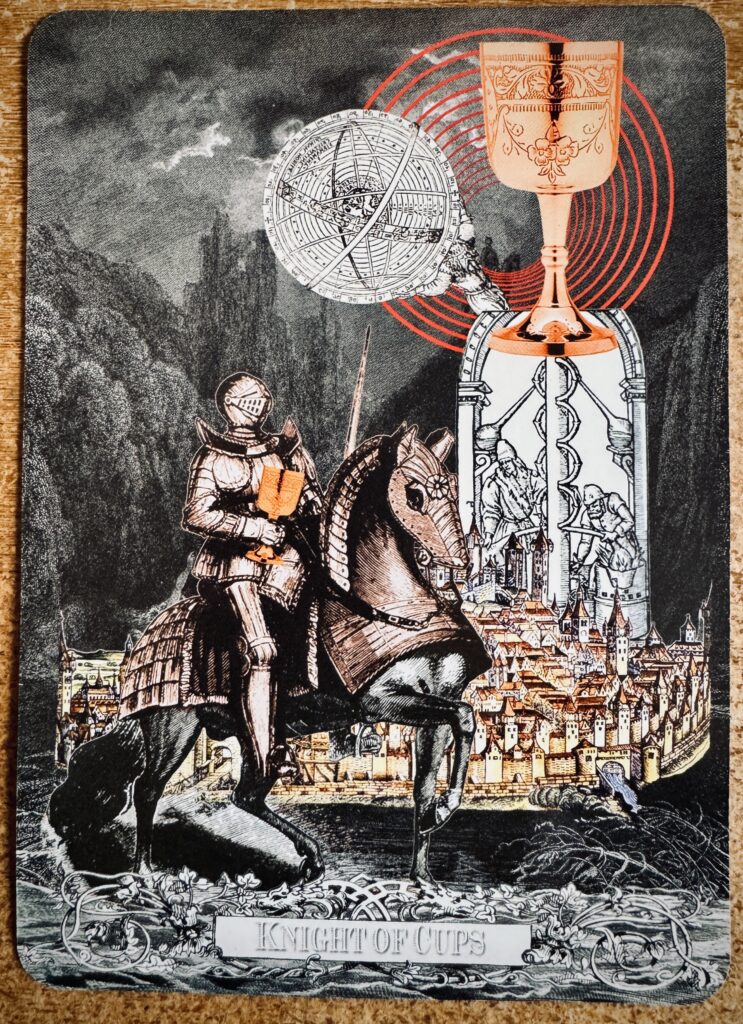
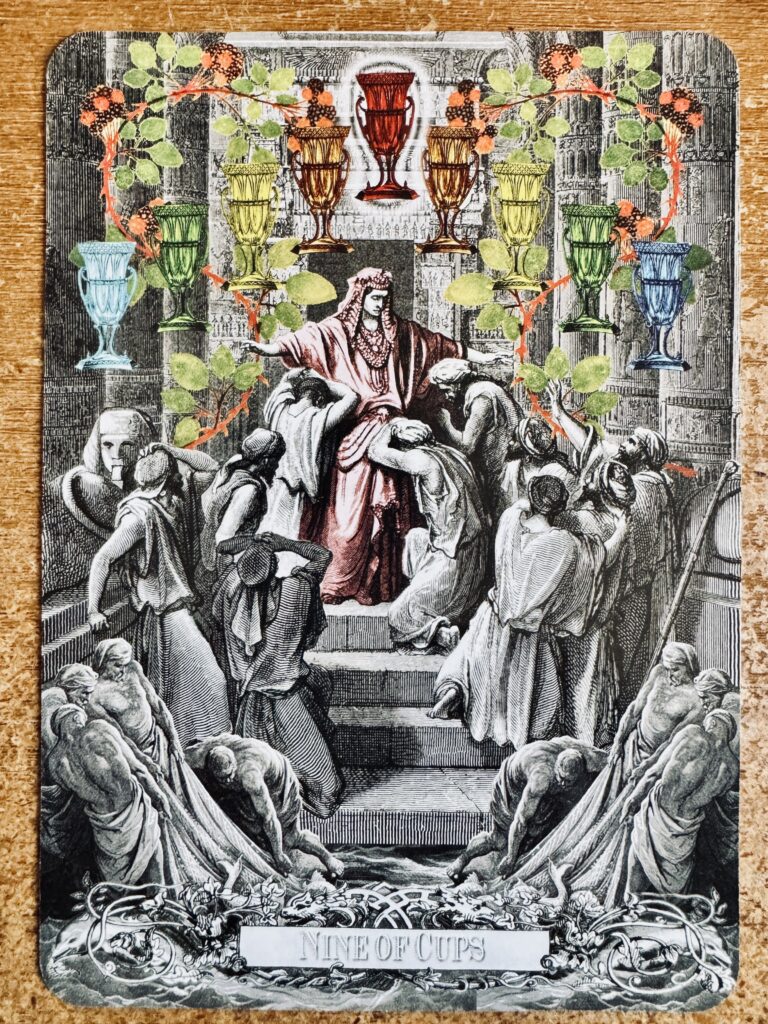
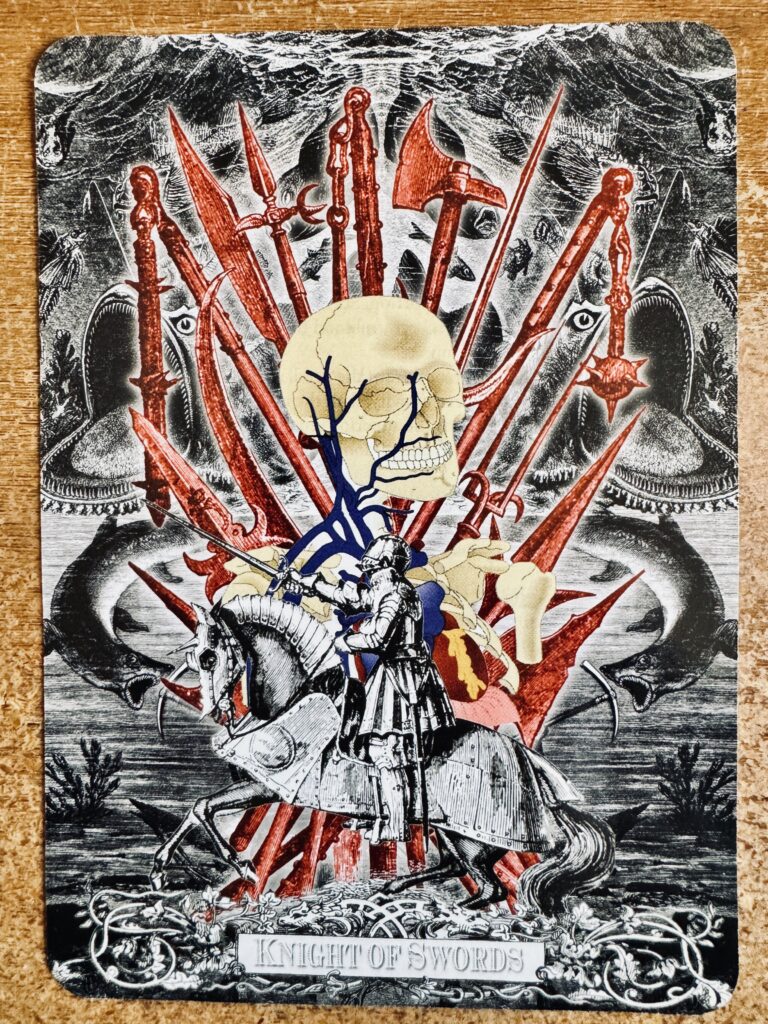
The Knight of Cups approaches at night, the city ahead glowing with its own inner light. The Nine of Cups traveller sits enthroned in a temple space removed from ordinary time. The Knight of Swords charges through a scene that Taussig makes completely explicit: underwater. In the psychic darkness of the unconscious, with monsters converging from every direction and a pale skull floating above like a moon that forgot to rise.
This is a spread with no interest in the surface world. Whatever it is pointing at, it happens in the deep.
The Knight of Cups arrives first, which matters because of what he is carrying. The chalice has a dark streak. It may be cracked. It cannot yet fully hold its contents. He approaches with the vision and the calling but with a damaged container, and the card poses its question immediately: how does the chalice get repaired?
The answer is through the city ahead and not by fighting through it.
The chalice gets repaired by entering the city, stabling the horse, setting down the weapons, removing the armour, and confronting the ogre inside without any of it. The ogre must be befriended and integrated. The union of the ego with the negative aspects of the personality is what repairs the vessel, what allows it to hold the golden energy the Work generates.
The city is hidden between craggy cliffs, glowing with its own inner light at night. Inside, two gates. The unconscious flows in through the iron grate whether the knight invited it or not, coming in without asking. Consciousness enters through the open bridge. Both are present inside the city, and both must be dealt with. There is no passage where only one of them comes through. The moon above strengthens the process, working with what is already there rather than overwhelming it with external light. The celestial feminine as an amplifier, not a source.
Yesterday was the city without armour.
The fallow day, the spinning wheels, and the pressure rising from below: all of that was the ogre in the city. The form it took was the question about production, about whether the inability to generate output was evidence of some deeper structural failure. The ogre always wears a practical disguise. It arrives as a legitimate concern about time or relevance or money and only reveals its real face once you are inside the city gates with it.
The response this morning wasn’t to fight it down or armour back up against it. Something quieter. Knowing what to do when you don’t know what to do. Turning toward the practice rather than away from it: the writing, the cards, the walking. The body holds knowledge that precedes the doubt. Twenty-five years of interior work leaves a residue, a cellular memory of how to return to the centre when the mind is spinning. That is the psychic work that repairs the chalice.
The city generates its own illumination. It always did. Entering at night is what it takes to see it.
The Nine of Cups sits at the centre of the spread wearing red.
Rubedo. The Great Work is in its final stages of completion. The traveller who has moved through all four elements and ascended the four steps holds the Philosopher’s Stone within reach. The chalice at this stage has been repaired by the interior work. The golden energy can be held and dispensed freely. The traveller is generous and kind and genuinely empathetic because the road has made them so.
The four steps to the throne matter enormously. Earth, water, air, fire. Jung’s four functions. You don’t arrive at that seat by bypassing any of them. The water step is the psychic dissolution, the monsters of the deep. The throne is only accessible because the traveller went through the water, not around it.
The figure is androgynous, which is worth sitting with. It has integrated enough that it can’t be pinned to one side of any binary. Psychic wholeness in this deck looks like a movement into something that holds all of it, rather than a resolution where one part wins. Androgyny isn’t a detail about gender. It is a statement about what the Work produces: something that can no longer be halved by the question.
But the centre card carries a warning as pointed as any sword.
Adulation is dangerous. The people around the throne are a trap as much as they are a sign of the traveller’s bounty. The life of blessing others is genuinely fulfilling and genuinely good and genuinely insufficient because it requires abandoning one’s own journey. Because the adulation becomes habit-forming. Because ego inflation stops spiritual growth in its tracks. The traveller faces a terrible choice: continue the life of public good or go deeper into internal psychic wholeness, which could bring the world an even greater good.
This is the performing versus doing tension I named in the Rosebud session this morning, stated in alchemical terms. The pull toward visibility, the freelancer’s anxiety about which platform carries which audience, and the question of what to post and when and for whom: all of that is the adulation trap wearing practical clothing. The social media performance anxiety and the “If I can’t produce, what chance do I have?” are the same voice, one dressed as ambition and one dressed as fear. Both of them are the sound of the traveller’s attention drifting from the work toward what other people are doing with their chalices.
Document, don’t create. That is my answer to the traveller’s dilemma. Follow the inner journey for its own integrity, and offer what arises from that freely, rather than crafting content for reception. The difference between those two things is the difference between a city that generates its own light and a city that keeps the floodlights on. Both are illuminated. Only one of them knows where the light comes from.
The performance is the throne without the four steps.
The Knight of Swords carries all of this forward in the most extreme way possible.
Taussig is unambiguous: the scene is completely underwater. The drama of this card takes place inside the unconscious. The fish aren’t coming at the knight from outside his world. He has entered theirs. He has ridden down into the psychic depths deliberately, armoured, sword extended, charging through the monsters of the deep on the way to the treasure. The Magnum Opus. The Great Work.
That reframes yesterday entirely. Goethe’s line is exact: through water all things must be destroyed before they can be reborn. The fallow day, the regression to the fluid state, and the dissolution: water is the element all substances must be reduced to before they can emerge, purified. Going underwater is an alchemical necessity. You went underwater yesterday. Today you came up charging.
Unlike the city work, this charge is done fully armoured. The armour makes the charge possible at all. The accumulated practice, twenty-five years of work on the inner life, the military training, the daily journaling that has never stopped, the walks, the tarot, the interior work done in the city without weapons: all of that is what lets you ride your instincts into the deepest water rather than be consumed by it. The charge is the act of will made possible by everything that preceded it.
The armour distinction carries a second reading worth naming. Two interpretations, sitting side by side. The first: the armour allows you to ride your instincts bravely into the unconscious, the accumulated practice as protection, as what makes the descent possible at all. The second: the armour becomes the Persona itself, so hardened it protects you from change rather than enabling the charge. A shell rather than a suit. The question isn’t which reading is true. Both are, depending on the moment. The question the card puts is which one is active right now, in this particular descent, and whether what you carry into the water is a working instrument or a defence against being changed.
The hands are where it gets personally sharp.
Right hand on the sword: intellect and logic, the conscious frameworks, the Narrative Alchemy structures, the systems thinking, and the public articulation. The left hand guiding the horse: intuition and creativity, the subconscious steering the direction, the walks, the journaling, the tarot, and the inner work. Taussig is explicit that both are required. Neither hand wins. The sword without the reins is performance. The reins without the sword is drift. The performing versus doing tension resolved in a single image: both hands on the job, the intellect extended and the intuition steering, neither dominant, both necessary.
Now the spread reads as a complete alchemical sequence.
The Knight of Cups is approaching the city at night with a cracked chalice, doing the unarmed interior work that will repair it. The Nine of Cups traveller enthroned in the rubedo stage, facing the choice between adulation and deeper wholeness. The Knight of Swords is charging fully armoured through the underwater darkness, which is only possible because the interior work has been done first. The three figures are working on the same thing from different positions in the same territory.
The middle card is the vision of what the Work produces and the choice being faced right now, this morning, after the fallow day and before the next charge.
This spread holds the full complexity of the Work as it stands. The interior city works without armour, facing the ogre, repairing the vessel. The choice at the centre between adulation and deeper wholeness. The underwater charge through the psychic darkness with both hands active. These are simultaneous modes of engagement with the same process, all present on the same morning. The error is reading them as stages to be worked through in order and left behind.
The Knight of Cups and the Knight of Swords are in the same territory as the traveller on the throne. The red of the rubedo in the centre card is the same alchemical fire as the red swords in the Knight of Swords. The charge through the unconscious and the figure who has nearly reached the Philosopher’s Stone aren’t separated by vast distance. They’re in the same stage of the Work.
And none of the cards are set in daylight. That keeps demanding attention. The whole drama of this reading happens at night, underwater, in temple time. The surface world of presentations and platforms and production anxieties doesn’t appear in any of the three cards. Not even in the Nine of Cups, the most outward-facing of the three, where the traveller sits enthroned and surrounded. Even there, the setting is interior, removed from ordinary time. The Work doesn’t happen up there, in the daylight of results and receipts and follower counts. It happens here, in the dark, with the city’s own light.
Yesterday was the regression to the fluid state, the dissolution of the water demands before things can be destroyed and reborn. Today the chalice is a little more whole, the traveller’s choice a little clearer, and the charge a little more sure.
We’re just south of Mold, tucked into a fold in the Flintshire landscape that the main roads have mostly forgotten about. I’m on a family retreat with my wife, our son and his partner, our daughter, and Rosie. Rosie is eleven months old now and is the reason we are all here. She’s the reason for most things now. The Welsh countryside handled the phones for us: my signal was nearly nonexistent, and the Airbnb WiFi was hit and miss, but nobody really minded. I did most of my reading in the mornings before the house woke up, which is my habit. And, during nap times, I would steal a few more pages.
My wife and I are settling into our new titles as Nanna and Pops. We are new to these titles and still finding out what they mean. What I know so far is that watching Rosie move through the world is one of the stranger and more absorbing things I have done. She is on the verge of walking. She can pull herself upright using furniture and edge along it, hand over hand, completely focused, working out in real time how a body operates in space. She crawls to whatever calls her attention and arrives at it with an expression of total seriousness. Watching a mind at that stage — before language, before category, just pure investigation — does something to you. I kept catching myself thinking, ‘That’s what learning actually looks like before we teach ourselves to be afraid of getting it wrong.’
I’m in a chair with a cup of coffee that’s gone lukewarm and a comic book guide to chaos magic open across my knees.
This is, I think, exactly where I’m supposed to be.
Mold is an interesting place to read this particular book.
The town sits in the Vale of Clwyd, and its name is Norman French — mont-hault, high hill — named after the man who built the castle here around 1140. Robert de Montalt raised his motte and bailey, and the Welsh promptly spent the next century taking turns tearing it down. Owain Gwynedd took it in 1146. Llywelyn the Great took it again in 1201. The English got it back. The Welsh took it back. This is how things worked on the Welsh March. The high hill changed hands, and the name stuck.
But the Norman castle is the newcomer. A mile west of Mold sits Maes Garmon — the Field of Germanus — the traditional site of what medieval chroniclers called the Alleluia Victory. In AD 430, the Bishop of Auxerre led a force of Romano-Britons against an invading force of Picts and Saxons. His weapon was a battle cry. He taught his troops a call, and at the critical moment, three times he cried Alleluia. The army took it up. The sound rolled back off the surrounding hills. The invaders, apparently, fled in terror.
A bishop who won a battle by understanding acoustics, psychology, and the power of collective belief. I’m going to come back to that.
And then there’s Bryn yr Ellyllon. The Hill of the Goblins.
In 1833, some workers quarrying stone just outside town broke into an ancient burial mound and found something that stopped everything. A cape made of solid gold, shaped to fit a single human body, hammered from one ingot into a piece of ceremonial dress that would have made the arms almost useless — the upper body pinned and immobilised, the person inside it turned into a figure of pure ritual power. It dates to somewhere between 1900 and 1600 BC. Whoever wore it was not going to fight or dig or carry. They were going to be seen. They were going to stand at the centre of something and radiate authority while the people around them supplied the meaning.
The Mold Gold Cape is in the British Museum now. The hill it came from is called the Hill of the Goblins because the local folk memory knew, without knowing how it knew, that something supernatural had happened there. That’s what happens when people bury power in the earth. The land remembers, even when the story is lost.
This particular corner of Wales is saturated. Layers on layers. You don’t read a book about magic here and feel like you’re doing something eccentric.
I came to The Psychonaut Field Manual sideways, the way I come to most good things.
I’ve been reading Sarah Lyons’ How to Study Magic, a book that does what it says and gives you the lay of the land across different magical traditions without trying to sell you any of them. She covers chaos magic, though lightly, and I suspect deliberately so. It’s clearly a territory she respects but doesn’t want to reduce. What she does instead is point toward the deeper water, like Phil Hine’s Condensed Chaos, Aidan Wacher’s Six Ways, and Bluefluke‘s manual for people who want to actually work the practice. She directs readers to the Ultraculture website for the download. I looked there and didn’t find it. Eventually I tracked it down on the Internet Archive. It’s a PDF. A comic book PDF. Forty-four pages of hand-illustrated guidance, drawn in a style that sits somewhere between a D&D sourcebook and an underground zine, and the best part is it’s free (as long as you don’t try to sell it).
The trouble with most introductory chaos magic books — and I’ve read enough of them — is that they fall into one of two failure modes. Either they go so deep into the historical and theoretical apparatus that the beginner drowns in citation before they’ve done a single practical exercise, or they’re so vague and evocative that you finish the book feeling spiritually stirred and practically no further forward. Bluefluke’s introduction names this problem directly: “Few legitimate books exist for the lone beginner, and even fewer aren’t just regurgitating century-old tech written in plain language under a cohesive narrative.”
It is “a theology-free manual containing all the best tech written in plain language under a cohesive narrative.” His words. And they’re accurate. He means it literally. There is no required belief system here, no tradition you have to buy into, no authority you have to defer to. You bring your own cosmology, add it to the exercises, and see what happens. The manual is the engine. You supply the fuel.
What hooked me, on page four, was this.
Level One is called BELIEF IS A TOOL. It opens with the following:
Any damned fool can operate any of the following tech provided they believe that they can. Belief is not only the first tool you’ll master on your journey but also the most powerful. Faith moves mountains and shit. Call it imposition of the will. Call it the placebo effect. Call it the descent into madness. Regardless, magic works.
This is precisely the point at which most esoteric writing flinches. The author will acknowledge that belief is important, then spend the next three paragraphs hedging the claim, gesturing at neuroscience or synchronicity theory or the morphic field, trying to make the supernatural respectable. Bluefluke does none of this. He states the operating principle, acknowledges that you can call it whatever you want, and moves on. The name is irrelevant. The mechanism is not.
What he’s describing is something that runs through everything I work with. In NLP it is the presupposition that the internal map determines the external territory. In Vaihinger’s Philosophy of As If it is the concept of the useful fiction — the idea that you can hold a belief provisionally, as a tool, without requiring it to be objectively true, and still gain the full functional benefit of holding it. In chaos magic it is the principle that Peter Carroll articulated in Liber Null: that the specific content of a magical paradigm matters far less than the intensity and clarity of the belief itself. And in Bluefluke’s visual shorthand it is two characters standing next to each other — one saying, ‘See! Nothing is happening!’ I knew magic was bullshit,” while the other says, “Holy shit. This is awesome! I knew it would work!” — demonstrating, in one panel, the entire phenomenology.
He goes further than the cartoon, though. Ceremonial magicians in robes doing the Enochian hokey pokey — his words — look ridiculous from the outside. But the theatre of the thing is load-bearing. “Shit happens not because they think it will but because they know it will. Whether they attribute the outcome to inner mastery or sketchy metaphysical hippie shit is irrelevant. It doesn’t matter what you believe. Just believe.”
The bishop at Maes Garmon understood this. He wasn’t doing theology. He was doing belief engineering. Get the collective into a single focused state, and the outcome follows. The alleluia rolled off the hills, and the army that heard it ran.
This is what has always drawn me to chaos magic over any system that requires doctrinal commitment. The other frameworks I work with — Jungian depth psychology, narrative therapy, and the archetypal tradition — they all make truth claims or at least make it tempting to treat their maps as the territory. Chaos magic refuses. It hands you the map, reminds you it’s a map, and suggests you throw it away once you’ve reached the destination. Belief is a technology, not a confession of faith.
From there the manual builds in clean, numbered levels.
Level Two is Gnosis, which Bluefluke defines with unusual precision: “Your goal here is not to find inner peace or become ‘one with everything’. Rather, it’s to shut down all auxiliary thought in order to focus most of your brain’s processing power on a singular point of action.” This is not the yoga retreat definition of meditation. It’s an operational state. You are developing the ability to hold complete attention on a single point, which will be the substrate for everything that follows — sigil work, visualisation, projection. Without this capacity the rest of the manual doesn’t function. He knows this and says so. Practise for at least ten minutes a day. He doesn’t ask whether you feel like it.
Level Three opens the third eye. Not as a mystical organ but as a visualisation training system. Step by step, increasingly demanding exercises to develop the ability to project stable imagery with what he calls vivid closed-eye clarity. The point he makes here stays with me: “The third eye + pineal gland theory is 100% required tech for future exercises, and the more you practise it, the more vivid your visualisations will become.” He’s not interested in whether the third eye is literally a gland. He’s interested in whether the training produces the result. It does. That’s the argument.
Level Four — Right Hand of Eris — introduces sigil construction using a tarot deck as a decryption key. It’s one of the most grounded and practical treatments of sigil magic I’ve read. The tarot isn’t invoked here for its traditional meanings or its esoteric associations. It’s used as an image generator: you pull cards, write down the figures, scratch out the vowels and repeating letters, and simplify the result into a geometric shape, and the sigil emerges from the process. Practical, demystified, immediately repeatable.
Then comes what Bluefluke calls the First Big Secret. This is where the manual earns its depth.
The mind, he writes, is not a single entity. It is a multi-organism. He maps it as three interlocking operating systems: the subconscious, which he calls the reptile brain — “the realist, the survivalist, the hungry man”; the superconscious, the higher self — “the artist, the moralist, the idea man”; and the self-conscious, the soul — the software layer created by the interaction of the other two in early childhood, built from perceived needs and the given environment. “Consciousness is less like a dictatorship in which you are supreme leader and more like a yin/yang democracy wherein you are the only voter.”
The goal of the magical practice, as Bluefluke frames it, is to get all three to operate in alignment toward a chosen outcome. When they disagree — when the reptile brain wants safety and the higher self wants transformation and the software layer is running old code about whether you deserve either — the working fails. Getting them on the same page is the actual work. The sigils and the gnosis and the third eye training are all infrastructure for that one conversation.
This is where chaos magic converges, fully, with narrative therapy, NLP, and depth psychology. Different maps, same territory. The three operating systems are the id and ego and superego in new clothes, or the subpersonalities of Internal Family Systems, or the representational systems of NLP, or the complexes of Jungian analysis. The content differs. The structure of the problem — a divided mind working at cross-purposes to itself — is universal.
If you’re a visual learner, you’ll love this format as an introductory text to chaos magic and beyond.
There is a lot of chaos magic material in the text. Dense, reference-heavy, arcane in the original sense — hidden, deliberately obscured, written for an in-group. The Psychonaut Field Manual is drawn. The ideas wear costumes. The characters argue in speech bubbles. The instruction steps are numbered in chunky headers. The warnings come in CAPITALS with illustrated faces making alarmed expressions. There is a character called a servitor — an artificial spirit created to carry out specific tasks — depicted as a small floating creature with its own personality, and the instruction on how to delete it when its job is done (“It is vital that once your servitor has completed its task that you delete it. If you fail to do so it will grow, become resentful and possibly turn on you”) is illustrated with an increasingly agitated small demon. This is not an accident of format. The visual language is the clarity. The ideas are strange enough without being packaged in language that performs its own strangeness.
Bluefluke uses rough language. He uses profanity as punctuation, which either puts you off immediately or signals immediately that there is no mystification going on here. The book is not trying to sound important. It’s trying to be understood.
That matters for a field where obscurity has often functioned as a barrier to entry — and a power mechanism for those on the inside of it.
Bluefluke has been sharing this manual since 2014. It’s now in its fourth edition. He has continued to update it, improve it, extend it — while keeping it free. The Internet Archive currently hosts at least three separate versions. His DeviantArt page has over a million views. None of this happened through marketing. It happened because the thing is good and he let it go.
That’s the sigil firing. The thing released is the thing that works.
I read the whole manual over the weekend, put it down, picked it up again on Sunday morning, and sat with it for a while. The hills rolled south toward the Clwyd Valley. Somewhere under the fields a few miles away, a Bronze Age figure waited three and a half thousand years to be found wearing a gold cape in the Hill of the Goblins.
The Alleluia rolled off the hills and the army fled.
Someone, three hundred years after that, built a castle and named it for his own high place.
Every layer of this landscape is somebody’s working. Somebody’s charged intention, buried or built or shouted into the acoustics of a particular valley at a particular moment. Not all of it survives. But the land does, and the names do, and the gold does, and something about the atmosphere of the place stays alive long past anyone who could explain it.
The Psychonaut Field Manual is free. If you’ve ever been curious about chaos magic and bounced off the available material because it assumed too much, was mystified too much, or positioned itself too far inside a tradition you didn’t share, start here.